Categories
Algebra Class Openers

Class Opener – Day 71 – Factoring Drills

What’s the first rule of factoring?

Don’t talk about factoring.

It’s a shame that few students get my Fight Club references anymore, because they’re GOLD!

I’m not sure there’s much in math class I look forward to less than factoring. There are many cool applications of functions and quadratics when we get to max/min problems or start to connect factors to quadratic graphs, but there’s also a lot of necessary drill time which really taxes my creative juices. Fortunately, the Nrich Maths site provided a fun opener which allowed my students to work collaboratively and strategically.

In the Finding Factors task, students are given a square grid of expressions to factor. Students then must determine which factor belows at the head of each row or column by strategically choosing expressions to factor.

nrich factors

Each group in my classes today was given one netbook to use, and worked together to factor expressions and discuss possible factor placements.

groups

On the front board, a more challenging 6×6 problem board was projected, and interested students helped crowd-source a solution. This interactive applet allowed us to move from endless drill to a collaborative experience.

Thanks as always Nrich!

Categories
Uncategorized

Class Opener – Day 70 – A “Homer”ic Effort

I confess – I was a bad person today. And here’s why….

BookOne of my recent reads is Simon’s Singh‘s fun book The Simpsons and Their Mathematical Secrets, where Simon shares math gems from Simpson’s episodes hidden craftily by the math-centric series writers.

I confess I haven’t been a regular watcher of the Simpson’s for many years. This book took me back to the fun of many of the early episodes – like the corny “R D R R” gag from season 1.

One of my favorite math memories from the Simpsons is the early “Treehouse of Horror” episodes, where Homer is sucked into a strange “3D” world. It’s from this episode which I shared a screen-grab from the strange “Tron-esque” world as today’s class opener:
Fermat

My math radar always goes off some when I see math included in movies or TV. Who exactly is providing the math – do they know anything about what they are sharing?  Here, we are presented with an interesting equation:

Where the heck did they get that from? Is it just gibberish? Is it even true? (note – this is exhibit A as to why I was a bad person today – of course I know where it came from, but it’s time to dangle the bait in front of the kiddies)

Many students dove into their calculators to verify the equation, and there were quite different results:

In my morning class, a few students quickly “verified” that the equation was true, and the rest trusted them. Bless them…..I can now dangle more bait….

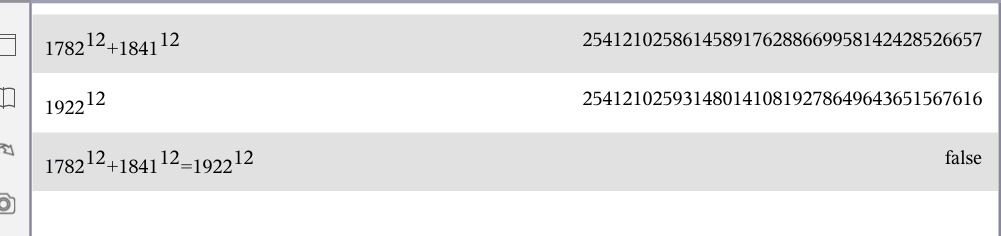
In my afternoon class, students were a bit more careful. You’ll find that the two sides of the equation share many leading digits, but the equal-ness falls apart in the later digits. One cunning student dicovered the Nspire will give a conclusive “false” when presented with the equation. This is shown below, along with the full calculations:
 nspire

So now, exhibit B of “I am a bad person”. I then gave both classes the following challenge: I will give you a candy prize if you can name any positive integers which satsify the following:

, where n is a positive integer greater than 2.

I really admire the students who tried here, even those who pretty much ignored anything else we were trying to get done. The agony when they came oh so close to a solution, only to see it break apart. I really can’t let this go on, can I?

STUDENT: Do you have any advice for us? Please?

ME: Yes…give up.

STUDENT: Come on…give me a hint here.

ME: I am…give up, it’s the best advice I can give you.

Letting students off the hook, we shared a brief discussion of Fermat’s Last Theorem, and why the Simpsons’ folks were so clever with this “near miss” in their Halloween episode.  Many stayed behind after class to hear more about some of math’s long-standing mysteries, and how exactly Fermat’s Theorem was eventually proven. After my bout of evilness, it was a pretty cool day.

Categories
Algebra Class Openers

Class Opener – Day 69 – There’s No Opener :-(

All 3 of my classes have a quiz today. And with a half-day of school today due to parent conferences at the elementary level, there’s just no time for a class opener in any of my classes today.

Sorry….


But wait…there must be something I can share with you all! This week’s freshman class offered a number of great activities which provided much-needed practice, along with team building and class-vs-class trash talk.  This week’s unit focused on functions: specifically, operations with functions , inverses and domain/range.

SPEED DATING WITH FUNCTIONS

To set up this activity, students ripped apart my classroom, moving desks into two long rows, with tables facing each other.  Then, each student took a card, which offered an expression, such as “2x+5”, “x^2+2”, “-3x+1”.  Students on one side of the table were assigned the role of f(x), while the other side of the table was g(x).  This was written on the board at the end of the long table so students could remember.

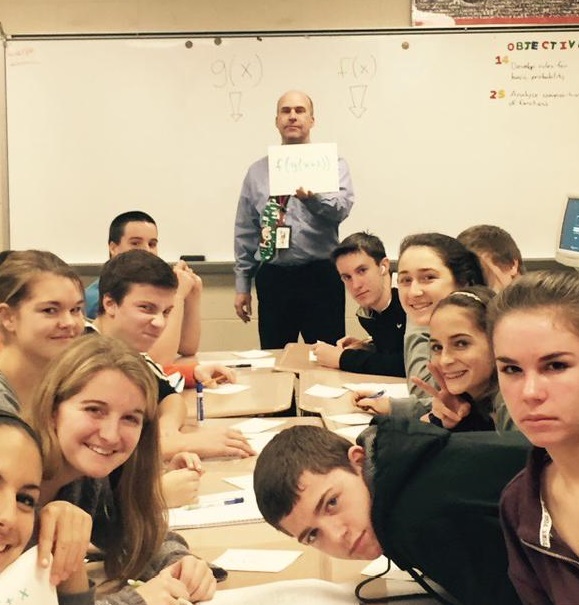
Next, I held up a dry-erase board with a function operation.  With their speed-dating partner, the pair completed the operation.  Here are some sample tasks:

  • Find (f+g)(x)
  • Find f(g(x))
  • Find (f/g)(x) and state any domain restrictions
  • Find g(f(n+1))
  • Find g(f(g( -2 )))

Partnerships reached an agreement on their answer, and I encouraged pairs to write down any problems which caused trouble so we could review them later.  After each question, all student rose from their chairs, and moved one chair over in a clock-wise direction, which ensured that students worked with a host of different partners and functions.  The entire activity took about 30 minutes, and was a fun review for our quiz today.

speed dating


FUNCTION INVERSE MATCHING

A dash of creativity and preparation can turn a mundane worksheet into a classroom filled with action and sharing.  In this activity, I created a worksheet (using Kuta software) of 25 linear functions, where students are asked to find the inverse.  Giving all of these for students to do would not be the most thrilling task of their high school careers, yet we need some practice with identifying inverses.  So, here’s what I did:

  • Take the questions and their answers, cut them all apart, seprating question from answers.  Place them in a baggie to store. Shake up the baggie.
  • My students sit in groups, so each group was given a handful of the slips of paper.
  • Project a stopwatch on the screen.
  • Have the class select a class captain.
  • When I say go (and start the stopwatch), the goal for the class is to match up all 25 functions with their inverses.  I give no rules for how they need to organize this, other than that the problems need to be in order, as I have left the question numbers with the original problems.
  • The class which completes the task quickest wins class snack.

This week, my morning class completed the task in over 12 minutes. My afternoon class was a bit more organized from the jump and took only 10.  The teamwork and whole-class participation was exactly what I was looking for!  The questions I used this week are given below.  Enjoy!

View this document on Scribd