Categories
Class Openers

Class Opener – Day 16 – A Revealing Discussion of Factorial

I opened today with what I had hoped would be a rich discussion concerning a past contest problem, but turned into something more substantial.  Here is the problem:
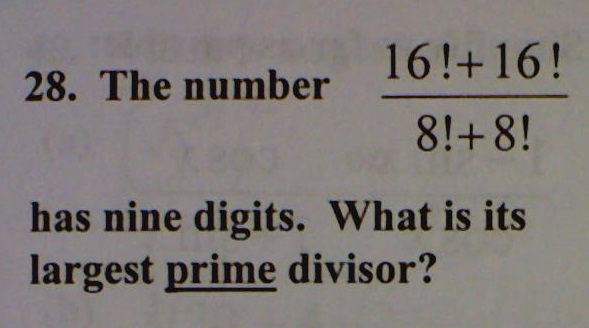
2014-09-23_0002

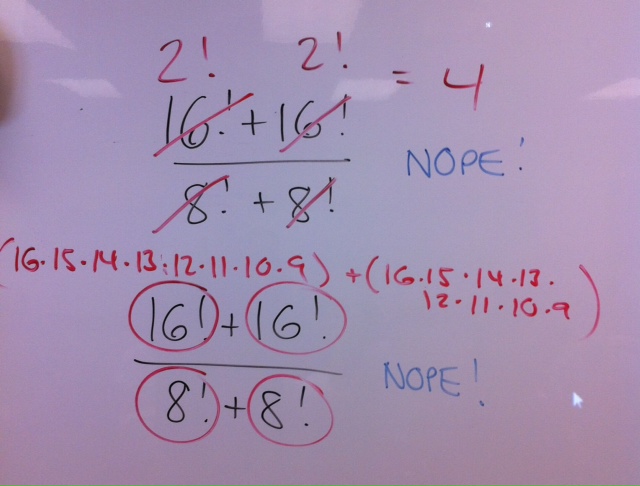
I wasn’t too surprised when many, many students reached for their graphing calculator…this is what freshmen do. I was however surprised when I asked the class to volunteer their ideas on how they could simplify the expression – placing ideas on the board.  Some appear below, and we discussed why or why not the procedures were valid.

photo1 photo2

Many misconceptions regarding what it means to “cancel” in a fraction were revealed; in fact, the very nature of what it means to reduce was the star of our discussion.

2014-09-23_0003Later in class, I provided a hint which I hoped would provide some clarity with our factorial challenge. Some students immediately saw the link to the original problem and simplified. But how much closer are wo to finding the largest prime divisor? After simplifying, it was back to the calculators….which doesn’t really help much here.  Listing the remaining factors of 16! after dividing common factors of 8! leaves us with the clear answer : 13.

The moral of the story – those who never touch a calculator discover the mechanics of this problem much more quickly than those who take a sledgehammer to it with a Nspire CX.

Categories
Class Openers

Class Opener – Day 15 – Paint it Black

Students arrived in class today to find tic-tac-toe boards on their desks, and a challenge on the board:

A 3×3 square is partitioned into 9 unit squares.  Each unit square is painted either white or black with each color being equally likely, chosen independently and at random.  The square is then rotated 90 degrees clockwise about its center, and every white square in a position formerly occupied by a black square is painted black.  The colors of all other squares are left unchanged.  What is the probability that the grid is now entirely black?

This is a scary, scary, looking problem, which I have shared before on the blog. I learn much about my classes by observing the reactions to these sorts of problems: who reads carefully, who dives right in, who turns to share thoughts with their neighbors, who gives up immediately, and so on…so much problem solving comfort revealed in one problem.

So how do we start? After a few reads, I asked students to experiment with their boards, and discover some patterns which meet the problem’s constraints.

photo2

As students made discoveries and found boards which met the problem’s requirements, I invited a few up to the board to explain their work. This led more students, many who were apprehensive at the start, to think about the problem and the rotations.

Students began to discuss their findings, and some agreements were reached:

  • The center square must be black
  • There must be at least 5 black squares

But do ALL grids with at least 5 square work? This led to one last challenge for the day – find a grid with 5 black squares which does not work? This was quickly tackled by a few groups:

photo

We haven’t tackled the randomness and probability aspects of the problem yet – that will resume tomorrow. But hopefully less apprehension over complex-looking problems and some developing teamwork!

Categories
Class Openers

Class Opener – Day 14 – Many, Many Meals

Starting one of my favorite units of the year: permutations, combinations and the binomial theorem. I stumbled upon this article proclaiming the arrival of 140 Million Burger Combinations, heading to New York City – and when I see combinations in the news, it’s time to investigate.

burgersThe article comes from 2010 and heralds the opening of an exciting new direction in burger construction (which has since closed). The website for 4food is sill active for now, and has a cool applet where you can build your own burger. There are many decisions to be made, and some exotic choices (a scoop of roasted brussels?).  I offered students the opportunity to create their own burger, with stations set up on my laptop and on my ipad. Much pro-con debate over the appropriateness of burger pickles ensued!

The choices 4food offers (or, offered, as they are closed…) were summarized by my students:

  • 4 choices of bun
  • 4 choices of “add-on”
  • 10 condiment choices
  • 5 cheese choices
  • 3 “slice” options
  • 12 “scoops”
  • 6 patty options

But multiplying these numbers does not get us near 140 million…so what gives? My classes will explore this problem deeper in the coming days, but for now some seeds have been planted. Soon, we will consider the possibility that you could select multiple condiments, cheeses, and scoops, and work to derive the final count.


This scenario brings to mind a counting principle challenge I have provided classes in the past:

The Tastee Donut Shop charges eighty-nine cents for its Mix N Match selection, which allows you to select any three doughnuts from among the following varieties: plain, maple, frosted, strawberry, blueberry, vanilla, chocolate, glazed, and jelly.  How many different Mix N Match selections are possible?

Here is a printable version of this problem you can share with classes.

I enjoy this problem because students need to think beyond a one-step counting problem. This challenge is more sophisticated than many worksheet problems in that we need to consider a number of possibilities – could a customer buy 3 of the same donut? 3 different donuts? 2 and 1? In the end, the solution comes down to the sum of 3 distinct possibilities, each more challenging:

  • Buy 3 of the same donut (easy): 9 ways
  • Buy 3 different donuts (medium): compute 9 choose 3
  • Buy 2 of one type, a 1 of another (hard): we need to pick two flavors. But picking 2 glazed and 1 jelly is distinct from 2 jelly, 1 glazed. Order matters. Compute 9 pick (permuation) 2.