Categories
Algebra Class Openers

Class Opener – Day 63 – Function Addition

Not all of the class openers go off as intended.  I suppose if they did, and I had a magic formula for engagement, then I’d be living on a dessert island by now with the money I’d made off bottling the secret.

After a short quiz today, a lecture/exploration on operations on functions would begin. It’s not the most exciting lesson of the year, but there are some “ooh” and “aah” moments as students experience new functions.  Domain and range also frame the discussion – and we finally move beyond “all real numbers”.
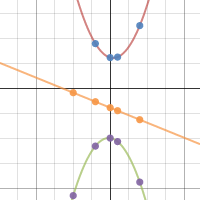
Even though we were starting with a quiz, I wanted a visual to get students thinking about function behavior, and start to make some conjectures about addition and subtraction of functions. The Desmos graph here was animated and rolling as students entered.

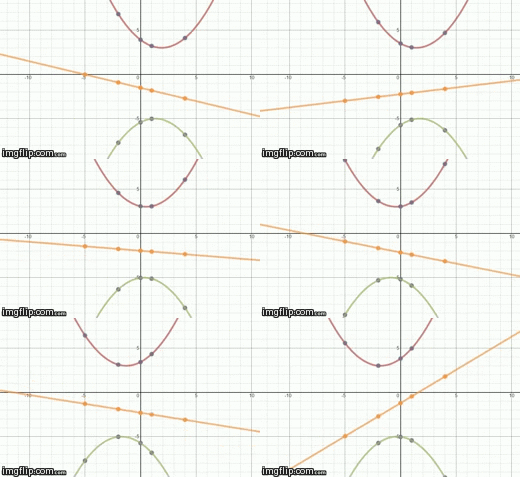
Click the graph to play on your own, and the animated gif below gives you a flavor the the motion.
evxel

After the quiz, I hoped to generate discussion regarding the graph.  What did the students notice? Any interesting patterns?  How are the graphs related? Can we gain some insight by looking at a table of values?

functions

I was hoping students would eventually notice that the ornage function was the sum of the green and red, or at least note the “betweenness” of it all. But with the rush to get notes and discussion started, this opener ended up on the back burner.  They’re not all winners….. All is not lost, though, as I’ll come back to this one tomorrow to build some connections between our notes and the homework.

Categories
Class Openers

Class Opener – Day 61 – Slicing the Cake

Today’s class started with a review of laws of exponents, including negative exponents. I like to send students up to boards often in class, and sometimes use a deck of cards to have students determine their fate. There are 3 large boards in my room, and those who drew Aces, twos and threes were each directed to a board – 3 at each board. Before I began to bark out problems, it’s time to claim our space –

Split the board into 3 parts so that each person has an equitable space.

This was no problem for most teams, as there is always someone willing to take control and draw big, vertical lines down the board. But you can easily determine the trios which had more than one “type A” personality, as erasing sabotage, arguing, and even boxing-out occurred to just split up the board….they’re freshmen….

After the first group of students had completed their problems, the fours, fives and sixes then went to the board. Remembering some lessons from a Contemporary Math class I had taught at Rowan University a few years back, this seemed like a great time to expose students to the divider-chooser method for fair division. And while we are splitting up a board, this would be ideal for splitting up a cake, land, or other assets.  Here are the instructions:

  • In your team of 3, assign roles of player 1, player 2 and player 3.
  • Player 1 – approach the board and divide it into 2 “fair” pieces, without help from the others.
  • Player 2 – choose one of the 2 pieces to claim as your own. Player 1 now owns the other piece. Both players should stand in fron of their pieces.
  • Players 1 and 2 – divide your area into 3 “fair” pieces.
  • Player 3 – choose 1 slice from the areas of players 1 and 2 to claim as yours.
  • Each player now has 2 “equitable” pieces.

Sometimes it’s fun to do 5 minutes of a math nugget they may never see again, but it’s worth the discussion it generates. It was interesting to see how some players chose to work horizontally, rather than vertically – and we even had a triangular arrangement (seen below). But these aren’t really practical for doing exponent problems, so we eventually went back to a traditional division.

North Carolina State provides a helpful file which summarizes a number of fair-division methods, including the Lone Chooser method for 3 people, and you can also easily search “Fair Division Methods” to find more interesting ways to divide assets.

boards

Categories
Class Openers Statistics

Class Opener – Day 60 – Herding the Cats

After a wonderful Thanksgiving break (made more wonderful by the Eagles win over the Cowboys!), it’s the 3-week sprint to the holidays, followed by 2 full weeks before final exams.  There’s a lot of stopping and starting going on, which doesn’t help continuity when thinking about class content.  In my AP Stats class, we are deep into our unit on experimental design, which is filled with ideas, terms and arguments must different than a traditional math class. Groups are working through their “Old Wives’ Tales” project, and after grading some student responses this weekend I need an opener which brings the whole class back into the Stats circle. My friend Glenn Waddell has some awesome resources for statistics on his website, which provided inspiration for today’s opener – a short video from ABC News featuring the placebo effect.

http://abcnews.go.com/video/embed?id=19850208
More ABC US news | ABC World News

For today’s opener, I asked students to design an experiment which could prove (or disprove) the efficacy of the WYFFT “energy drink”.  This gave groups much to talk about, and a thorough discussion of elements of experimental design, including:

  • Treatments: WYFFT is not a “real” drink, it’s just soda. Students conjectured that the labeling and associated signage were the actual treatment. We can compare this vs a plain bottle, or against no drink at all.
  • Matched-Pairs: could subjects plausibly participate in both treatments? Is this reasionable?
  • Blocking: could the implied reaction be different in men than in women? Perhaps we should have two different experiments?
  • Response: what exactly are we measuring? What would be a suitable activity to measure a change in energy?
  • Randomization: how will subects be selected for the treatments?

And we are off and running after a long turkey-induced rest!