Categories
Class Openers

Class Opener – Day 51 – Codebreaking Continues.

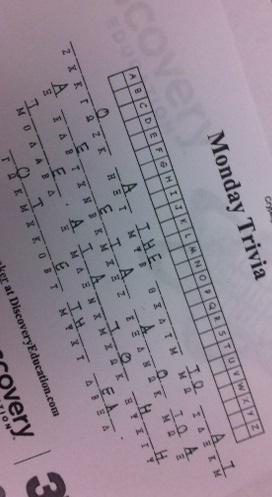
Yesterday, a team of students managed to win Jolly Ranchers off of me in my cryptogram challenge. I don’t feel nearly as generous with today’s cryptography challenge:
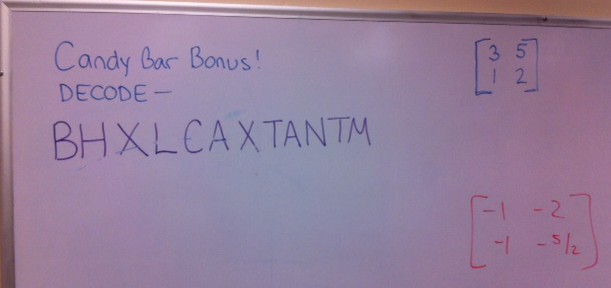
code

How many words is that? How did you code it? What do I do?

This is definitely a much trickier challenge than yesterday. The only hint I offered is that the original message was two words, 12 letters total, and that some extra information would be coming later in class.

This extra information came when we began our notes on matrices, where we talked about the constant need in math to “undo” an operation. So if we multiply matrices to obtain a product, we can use an inverse matrix to undo the operation.  Slyly, I then offered that if I were to (hypothetically) convert a message into numbers, arrange it into a matrix, then multiply it by a secret matrix, then a cunning student could undo my work by considering the inverse.

Clearly this isn’t much of a hint, as there are an infinite number of coding matrices to consider. But take a look at that original photo again….what’s that matrix lingering in the darkness?  To code my message, this matrix method (called the Hill Cipher) was used, and my coding matrix was provided all along.  This still provides a challenge to students who are new to inverse matrices, but before we departed I did show my class a Hill Cipher applet which I used to code my message, and which verifies the original message.
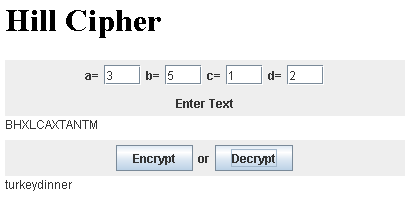
turkey

Tomorrow we’ll take another look at this cipher method, and try some of our own with a puzzle I have created.  By the end of the week, expect the Enigma to make an appearance for a final challenge!
Categories
Class Openers

Class Opener – Day 50 – Codebreaking Begins!

From now until Thanksgiving, my 9th grade classes will be working through a unit on matrices.  This unit starts off innocently enough, with procedures for adding, subtracting, multiplying – even finding the inverse.  But we then move on to challenging ideas, like translating a system of equations (including those with 3 or 4 variables) into a matrix equation and using inverses to solve. Cramer’s Rule will also be included next Monday, with a step-by-step packet I wrote a few years back.  By the end of the week, we will also touch upon the Hill Cipher – a codebreaking method which utilizes matrices – with some class challenges upcoming.

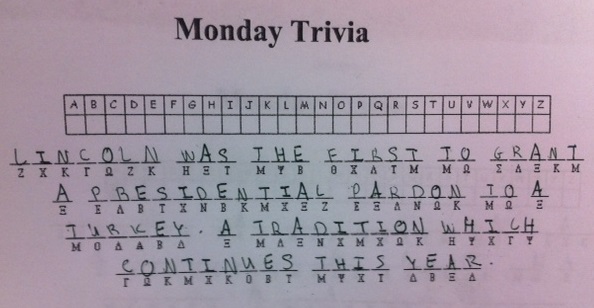
To set the theme, students were handed a cryptogram to work on as homework was checked. The puzzle was made using Discovery Education’s Puzzlemaker, and I offered Jolly Rancher prize to anyone who could decode the message (which involves presidential turkey pardons!).  Some students had experience with these puzzles before and dove right in, helping others in their group who were not so sure. To make the puzzle a little more challenging, the cryptogram does a 1-1 replacement with letters from the greek alphabet.

pic2Soon, some students began to piece through many of the clues.  That 1-letter word which appears?  That must be the A (unless it is I).  The word THE probably makes an appearance, and we can leverage some thoughts about letter distributions to conjecture the replacements of E and T, and thus get THE to appear.

Eventually one of my groups was oh so close to completing the phrase, and my gentle nudge that I bet they could finish it “by Thanksgiving” gave them the one final word – TURKEY – which eluded them.

pic1

Later this week, I look forward to sharing stories regarding the Hill Cipher, and the Engima machine.  In a summer program I once mentored with friends at LaSalle University, we taught students how to perform a freqeuency analysis on coded text using Excel.  The challenges became more difficult during our time together, and culminated with a coded passage from the story Gadsby, by Ernest Vicent Wright.  This story is unique, and frustrating to amateur cryptographers, as the text does not contain the letter E anywhere.

This is also an exciting time to consider cryptography in your classroom, with the soon release of the movie The Imitation Game.  The movie tells the story of Alan Turing, a British mathematician credited with breaking the Enigma code during World War II.  I have only seen the preview thus far, and am hoping the movie will be appropriate to share with classes down the road. You can view a preview for the Imitation Game online.

Categories
Algebra Class Openers

Class Opener – Day 49 – A Magical Prime?

Today is student choice day, where I look through the Edmodo submissions from my students and choose a short and snappy opener.  Chris B. submits this number “magic” as a video worth sharing with the class:

What’s going on here? Is it just plain coincidence? Dumb luck? The devil’s work? 37 is certainly not a number we encounter too often in our daily math life.

A student in my afternoon class quickly picked up on the mystery:

37 times 3 is 111, and they all have 111 in them

Good enough. Converting a division example from the video into multiplication helps verify the claim”

777 = 37 * 21
111 * 7 = 37 * 3 * 7

It’s a quiz day, but I leave the class with the following challenge:

Develop a similar pattern for a longer string of identical numbers

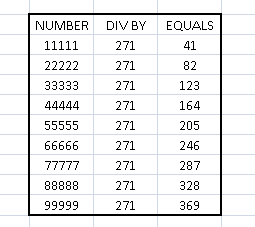
They are pretty easy to find, such as the one below for five-digit strings. And Chris provided a low-stress math challenge to get us into math thinking mode before our quiz.

numbers