Categories
Class Openers Statistics

Class Opener – Day 43 – Statistics as Art

Big Stats test tomorrow – students are getting antsy, lots of movement happening with review and reflection.  Today was a good day to step back, think about the role of numbers in society and appreciate some intriguing artwork.

Chris Jordan is a photographic artist whose works “Running the Numbers – an American Self-Portrait” cause you think of the largeness of our world, and the amount of waste we create. His website contains a number of fascinating pieces which zoom to reveal a statistic about our society’s wastefullness.  It’s an awesome experience, and we started class today by discussing a number of the pieces and the large numbers they represent.  There were a number of “whoa” moments as the composition of each picture was revealed, and I read the helpful statistic attached to each work.  Based on the size of each piece, there are some great estimation discussions to be had here as well.  It’s statistics – it’s art – world are colliding in a cool way!

Chris’s TED Talk “Turning Powerful Statistics Into Art” can also be shared with classes to learn more about the message of these pieces.

Categories
Class Openers Statistics

Class Opener – Day 42 – A Sampler of Sampling Methods

2014-11-05_0001After a day off for election day, it’s back to the world of random sampling, margin of error and plausible intervals.  These tend to be tricky ideas for students, as we move from the “absolute” world of algebra and into the slightly more wishy-washy world of sampling and plausability.  My board scribblings were intended to remind students that we draw samples to represent populations, and that random sampling is king!

But random sampling is messy business, and there are other sampling techniques I want students to consider, and think about their effectiveness.  Rather than lecture each type (caution – excessive vocabulary lectures may cause drowsiness), I gave students a list of words I expected them to research and find suitable resources.

  • Cluster Sampling
  • Stratified Sampling
  • Systematic Sampling
  • Convenience Sampling

After a few rounds of walking around the room to discourage random copying of definitions which they didn’t understand anyway, many groups began to ask the “right” questions, relating the ideas to hypothetical surveys we could do of high school students.  Towards the end of our time, each group was assigned one term to “explain” on a poster through a visual representation. And now, we have a great crowd-sourced wall of survey vocabulary to refer to during discussions!

posters

Categories
Class Openers Statistics

Class Opener – Day 39 – It’s a Heat (Map) Wave!

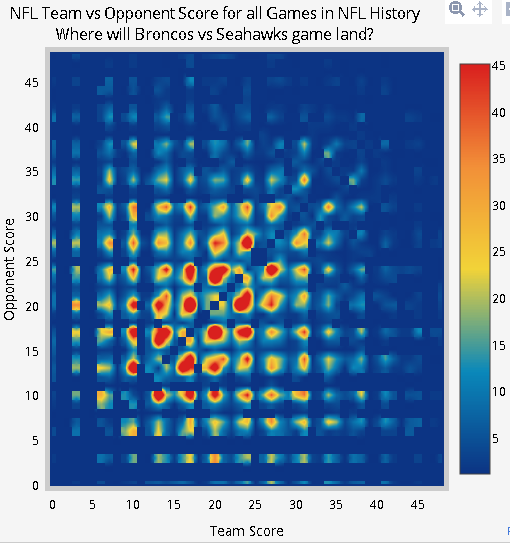
Finishing up discussions with scatterplots – today’s visual when students entered presented a new idea in scatterplots (from the awesome Plot.ly site) – a scatterplot representing the score of every NFL game ever played!

superbowl

What’s the story here? So many great features of this plot to discuss including:

  • It’s apparent symmetry
  • The vertical and horizontal avoidance lines
  • The colors – many students have never seen a heat map before
  • The clustering in the center of the graph

This was a quick warm up as I wanted to get to the main event – scatterplot stations!  Students worked in teams to complete activities (in 15-minute intervals) designed to strengthen their understanding of many ideas surrounding scatterplots.

Station 1 – using graphing calculators to assess data sets, and writing clear summaries of the trends.

Station 2 – estimating best-fit lines given a scatterplot, and using their algebra skills to make good estimates.

Station 3 – netbooks! Play with the Rossman-Chance “Guess the Correlation Applet” and develop and understanding of “least squares” with this Geogebra applet.

Fun day today…..moving on to sampling tomorrow!