Categories
Uncategorized

Odds and Ends from a New Semester

A new semester for me started last week.  Lots of excitement, new faces, new classes, and much going on professionally. So many feelings coming from all directions….

I’M INSPIRED BY THE MATH FORUM FOLKS

Last fall, I participated in an Ingite session with the awesome folks from the Math Forum at the Association of Math Teachers of New Jersey conference.  Thanks to Suzanne for her kind invitation to share with a group of math leaders I have admired from afar.  The videos from the Ignite are finally available. Enjoy my flailing arms in a talk related to a blog post from long ago on math phrases I’d like to expunge.

While you are on YouTube, check out talks from the rest of the panel especially Max Ray and Annie Fetter. I marvel at Max’s ability to weave a math story cleanly and effectively about a theme. And Annie always provides ideas I need to try the next day in my math class.

I’M FRAZZLED BY NEW CLASSES

This new semester brings me 3 new classes, which are 3 completely different preps: AP Statistics, Academic Prob/Stat (which is co-taught) and CP Pre-Calculus. Are there 3 classes which could be any more different? I feel troubled when I have a schedule like this, since I feel like none of the classes get the attention they deserves, and I spend most of my time chasing my tail. Also, CP Pre-Calc is a course I have never taught before. Does anyone else have trouble becoming invested in developing inquiry lessons for a course, when you know you may never teach it again?  Tough days….

I’M AWASH IN ANTICIPATION…

For my new niece, who may be born any second now!

I’M ENCOURAGED BY NEW DISCOVERY SESSIONS

Our school adjusted the bell schedule this year; the result being structured time in the middle of the day where all students have lunch and/or study time. This semester, I am organizing Hatters’ Discovery Time – an opportunity for teachers to share their passions with students – modeled after the Genius Hour concept.  So far, our No Place for Hate team has facilitated an open discussion on race – a well-attended event with productive, positive discussions. This month, one of our science teachers who is also an EMT will share lessons on medical diagnoses, while a fellow math teacher offers an introduction to juggling. My session at the end of February will feature codebreaking, inspired the movie The Imitation Game, and just in time for Oscar season. Sessions on medidation and woodworking are also in the hopper. Such great ideas from my colleagues and hope students enjoy the offerings!

I’M EXCITED TO SHARE MORE…BUT…

The last month has brought a flurry of professional plans for the summer and beyond. I’ve been invited to attend the AP Statistics reading for a 4th year, which is one of the highlight of my year…it’s summer camp for the Stats Kids!  Late in June, I have been accepted to share Desmos ideas for the classroom at the ISTE conference in my hometown of Philadelphia. And plans for Twitter Math Camp in July are taking shape: a team of 3 math professionals whose work I all admire and I will team to present morning sessions on “Next Steps with Desmos”, while I have been accepted to present a session on tackling those “tricky statistics concepts”.  Should be a blast in LA.

But, today also brought rejection from NCTM, as my session on Standards-Based Grading in Algebra 1 was rejected for 2 regionals. Last year, I was rejected for a Desmos session, and the year before for a session on encouraging writing skills in math class. At this point, I really think I am being punked.  But congrats to all of my friends and colleagues who have been accepted, I’ll be curled up at home with a box of cookies while you all enjoy the conference……

All is not lost though. I think it’s time to put the SBG talk away, as I have done it at PASCD and a local conference now. I never got around to editing the video of this talk from our fall ATMOPAV conference, but I’ll share it now for old time’s sake.  Enjoy!

Categories
Uncategorized

Thoughts on Teacher Preparation

Just before winter break, I received an e-mail from a former student who was now teaching in a private school in Maryland. This is his first year teaching AP Statistics, and he was looking for some nuggets of wisdom and advice from someone he trusted.  Drew was one of my favorite students, mainly because he can keep up with my warped sense of humor, and it’s thrilling to add another former student to my teaching “tree”.  The conversation began with a comment I suppose is universal to new teachers. (note – many quotes here paraphrased by my weak memory).

Nobody told me it was going to be this much work.

Yep. Drink up, Drew! Anything else?

I don’t know how I find time to plan. Between getting tests ready and grading the homework I collect every night, there’s just not enough time.

Wait…you collect and grade homework every night?  Why the hell are you doing that?  Let’s have a chat about the intent and value of homework.

How did college prepare me for any of this?

They didn’t. You need another beer Drew?  The lack of classroom realism education colleges provide seems to be a common tale, and for my money is one of the big problems we need to tackle if we seek to improve the profession. So here comes the big reveal I’d like to share with all new teachers and/or those considering the profession.  Ready?  This is free advice, though putting a buck in the tip jar is always welcome.

The day-to-day profession of teaching is nothing like the tired stereotypes, nor does it resemble the vision you have of teaching when you think back to your own schooling. It’s likely that for the first few years of your profession you will adhere to stereotype: neat rows, textbook pages, planned lectures. The path of your career, your effectiveness as a teacher, and your own happiness all rest on how quickly you challenge your methods. Find colleagues doing great things, learn from them, tweak them, and make them your own.


PodcastThis past week I caught up on past episodes on the Freakonomics Podcast while working out. One episode from November was of particular interest, titled “Is America’s Education Problem Just a Teacher Problem?“. When I talk about the teaching profession with non-educators, my prescription for “fixing” the system often comes down to 3 easy-to-understand steps:

  1. Hire the best people
  2. Train them well
  3. Keep the best and let them lead

Isn’t that how all professions should operate? Where are we faling short? And while this podcast started off slow, with a narrow focus on where teachers tend to fall in their graduating classes, it was a later conversarion regarding teacher training which moved me. The quotes below come from David Levin, co-founder of KIPP schools, which you can find on the podcast transcript.

The way we train teachers is fundamentally broken in this country.

Yep….My bachelors degree is in mathematics. Only after graduation did to I go back to Drexel University to obtain teaching certification. I clearly recall a conversation with my advisor back then, who touted the Drexel program with “we believe anyone can teach”, and assurance that I could teach with an intern certificate after taking just 1 class.  Somehow I made it through, but I can’t recall much from my training which was helpful to me as a young educator. I’ve also discovered that not everyone with a bachelor’s degree can teach…not surprising.

It’s disproportionately theory-based. …I’m not sure of what good the theory of math instruction is if you don’t actually know how to deliver a lesson on math as well.

I would go even further here. It’s not just about planning and delivering a lesson – it’s about having the expectation that lesson study is a critical element in becoming an effective educator. How do we know if a lesson is effective? How do we adjust for student needs? What do we do to improve even our best lessons?

Sometimes the best math teachers weren’t necessarily the best math students, because you know you often teach better what you weren’t so good at, because you actually had to work to learn it.

Whoa….so, should we be hiring all of the top students to teach, or no? I immediately had a flashback to college calculus. I fully admit to not being a top math student, mainly because my work habits were supect. But I could learn new things quickly on my own if I had the inclination. I have to say that I didn’t really understand calculus until I started tutoring it. Having to explain the chain rule to a peer caused me to think about how it worked, to prepare for snags, to consider how ideas fit within the big picture. There’s an assumption that math teachers simply transmit information, with little regard for how we facilitate learning. This was quite a refreshing statement.


Back to my conversation with Drew, where it was also a great time to confess many of my teaching sins from over the past years, and measure the reaction. So, over some beverages, I had to confess something to Drew about the AP Stats class he attended, which was in my 3rd year of teaching the course.

Drew, I didn’t know what the hell I was doing back then.

It’s true. Sorry. I mean, everyone passed the AP exam and everything, but I look back on some of my old techniques and can confidently place them in the “stuff I would never advise people to do” file.  Drew gave me look on par with the wide-eyed glare a 9-year-old gives you when you finally tell him Santa isn’t real, that awkward, incredulous stare which is followed by knowing head nods.

So what changed? I used the same textbook, provided many of the same materials, revised my tests a bit. Tweaking problems and getting better at identifying the tricky part of problem 45 on page 312 just isn’t enough.  My development as a teacher comes from finding and utilizing a support system to help me improve. This goes beyond conversations with building colleagues, though having an enthusiastic department here at my home school has been valuable. Local groups like the Philadelphia Area Stats Teacher Association and ATMOPAV have helped me develop a local network of master teachers with whom I can discuss lessons. Recently, reaching out through twitter and the AP Stats message boards grew my learning community, and help me continually improve.

I wonder how many teacher prep programs are helping teachers find and build their own professional networks? In this age of connectivity, it’s simply silly to leave out this crucial piece.

Categories
Uncategorized

Class Opener – Day 70 – A “Homer”ic Effort

I confess – I was a bad person today. And here’s why….

BookOne of my recent reads is Simon’s Singh‘s fun book The Simpsons and Their Mathematical Secrets, where Simon shares math gems from Simpson’s episodes hidden craftily by the math-centric series writers.

I confess I haven’t been a regular watcher of the Simpson’s for many years. This book took me back to the fun of many of the early episodes – like the corny “R D R R” gag from season 1.

One of my favorite math memories from the Simpsons is the early “Treehouse of Horror” episodes, where Homer is sucked into a strange “3D” world. It’s from this episode which I shared a screen-grab from the strange “Tron-esque” world as today’s class opener:
Fermat

My math radar always goes off some when I see math included in movies or TV. Who exactly is providing the math – do they know anything about what they are sharing?  Here, we are presented with an interesting equation:

Where the heck did they get that from? Is it just gibberish? Is it even true? (note – this is exhibit A as to why I was a bad person today – of course I know where it came from, but it’s time to dangle the bait in front of the kiddies)

Many students dove into their calculators to verify the equation, and there were quite different results:

In my morning class, a few students quickly “verified” that the equation was true, and the rest trusted them. Bless them…..I can now dangle more bait….

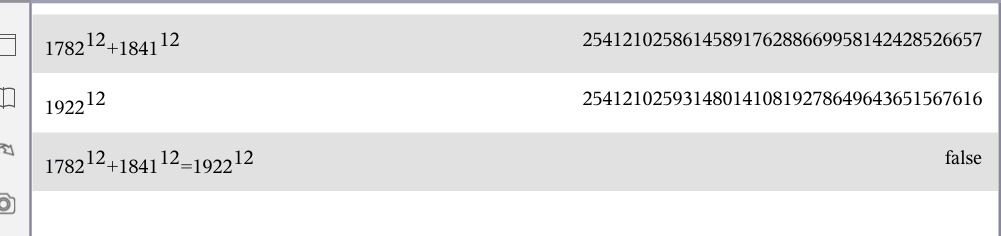
In my afternoon class, students were a bit more careful. You’ll find that the two sides of the equation share many leading digits, but the equal-ness falls apart in the later digits. One cunning student dicovered the Nspire will give a conclusive “false” when presented with the equation. This is shown below, along with the full calculations:

 nspire

So now, exhibit B of “I am a bad person”. I then gave both classes the following challenge: I will give you a candy prize if you can name any positive integers which satsify the following:

, where n is a positive integer greater than 2.

I really admire the students who tried here, even those who pretty much ignored anything else we were trying to get done. The agony when they came oh so close to a solution, only to see it break apart. I really can’t let this go on, can I?

STUDENT: Do you have any advice for us? Please?

ME: Yes…give up.

STUDENT: Come on…give me a hint here.

ME: I am…give up, it’s the best advice I can give you.

Letting students off the hook, we shared a brief discussion of Fermat’s Last Theorem, and why the Simpsons’ folks were so clever with this “near miss” in their Halloween episode.  Many stayed behind after class to hear more about some of math’s long-standing mysteries, and how exactly Fermat’s Theorem was eventually proven. After my bout of evilness, it was a pretty cool day.