Categories
Uncategorized

Can You Defend Your Practices?

The most interesting classroom-related Twitter conversation of 2013 took place within the last week of the year, and has carried over to the early days of 2014.  An intense debate between a twitter “member” named @StopSBG, committed to “Stop Standards-Based Grading (SBG) in Ankeny Schools”, and a number of education professionals has produced spirited back-and-forth on the nature of grading, standards, test retakes, and what we value in our communities.

I can’t fairly summarize the many webs woven and arguments made over the past week, and encourage you to look up Frank Noschese, Ken O’Connor, and Rick Wormeli, and the many others who have joined the conversation.

https://twitter.com/StopSBG/status/418636802807697408

Kudos to Frank, and his many, MANY tweets over the last few days in trying to defend best practices in grading.  In my own building, I have moved towards retakes in my classes, which I have blogged about here, and have worked to defend my ideas and practices with colleagues.  I have had some success in convincing colleagues to join me in making retakes part of their classroom culture.  But change of long-held practices takes time, reflection and discussion.  For me, my classroom guidelines on retakes are based on 3 conclusions:

  1. It’s best for student learning.
  2. It’s best for student reflection.
  3. It’s best for student feedback.

And aren’t those the most important things?  My opinions on retakes certainly didn’t develop overnight; I read literature, sought out research, shared ideas with colleagues, and found opportunities to hear experts share their ideas (which is much easier with things like YouTube and Twitter around to facilitate self-directed PD).

But my opinions aren’t sufficient if I can’t defend my policies.  And they need to be defensible, not only to colleagues (who I hope to get on-board as part of a department and building network), but also to:

  • Students – who have mostly been exposed to “traditional” classroom practices.  How do I get them to become better learners by investing themselves and trusting in my classroom practices?
  • Parents – who may have legitimate questions about their child’s education.  Can I defend how my practices are best for their learning?  Also, can I explain my practices without throwing other teachers “under the bus”?
  • The community – who often only hear about schools through quick bites of often mis-leading information.  How can I be an effective communicator of how schools are adapting and evolving?

This is where the recent Twitter debate has been so fascinating.  A chorus line of edcucators, well-versed in best-practices in the classroom, have been debating the nuts and bolts of education policy with a non-education professional.  And while I trust some head-way has been made, it will take a lot more folks with the will and persistance of Frank Noschese to deliver clear, well-researched messages in order to forward the national education debate.  I find myself often sitting on the sidelines when debates intensify, and I feel the conversations of the last week have given me inspiration to become more involved in 2014….so there’s my New Year’s Resolution!


At the end of January, we start a new semester at my school, and I will have a 9th grade Prob/Stat course.  This is a course I have taught many times before, but this time around will be after a 2-year absence in the classroom, and this will be an “academic” level class – for students who have traditionally required more intense instruction.  I am eager to implement a Standards-Based Grading system, and have been poring through blogs and readings on SBG to help craft an approach I think will be manageable for my classroom.  Despite my enthusiasm and planning, the success of my programming will only be as good as the communication I provide, and the clear goals I set.  The past week’s debate has provided an opportunity to clarify my goals, and think about their importance in the process:

  • Create a culture where students routinely reflect upon their progress.
  • Provide opportunity for students to communicate their strengths, weaknesses, and needs.
  • Allow for multiple opportunities and avenues to demonstrate skill mastery.
  • Help guide students “out of the pit” (a Rick Wormeli phrase!)

I appreciate the vast network of professionals I have connected with through Twitter, and their kind assistance in helping shape my goals.  It’s quite a time to be an educator…it’s also a better time to be an cheerleader of best practices!

Categories
Uncategorized

The Conic Sections Project Saga Continues….

April 2012 edit: interested in how I present this activity, and many others, to teachers?  Check out my talk at the AMTNJ Tech Conference: 2014 Desmos Talk

Here on the blog, the conic sections project we use at my HS in Algebra 2 is one of the most popular posts, generating lots of hits and e-mails to me asking for more information.  I am just now grading conic sections projects for this year, and want to share some new additions to the project, and a rubric you can use.  The projects are all over my living room now, just waiting to be graded.

Posters

For the newbies to this project – the concept is simple: use equations you have used, specifically conic sections, to draw something.  The Desmos calculator is perfect for this task, and students turn in their graph-based picture, then a completed, colored picture.

Monkey

So, what’s new this year?

FOLDERS AND LINKS

In the past, students printed their equations and submitted them.  This year, students instead shared a link to their Desmos product using Edmodo.  Also, using folders has improved student organization, making it easier to locate and edit crucial equations.

Bumbo

VERIFYING SYSTEMS

In my conics unit, students learn to solve both linear-conic and conic-conic systems.  This year, I asked students to choose two systems from their drawing and verify the intersection points.  This served as a personal review of the chapter, and students had an investment in linking the algebra they had learned to their picture.

SCREENCASTS

Last year, I participated in a Desmos webinar where I explained the evolution of the conics project.  For the webinar, one of our sophomore students recorded a screencast where she explained an aspect of her picture.  Having a student comment and reflect on their work was so powerful that I made it a requirement for all students this year.  Many students chose ScreenCastOMatic to record, and the reflections were excellent.  Edmodo was used to share links, though some students had tech issues which I will work to head off earlier the next time I give this project. Below is a screencast from Nick, who was kind enough to allow me to share his work with you:

I have received many e-mails from folks asking for guidelines and a rubric for this project, and am happy to share with you a more detailed document.  Feel free to use any part of it, and let me know how it works in your classroom!

Download the project description and rubric

MORE RESOURCES:

My first blog post on the conics project

More conics news

The Desmos YouTube Channel – Classroom Conics Project:

Categories
Statistics Uncategorized

A Day With Rick Wormeli – Redos and Retakes

Earlier this week, a handful of colleagues from my district and I experienced the educational whirlwind that is Rick Wormeli.  I have studied Rick’s writings for some time now, shared thoughts on redos and retakes and standards-based grading before, and incorporated some of his ideas into my own classroom procedures.  What I most enjoy about Rick is that he challenges your existing classroom practices, and breaks them down to their foundations:  if it’s not about achievement, and moving kids forward, then it’s not part of the plan.

The day began innocently:

Today will be a waste of your time.

Thanks?  But Rick’s point was that a single day of PD is simply not sufficient to synthesize these ideas.  Change only comes when we take what we learn back to our school, have discussions, think about our policies, and work as a team to do best for our kids.  Rick is correct when he states that “school is set-up to meet the needs of those who get it first”.  Let’s work on breaking down long-standing policies and  drafting new ideas which benefit all learners.

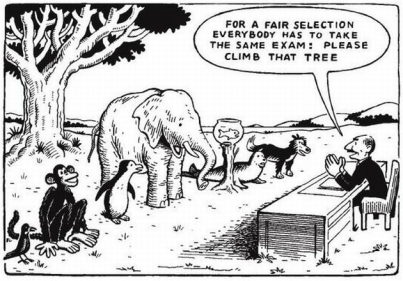
Climb That Tree

While the day was billed as a “formative assessment” seminar, the concepts really be-bopped from standards-based grading, redos and retakes, learning targets, and formative vs summative assessments.  I fear this blog post would be 10 pages long if I tried to summarize everything, so I’ll instead focus on one idea I have incorporated into my classroom routine this year: test retakes.

Rick WormelliHow do students react to the grades we give them on assessments?  How do our grading practices impede students reaching their learning targets?  Rick argues that many of our strategies cause students to wind up in “the pit”; further, many schools perpetutate practices (like losing lateness points, or not allowing corrections) disguised as “teaching responsibility” which cause students to fall deeper into the pit.  It’s our duty to lead students through strategies which will get them out of the pit, and professionally unethical to conflate evidence with compliance.

I have incorporated re-takes into every exam I give this year in AP Statistics, and have allowed re-dos in many Algebra 2 tasks.  I continue to evaluate the success of these methods, and I have been largely happy with both the results, and the attitudes of students in embracing the new procedures.  When should you allow redos?  To Rick, the answer is ALWAYS..it’s our professional responsibility to allow redos – unconditionally.  Here are some resources from Rick Wormelli which will get the conversation started:

Educational Leadership, “Redos and Retakes Done Right” – requires ASCD log-in, harass your principal!

“Fair Isn’t Always Equal” – Rick’s landmark book on assessing and grading in the differentiated classroom

Video on Redos and Retakes – Rick defends the redo/retake practice.

What’s the problem with allowing a failing grade?  Doesn’t that build character?  How do students react to a failing grade, as opposed to a different designator, like “not yet”…

HOW I MANAGE RETAKES

This year, my colleague Joel and I wanted to incorporate retakes into our statistics classes.  But there are certainly organizational challenges to be met, and our discussions challenged our beliefs on assessment and its purpose.  Here’s what we decided on for our classes this year:

  • Each unit test has two parts: multiple-choice and free-response, graded equally like they will be on the AP Exam.
  • There are always two free-response questions.  Sometimes they are actual former items from AP Exams, sometimes they are questions we write or adapt.  A free-response question is one scneario with multiple parts
  • After the exams are handed back, students may come in to take the “replacement question” for the exam.  The replacement question is a third free-reponse question, which students take on their own time during a daily directed-study period, or after school.  The grade on the replacement question replaces the score on the lower-scoring question from the unit test.
  • We don’t have a procedure for recovery for multiple-choice.  But we are kicking some ideas around.

Here’s why this procedure has worked for us.  Unit learning doesn’t end with the chapter test.  Students need to go back, reflect upon their misunderstandings, and develop a plan for doing better on the replacement question.  It’s great to see kids really reflecting about what went wrong on their test, and coming back to clarify what went wrong….that simply didn’t happen before.

The record-keeping is awkward.  But I am getting better at it, and figuring out the best way to manage this extra level of grading.  And Rick is now whispering in my head “Don’t drop the principle because you can’t handle the logistics.”

This is the first of what I am sure will be many posts reflecting upon this special day of PD.  Looking forward to sharing more ideas, discussions, and anecdotes!

To Rick: Thanks for the great day…and The Three Amigos was underrated