Categories
Uncategorized

4 Activity Builder Formative Assessment Ideas

The creative team at Desmos continue to develop engaging lessons using their Activity Builder interface, found at teacher.desmos.com. While teachers I encounter have their own favorite activity, many desire to dive in and create their own. But building your own activity, testing it, and hoping it works with your class can be an intimidating task (pro-tip: making your own activity is really hard!).  But there are a few simple ways teachers can use Activity Builder as a mechanism for formative assessment.  Here. I share 4 quick and easy ideas – you can check them out and observe their structure at this link.

SELF-CHECKING GRAPH MATCHING

blog2

I used this often with my Pre-Calculus class in the fall, and the concept works equally well with younger students.  Simply start a new Activity Builder screen, and enter the equation you’d like students to provide.  Place the equation in a folder, which you can hide so students won’t see it when they encounter the screen.  Finally, by making the graph with dashed lines, students can easily see if their submission matches the requested graph, and can adjust accordingly.

GALLERY WALK
blog4

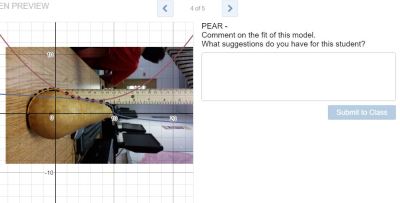
Here’s a neat Activity Builder hack you may not know about.  If you have an existing Desmos graph, copy the URL from your graph to the clipboard.  Then, in an Activity Builder screen click the “Graph” button and paste the URL into the first expression line – and PRESTO, the graph is imported into an Activity Builder screen.  I often collect student work by simply having them submit a Desmos URL.  Consider taking samples of student works and create a virtual gallery walk.  Let students view each other’s ideas, comment and make suggestions. Thanks to my colleague DJ for providing neat student graphs!

SELF-ASSESSMENT SLIDERS…AND OVERLAY

blog5

Have students assess their own learning with a moveable point. Provide an “I can…” prompt and let students consider where they fall in the learning progression.  Hold a class-wide discussion of unit skills by anonymizing student names and using the overlay feature to take the class pulse on skills.

MY FAVORITE DISTRACTOR

blog3

Activity Builder allows teachers to build their own multiple-choice questions, with the option of having students provide an explanation for the choice they make.  In “My Favorite Distractor”, students select an answer they KNOW is wrong, and explain how they know.  This may not work for many multiple-choice type questions, but consider using this idea in situations where the distractors have clear, interesting rationales for elimination.

Have your own quick formative assessment ideas?  Share it here!
 

Categories
Uncategorized

A Bulleted Assemblage of Items for the New School Year (but not a list)

The “list” article is a popular device, and one which often draws the eyeballs. Lists are also, often, a cop-out – a way to express many ideas without having to dig too deeply.  I hate lists….

As I start my new school year tomorrow, I give you this bulleted assemblage of items which are on my mind as I look forward to our first day.

  • Fawn Nguyen’s 7 Deadly Sins of Teaching Math is required reading for all professionals. In particular, I strive to pay more attention to my (teacher talking / student talking ) ratio.  I like to think I am strong in this area, but I need to do better. Before the end of the last school year, our district screened the movie “Most Likely to Succeed” to all professional staff.  In an opening scene, the teacher provides first-day freshmen with an opening day task – and then leaves the room.  The students struggle, the teacher eventually intervenes, but a powerful classroom culture is established.  I want to provide more tasks to my students where I’m simply not needed.
  • I have used a number of opening-day activities for AP Statistics over 14 years. Distracted Driving and the Henrico hiring case are two I used most often. But I think Doug Tyson’s Smelling Parkinson’s activity could be my new favorite. It’s a powerful premise which gets kids talking about the possible vs the plausible on day 1, with a hint of simulation thrown in for good measure. I show the video below to the class and right away the statistical importance of what we do for the entire school year is established.
  • Desmos Activity Builder will take on a much bigger role in my classroom.  I’ve created activities for both my Pre-Calculus and my freshman Prob/Stat class to review their understanding, and also to serve as my “getting to know you” opportunity.  Look forward to sharing out how it goes.
  • Shoes.  I hate new shoes. They’re tight and often rip apart the back of my ankle until I break them in.  If we can have pre-washed jeans, then we can have pre-worn shoes.  We need our best people on this.
  • Who knew a cute Pythagorean triple generator could be of interest to so many. After I posted about an interesting share from Ken Sullins at the PCTM summer conference, so many folks chimed in with their ideas.  Thanks especially to Joel Bezaire who shared additional ideas from Twitter Math Camp.  I’m using this in my pre-calc class on day 1.

  • I’ve given the same probability problem to my freshmen for the last few years. I love everything about this problem on day 1: it gets kids talking, it gets kids struggling, and it tells me much about their problem solving background.


OK, maybe this was a list after all.  I need to do some last-minute ironing.

Categories
Uncategorized

The People in My Math Neighborhood

Oh, who are the people in your neighborhood?
In your neighborhood?
Say, who are the people in your neighborhood?
The people that you meet each day

I work with an awesome group of people at a high school outside of Philadelphia.  They are my colleagues, the people I share ideas with on a daily basis, and some of my closest friends.

But in recent years, my math neighborhood has grown considerably.  I suppose I discovered the power of the online neighborhood 4 or 5 years ago, developing and growing a wonderful network of professional colleagues through the #MTBoS. And my relationship with this neighborhood has grown from a mechanism for sharing ideas, to a source of inspiration, positive thought, discussion and reflection.

We are now 3 weeks after the NCTM Annual Conference in San Francisco. It’s easy to forgot the little things which occur in a big conference, and I hopefully will find time to reflect and utilize new ideas later. NCTM this year has done a wonderful job of providing a means to continue reflections and growth outside of the conference, along with archiving session resources.  Here, I highlight 4 sources of inspiration, and friends in my math neighborhood, as I look back on my San Francisco experiences.

GRAHAM FLETCHER – Graham, an elementary specialist from Georgia (or is he Canadian? such a chameleon), challenged teachers to consider the mathematical story we share with students in his ShadowCon talk. How is your story different than the one being told by your colleague teaching the same material just across the hall?

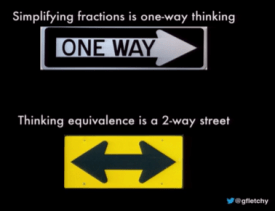
grahamHigh school teachers may be intrigued by Graham’s discussion of fractions, reducing and equivalence and the role of “simplifying”. His talk has caused me to think about the many odd restrictions we place on student work: i.e. “write the equation of your line in standard form”, and their necessity in my math story. Graham’s call to action – challenging teachers to identify their own “simplifying fractions” (something they teach not currently in the standards) – is an appropriate task for all grades.

ROBERT KAPLINKSY – Robert was featured on the MathEd Out podcast last summer, and I recall taking a walk, listening last year when it occurred to me that Robert’s path to becoming a math teacher was eerily similar to mine. His ShadowCon talk, “Empower”, reminds me that no matter how top-down our education world may feel, we all have a role to empower others and become influential in our math neighborhoods. I appreciate the multiple mechanisms Robert suggests for fostering empowerment, and his call to action that we thank a colleague who helped us feel empowered is a wonderful way to close out a school year – and look forward to new things.

PEG CAGLE – I have admired Peg’s ideas for some time now, and was thrilled to meet and chat with her last year at Twitter Math Camp. Even though I rarely teach geometry, I felt pulled to Peg’s session “Paper Cup + Gust of Wind”, and was awed by the simplicity, engagement, theme-building in this simple task. By rolling a paper Dixie cup along a surface, Peg develops a lesson which extends through the school year, building complexity each time.

Day 1:Explain what happens when we roll out the cup

Day 40: Convince a skeptic of the shape it makes. Find its area.

Day 105: find area of shape based on dimensions

Day 140: How can you build a cup from a single sheet (with base) of 8.5 x 11 paper to trace out the maximum area as it rolls?

Day 175 (after trig ratios): how do you NOW find the area of the shape, given its dimensions

This session has caused me to think about other simple tasks which could become full-course themes. Peg’s inspiration came from a cup blowing in the breeze – you never know where the next fun math idea will come from!

CHRISTINE FRANKLIN – Why was I so nervous and awe-struck to meet Christine at the AP Stats forum in San Francisco? Because she is so awesome – and was the inspiration for my NCTM talk on Variability and Inference, geared towards the middle school community. It was at Professional Night at the AP Stats reading 2 years ago where Christine diagrammed the historical path stats has taken in K-12 curriculum, and the parallels between AP and middle school descriptions. Christine was recently named the K-12 statistical ambassador by the ASA, and a sweeter person could not fill the job.

Hoping I never move out of the neighborhood!