We’re now about 9 months into the Desmos Activity Builder Era (9 AAB – after activity-builder). It’s an exciting time to be a math teacher, and I have learned a great deal from peeling apart activities and conversing with my #MTBoS friends (run to teacher.desmos.com to start peeling on your own – we’ll wait…). In the last few weeks, I have used Activities multiple times with my 9th graders. To assess the “success” of these activities, I want to go back to 2 questions I posed in my previous post on classroom design considerations, specifically:
- What path do I want them (students) to take to get there?
- How does this improve upon my usual delivery?
AN INTRODUCTION TO ARITHMETIC SERIES (click here to check out the activity)
My unit or arithmetic sequences and series often became buried near the end of the year, at the mercy of “do we have time for this” and featuring weird notation and formulas which confused the kids. I never felt quite satisfied by what I was doing here. I ripped apart my approach this year, hoping to leverage what students knew about linear functions to develop an experience which made sense. After a draft activity which still left me cold, awesome advice by Bowen Kerins and Nathan Kraft inspired some positive edits.
 In the activity, students first consider seats in a theater, which leads to a review of linear function ideas. Vocabulary for arithmetic sequences is introduced, followed by a formal function for finding terms in a sequence. It’s this last piece, moving to a general rule, which worried me the most. Was this too fast? Was I beating kids over the head with a formula they weren’t ready for? Would the notation scare them off?
 The path – having students move from a context, to prediction, to generalization, to application – was navigated cleanly by most of my students. The important role of the common difference in building equations was evident in the conversations, and many were able to complete my final application challenge. The next day, students were able to quickly generate functions which represent arithmetic sequences, and with less notational confusion than the past. It certainly wasn’t all a smooth ride, but the improvement, and lack of tooth-pulling, made this a vast improvement over my previous delivery.
DID IT HIT THE HOOP? (check out the activity)
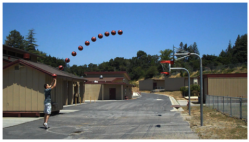 Dan Meyer’s “Did It Hit the Hoop” 3-act Activity probably sits on the Mount Rushmore of math goodness, and Dan’s recent share of an Activity Builder makes it all the more easy to engage your classes with this premise. In class, we are working through polynomial operations, with factoring looming large on the horizon. My 9th graders have little experience with anything non-linear, so this seemed a perfect time to toss them into the deep end of the pool. The students worked in partnerships, and kept track of their shot predictions with dry-erase markers on their desks. Conversations regarding parabola behavior were abundant, and I kept mental notes to work their ideas into our formal conversations the next day. What I appreciate most about this activity is that students explore quadratic functions, but don’t need to know a lick about them to have fun with it – nor do we scare them off by demanding high-level language or intimidating equations right away.
The next day, we explored parabolas more before factoring, and developed links between standard form of a quadratic and its factored form. Specifically, what information does one form provide which the other doesn’t, and why do we care? The path here feels less intimidating, and we always have the chance to circle back to Dan’s shots if we need to re-center discussion. And while the jury is out on whether this improves my unit as a whole, not one person has complained about “why”…yet.
MORE ACTIVITY BUILDER GOODNESS
Last night, the Global Math Department hosted a well-attended webinar featuring Shelley Carranza, who is the newest Desmos Teaching Faculty member (congrats Shelley!). It was an exciting night of sharing – if you missed it, you can replay the session on the Bigmarker GMD site.

 mathcoachblog