Categories
Class Openers

Class Opener – Day 17 – Time for a Card Trick

Today is the last day of school before a 4-day weekend. Since we have been talking a lot about cards and probability in class, it’s a great time for a card trick to maintain enthusiasm before a few days off. Enjoy a glimpse into the craziness which is my classroom…

A “how to” guide for this trick is given here by Mismag822 on YouTube:

In the instructional video, you find that the secret to this trick lies in the cards being face-up the first time around, which does transform the order of the cards during a “switch”. Later, when the cards are dealt face down, two single cards placed face down individually is equivalent two cards switched and placed faced down. For my geometry folks, there is a cool transformation introduction here.

Categories
Class Openers

Class Opener – Day 16 – A Revealing Discussion of Factorial

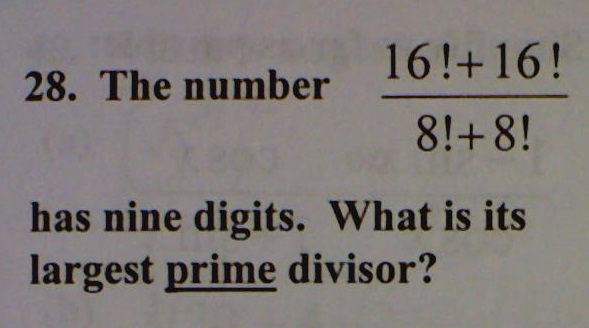
I opened today with what I had hoped would be a rich discussion concerning a past contest problem, but turned into something more substantial.  Here is the problem:

2014-09-23_0002

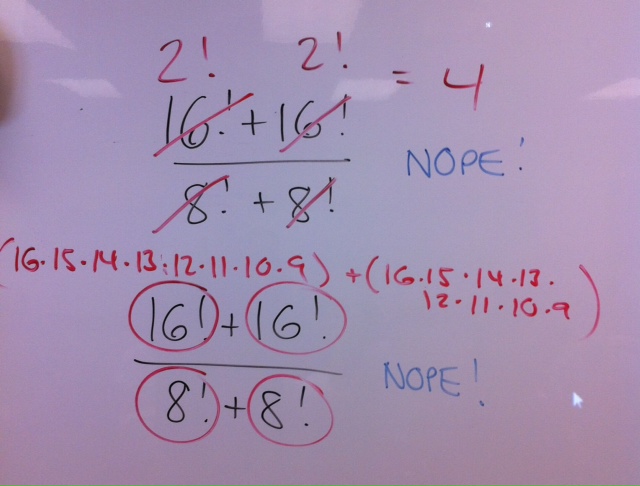
I wasn’t too surprised when many, many students reached for their graphing calculator…this is what freshmen do. I was however surprised when I asked the class to volunteer their ideas on how they could simplify the expression – placing ideas on the board.  Some appear below, and we discussed why or why not the procedures were valid.

photo1 photo2

Many misconceptions regarding what it means to “cancel” in a fraction were revealed; in fact, the very nature of what it means to reduce was the star of our discussion.

2014-09-23_0003Later in class, I provided a hint which I hoped would provide some clarity with our factorial challenge. Some students immediately saw the link to the original problem and simplified. But how much closer are wo to finding the largest prime divisor? After simplifying, it was back to the calculators….which doesn’t really help much here.  Listing the remaining factors of 16! after dividing common factors of 8! leaves us with the clear answer : 13.

The moral of the story – those who never touch a calculator discover the mechanics of this problem much more quickly than those who take a sledgehammer to it with a Nspire CX.

Categories
Class Openers

Class Opener – Day 15 – Paint it Black

Students arrived in class today to find tic-tac-toe boards on their desks, and a challenge on the board:

A 3×3 square is partitioned into 9 unit squares.  Each unit square is painted either white or black with each color being equally likely, chosen independently and at random.  The square is then rotated 90 degrees clockwise about its center, and every white square in a position formerly occupied by a black square is painted black.  The colors of all other squares are left unchanged.  What is the probability that the grid is now entirely black?

This is a scary, scary, looking problem, which I have shared before on the blog. I learn much about my classes by observing the reactions to these sorts of problems: who reads carefully, who dives right in, who turns to share thoughts with their neighbors, who gives up immediately, and so on…so much problem solving comfort revealed in one problem.

So how do we start? After a few reads, I asked students to experiment with their boards, and discover some patterns which meet the problem’s constraints.

photo2

As students made discoveries and found boards which met the problem’s requirements, I invited a few up to the board to explain their work. This led more students, many who were apprehensive at the start, to think about the problem and the rotations.

Students began to discuss their findings, and some agreements were reached:

  • The center square must be black
  • There must be at least 5 black squares

But do ALL grids with at least 5 square work? This led to one last challenge for the day – find a grid with 5 black squares which does not work? This was quickly tackled by a few groups:

photo

We haven’t tackled the randomness and probability aspects of the problem yet – that will resume tomorrow. But hopefully less apprehension over complex-looking problems and some developing teamwork!