Categories
Class Openers Statistics

Class Opener – Day 43 – Statistics as Art

Big Stats test tomorrow – students are getting antsy, lots of movement happening with review and reflection.  Today was a good day to step back, think about the role of numbers in society and appreciate some intriguing artwork.

Chris Jordan is a photographic artist whose works “Running the Numbers – an American Self-Portrait” cause you think of the largeness of our world, and the amount of waste we create. His website contains a number of fascinating pieces which zoom to reveal a statistic about our society’s wastefullness.  It’s an awesome experience, and we started class today by discussing a number of the pieces and the large numbers they represent.  There were a number of “whoa” moments as the composition of each picture was revealed, and I read the helpful statistic attached to each work.  Based on the size of each piece, there are some great estimation discussions to be had here as well.  It’s statistics – it’s art – world are colliding in a cool way!

Chris’s TED Talk “Turning Powerful Statistics Into Art” can also be shared with classes to learn more about the message of these pieces.

Categories
Class Openers Statistics

Class Opener – Day 42 – A Sampler of Sampling Methods

2014-11-05_0001After a day off for election day, it’s back to the world of random sampling, margin of error and plausible intervals.  These tend to be tricky ideas for students, as we move from the “absolute” world of algebra and into the slightly more wishy-washy world of sampling and plausability.  My board scribblings were intended to remind students that we draw samples to represent populations, and that random sampling is king!

But random sampling is messy business, and there are other sampling techniques I want students to consider, and think about their effectiveness.  Rather than lecture each type (caution – excessive vocabulary lectures may cause drowsiness), I gave students a list of words I expected them to research and find suitable resources.

  • Cluster Sampling
  • Stratified Sampling
  • Systematic Sampling
  • Convenience Sampling

After a few rounds of walking around the room to discourage random copying of definitions which they didn’t understand anyway, many groups began to ask the “right” questions, relating the ideas to hypothetical surveys we could do of high school students.  Towards the end of our time, each group was assigned one term to “explain” on a poster through a visual representation. And now, we have a great crowd-sourced wall of survey vocabulary to refer to during discussions!

posters

Categories
Class Openers

Class Opener – Day 41 – All Hail Martin Gardner

Sometimes class openers have nothing at all to do what is happening in class, and are meant to generate positive math vibes, or think about ideas beyond the confines of curriculum. Today my classes celebrated the 100th birthday of Martin Gardner, the long-time master of the math challenge. His birthday would have actually been last month, but better late than never to enjoy some math puzzlers, these from a 2011 edition of Scientific American, where his problems were often published.  Many similar problems appear online, and can be easily found through searches.

Gardner

The “crazy cut” problem proved difficult for students, though eventually a few students found the answer, which was shared under the document camera.  Click the Scientific American link above for the solution.

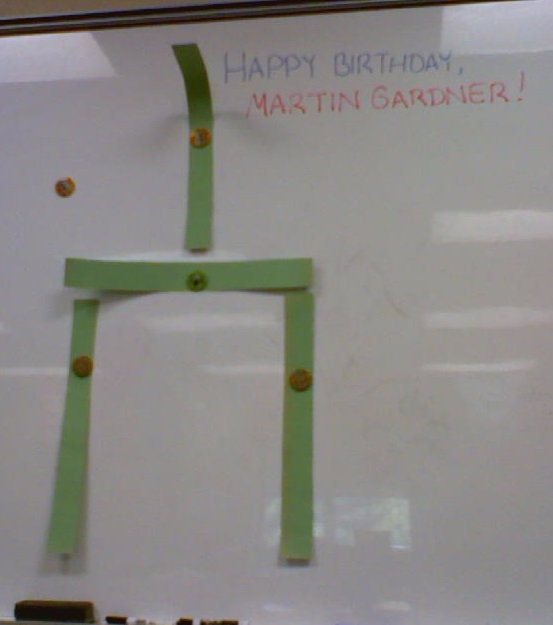
2014-11-03_0003The Martini Glass problem was solved quickly, and modeled on the board by a number of students using strips of paper and magnets.  I’m hoping that enough students were intrigued by the puzzles to look up more great Garnder puzzles on their own!