Categories
Algebra Middle School Technology

Siemens STEM Academy – Sunday with Lodge

This week, I have the incredible opportunity to participate in the Siemens STEM Academy, held at Discovery HQ in Silver Spring, MD.  This year, I am serving as a team leader, after having been an attendee (fellow) last year.  What a tremendous week of sharing with colleagues who are are all into advancing the cause of STEM education.  As a team leader, I am excited to share my skills and ideas with the group, and will post parts of my presentation to the blog later this week.

Right now, the group is hearing from Dr. Lodge McCammon, a pioneer in using music and video to stimulate and educate students.  This year’s group of 50 fellows, after some initial networking, are hearing about Lodge’s process for putting together his songs, which often require the recruitment of his mom and dad to perform musical parts.

Lodge

But moving beyond the songs, Lodge seeks to have students symbolize the lyrics through movement, the “Kinesthetic Lecture”.  Today, the fellows learned new “moves” to share for Lodge’s “Mitosis” song.  Check out there lyrics here (you can also experience more of Lodge’s great songs there), and the kinesthetic moves below:

Lodge is also an expert in the “flipped” classroom model, where teachers produce videos of lessons and concepts, for students to watch and review at home.  In the presentation, Lodge shared anecdotes and ideas for implementing the flipped model.  Many of his ideas and resources can be found at his FIZZ site on the Friday Institute for Educational Innovation.  Here’s a quick introduction by Lodge explaining the flipped concept:

I have worked with a number of teachers who are interested in the flipped model, and the flipped ideas have received much press through sites like Khan Academy.  Lodge has collected data on the success of the flipped model through middle school math teachers he works with,  including a comparison of a teacher-created video lesson versus Khan Academy.  I appreciate that Lodge stresses the need for teachers to produce their own videos, and continue to be identified as their students’ educational expert:

It’s critical that the teacher be the deliverer.

Teachers teaching cannot be outsourced and replaced.

Teachers matter now more than ever!  You can follow Lodge on Facebook at http://www.facebook.com/fizz.education.  What a fantastic kick-off to the week. Looking forward to hearing about and sharing more classroom ideas.

Categories
Algebra Statistics

Developing Math “Spidey Sense”

A recent post in the math blog Divisible by 3 made me reflect upon the role of importance of estimates and initial gut feelings in math class.  In the blog post, Mr. Stadel shared some estimation anecdotes from his middle school classroom, and a great Ignite video on quality instruction from Steve Leinwand (do yourself a favor and watch Steve’s 5 minute rant on instruction….you’ll be glad you did!).  How often do we challenge our students to communicate initial guesses or predictions of what will happen next?

Recently, I tutored a young man named Kevin in AP Statistics.  Like many AP Stats students, Kevin was quite comfortable with using his calculator, to the point where I often grabbed the calculator from the table as he was reading a problem.  Consider the following problem:

In a recent survey, adults were randomly selected to provide their opinion on presidential campaign spending.  200 adults were randomly selected from Pennsylvania, and 200 were randomly selected in California.  In PA, 130 of the adults supported campaign spending limits, while only 122 in California supported limits.  Do the data show a significant difference in the opinions of all adults in the two states?

Before diving into the computations, I found it helpful to ask Kevin what his “spidey sense” told him about the problem?  Does the result “feel” significant?  Could he predict the p-value?  Does the student have a feel for what the numbers might bear out after we crunch them?  These “spidey sense” discussions were fruitful, in that the conversation would focus on important concepts like the effect of sample size on sampling distributions.  Have your students make initial predictions before performing any computations, and see how understanding and misconceptions are revealed.

spidey sense

How can we develop “spidey sense” in other high school courses?  Consider the following scenario, which is often used to introduce systems of equations:

  • Dave and Julie are each saving money in a bank account for a new television for their room.  Dave started his savings with $80, and adds $10 each week to the account.  Julie started with no savings, but adds $15 to the account each week.

I have used problems similar to this one, and often the lesson requires students to create a data table for each week, graph their data, and answer a series of questions which lead to Julie having more money than Dave.  Eventually, algebraic expressions are introduced and we can solve systems!  Ta-dah!

But since this is a money problem, there’s a great opportunity here to communicate and develop initial opinions.  Ask your class, “Who will be able to buy the TV first?”, “What does your spidey-sense tell you?” and see how many of the concepts develop organically.  Or, if you want to compare the two students, ask which of the following is true?

  1. Dave will always have more money than Julie.
  2. Julie’s savings will pass Dave’s soon.
  3. Julie’s savings will eventually pass Dave’s, but it will take a while.

Let the discussions drive the instruction.  Let students tap into their built-in intuitions and share ideas.  And, as Steve Leinwand exclaims, “value and celebrate alternative approaches”.

How do you challenge students to tap into their math-spidey-sense?

Categories
Algebra Technology

Channeling Creativity in Algebra 2

UPDATE – I recently posted more info about this project, with a rubric and more examples, at this post.

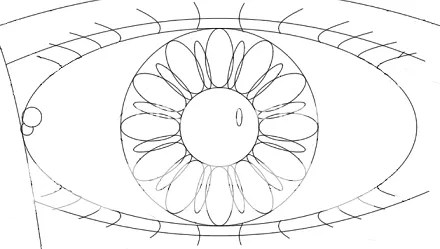
One of my favorite math projects takes place during our unit on conic sections in Algebra II.  In the project, students are challenged to manipulate equations of conics and graph them using software to make pictures.  I started with this project 12 years ago when a colleague, who has since retired, introduced me to his ideas.  Back then, we used a DOS program which could only graph in black, cyan and magenta.  We were happy if we saw a tree made from a hyperbola and a parabola leaf line.

The project grew new wings with a program called Math Toolkit, which allowed for finer graphing and the ability to save work.  Later, we started using Print Screen to grab the graphs and move them into MS Paint.  The projects grew more intricate, and many kids took off with their creativity.

This year, the Desmos online calculator brought the project to a new level.  Students this year could work on their equations at home, save work, and work with their teacher during time allotted in class.  Thanks to Kevin for working with his class to share their creations.

First up is Kristin.  Her project moves from Desmos to Paint.  Then un-needed pieces are removed, and the final product emerges.

Conic 1

Conic 2

Conic 3

Next up is Matt.  Here are his graphs after the axes and grid were removed….

Conic 4

Any ideas what the finished product will be?

Did you guess yet?

OK, so you just want to see it…ok….

Conic 5

What I love most about this project is when students discover how the conics behave, and experiment with them without fear.  In the next example, Connor wanted to tilt his ellipses and researched on his own how to make that work using trig functions (did I mention that these kids haven’t had trig yet?).

Connor1

Connor 2

Connor 3

In some years, I have had students peer-assess their work by creating an art gallery of their work.  Giving each student 5 star stickers, I had students select their favorites.  Contact me if you would like any of the instructions or rubrics I have used for this project in the past.  Thanks again to Kevin and his Algebra II class!