Categories
Class Openers

Class Opener – Day 31 – Test Day!

It’s a big day for my freshmen, as today is their second unit test – this one on sequences, series and the binomial theorem.  For the last few days, we have been knee-deep in the world of arithmetic and geometric sequences, so much so that you’d think they are the only types of numerical patterns. But in today’s opener I want to expose them to something deeper, without freaking them out before the test –

sequences

My fear is that if I dive too deep into these problems now, I’ll worry students who are studying for the test.  So instead I provide about 60 seconds to discuss what we see, and will let the problem marinate.  If students finish the test early, they’ll have something to think about and tackle. Hopefully we will have a chance to come back to these problems next week, but sometimes I feel bad when I start a new problem and don’t find the time to re-visit it. For now, I think I’ll leave the problems on the board, and see if anyone volunteers information.

If you are playing along at home, here is information about the two problems above.  The first is the harmonic series, which diverges (approaches infinity), while the second (the sum of the reciprocals of the triangular numbers) surprisingly approaches 2.

Upon reflection, there were some natural places to flip instruction in this chapter. In the video below, students took notes on the sum of an arithmetic series. As a number of students in my last period class leave for sports, this was an effective way to keep everyone on the same page.  Enjoy!
Categories
Class Openers Statistics

Class Opener – Day 30 – Stats Entrance Tickets

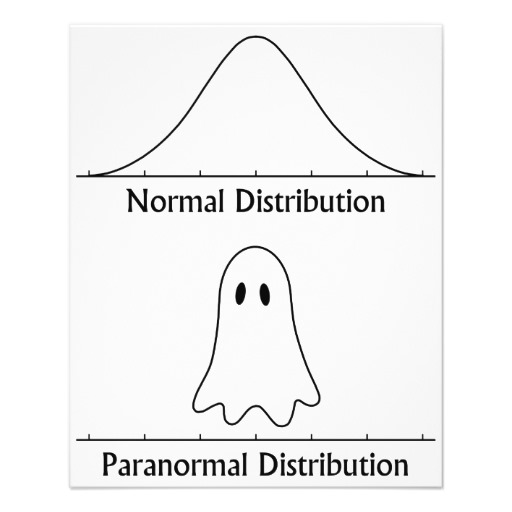
paranormalUsually my openers here on the blog are those I share with my freshman classes, but today’s post features my AP Statistics class.  They are preparing for their test on normal distributions, and it’s no time to be spooked!  Today’s class started with the famous stats cartoon shown here, and an entrance ticket – one part of a past AP problem dealing with normal distributions.

Schools in a certain state receive funding based on the number of students who attend the school. To determine the number of students who attend a school, one school day is selected at random and the number of students in attendance that day is counted and used for funding purposes. The daily number of absences at High School A in the state is approximately normally distributed with mean of 120 students and standard deviation of 10.5 students.
(a) If more than 140 students are absent on the day the attendance count is taken for funding purposes, the school will lose some of its state funding in the subsequent year. Approximately what is the probability that High School A will lose some state funding?

The full exam (and all free-response questions) are available on the AP Statistics area on the College Board website, who own the copyright on all AP problems.

Despite the length of text in this problem, part a here is a simple normal distribution probability, one which any AP student should be able to tackle easily.

I gave students 4 minutes to provide a solution on the printed sheet, but did not ask them to identify themselves on the paper. After collecting the sheets, I mixed them up and prepared to share them under my document camera.  This particular problem is one I graded last summer at the AP Stats reading in Kansas City, and if you know what you are looking for, it is a quick grade (by my super-unofficial count, I probably graded this question about 1500 times).  All papers received a score of E (essentially correct), P (partially correct) or I (incorrect) based on the College Board rubric.  Even though this would qualify as an “easy-ish” problem in AP Stats, it’s still the student’s responsibility to justify and communicate.  For this problem, there are 3 features we AP readers looked for:

  • A correct answer
  • Indictation of a normal distribution used, along with mean and standard deviation identifiction
  • Indictation of a boundary value of 140

The last 2 bullets could be met in a number of ways – by diagram, by symbols. It’s a good lessson to students that even basic stats problems require justification.

Categories
Algebra Class Openers

Class Opener – Day 29 – Geometric Series

Aren’t infinite geometric series cool?  If you just shouted “yes”, then you are potentially as geeky as I am. A “proof without words” from MathFail kicked off today’s discussion:

Proof
I wasn’t quite sure what sort of observations I would receive from my class. But just enough ideas were generated to get us going:

There are an infinite number of triangles down the right side.

All those triangles on the right add up to the half-triangle on the left.

Both are great starts for what I hope my students will learn today. A video I made in my driveway continued the ideas of geometric series and their infinite terms.

A few students wanted to argue that the sequence in the video was arithmetic, but some meaningful debate yielded agreement that geometric made more sense.  Groups then worked through a similar problem involving a Superball being dropped, leading to terms and total distance traveled.

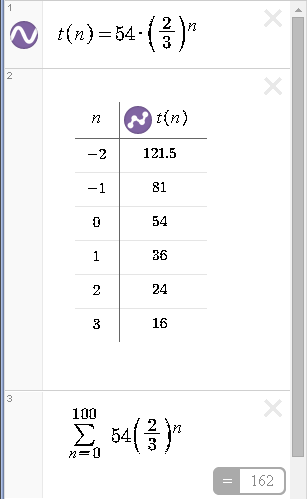
seriesMany groups employed a “brute force” method to find their answers. Using the Desmos calculator (many students chose to use the iPhone app), we found value in developing the equation and using tables and summation symbols to find solutions. This was my first time usign Desmos with this particular lesson, and it was an awesome addition, which added value to the need for writing a clear function to define your situation.