Categories
Class Openers

Class Opener – Day 55(?) – Can We Just “Guess and Check”?

I’m a little off schedule with the class openers lately, so we’ll call this one day 55. There have been a few schedule disruptions here at school, and I was out yesterday – presenting on Standards Based Grading in Algebra 1 at the PASCD conference – on top of all of that, the dog ate my homework…..OK, enough excuses!  Today really isn’t a class opener, but rather a summary of some goings-on related to math persistence – those times when you give your students a problem which will require more than a one-time effort, and observe their response.
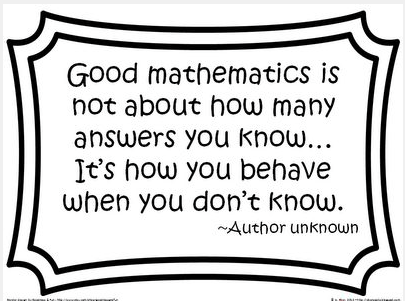

PosterJon Orr, a teacher from Ontario,  shared the poster shown here on twitter, and I love it! If you aren’t following Jon, do it now, and be sure to check out his blog with lots of great classroom ideas, mostly for Algebra 1.

When I was out yesterday, my students had two tasks to complete: work through problems as review for their quiz on matrices today, and complete a “problem solving” task involving matrices. In the task, which you can download here, students are asked to find a matrix which is its own inverse, with a few restrictions.

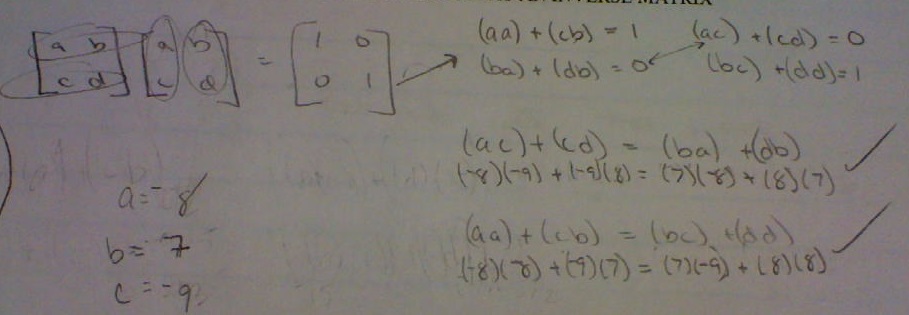
One team today submitted a paper which did find what was requested, but left me uneasy:

2014-11-25_0001

The group clearly found a matrix which is its own inverse, but am I confident that they could generalize and perhaps find more? And are those “random numbers” they started off with actually random, or do they signify the end of a process which has not been communicated? I find that this is typical of a problem-solving process for many students – begin with some “random” numbers and hope that they lead towards a fruitful path.  Hey, what’s the matter with good old “guess and check”, if the question at hand is answered? I don’t have a problem with this “brute force” method IF the process leads to a generalization, which this paper did not. I struggle with having my students move from “I got an answer” and towards “hey, now I see how this REALLY works”.  All is not lost, however, as some students thought about variables and attempted to generalize, but then opted to plug and chug.
2014-11-25_0002

I’m looking forward to the group conversations we will have in the coming days surrounding this problem.

Tonight for homework I assigned a problem involving a wire being streched around the earth. Within 60 seconds the first all familiar call was heard: “I don’t know what to do!”.  A sly smile from me and pointing out today’s quote sent the message that this cry wouldn’t get them off easy…it’s a hard-fought battle to get kids to move past theiur initial blockades and think.
Categories
Class Openers Statistics

Class Opener – Day 54 – Matched-Pairs in AP Stats

The unit on experimental design is one of my favorites in the AP Stats year, but the structure of a matched pairs experiment – where every subject participates in both treatments – often confuses students. For the past few years, I have been introducing students to matched pairs design through a sport which is sweeping America…

HALLWAY BOCCE!

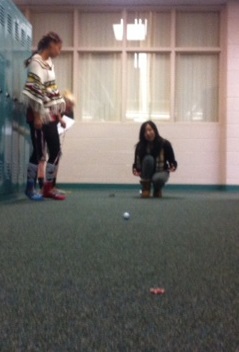
bocce2In hallway bocce, students place two poker chips 5 meters apart in the hallway. Then, standing behind one of the chips, they roll a golf ball towards the opposite chip, trying to get as close as possible. With our carpeted hallways, the golf balls really take off, so some practice is needed to get the right touch. During this practice session, the students don’t know where this is all heading in terms of experimental design.

Next, the students are given a direction sheet for recording results. Each “stat-lete” is asked to play bocce 4 times, twice with their right hand, twice with their left, alternating hands. A coin is used to determine which hand to start with. Partners then measure their attempts and record results.  Note that today was “fashion disaster” day as part of our school’s spirit week.

bocce1


Back in class, we then think about what could be conjectured before this experiment.  Sure, we could compare the attempts by right hands and by left hands, but what does this tell us?  We then settled on looking at players’ dominant versus their non-dominant hands, and made a dotplot of the results (note – my pre-made scale really was not sufficient here…those golf balls really fly!)

bocce4

But this only allows us to compare hands in general. What we’d like to be able to do is determine if players are better with their dominant, rather than their non-dominant, hands. Subtracting these results, since all players participated in both treatments, allows for this comparison.

bocce3In the end, those reasults seem quite inconclusive, but that’s okay! Not all experiments prove conjectures, and we learn about the process.

Categories
Class Openers

Class Opener – Day 52 – “Impossible” Codebreaking

It’s day 3 of codebreaking openers, and time to up the ante! After offering Jolly Ranchers (who should provide me stock, with all the great pub I give them in my classroom) and candy bars for codebreaking challenges, we’re ready for the big time….

message

And BOOM goes the dynamite!

“That’s a filthy lie!”

Wait…do my students not trust me? Well, I suppose my students have good reason to NOT trust me, as it’s not everyday practice to hand out gift cards for solving problems.  But the cell phones came out, typing in the phrase with faint hopes of Googling an answer.  Many students had questions about yesterday’s code – a Hill cipher – wanting to know how letters become numbers, and great questions about the role of inverses. And while I gave very few clues about today’s challenge, I assured them that it was NOT done with a Hill cipher – something much more complex is going on.

rotors

I was feeling a little generous (just a little), and left a small clue on a side board for them to consider. But just how helpful is it?  What are rotors? And what’s with the Roman numerals?  Just a small clue that today’s challenge was coded using an Engima machine – or at least an online applet simulation of one. This is a challenge I have done before, and for the last 12 years, and have yet to give out a gift card.  This is the first year I have given out at least a little information – rotor positions – and I am still supremely confident that my message will not be broken.

I’m giving away some of the explanation, but I am not worried – unless my students are REALLY persistent. While classwork was done today, many students had great questions about the problem, finding ideas on their phones (which I endorse!).  And I admit I started to get a little nervous when I saw a photo of an Enigma machine on one phone.  Am I tempting fate?  We’ll find out by tomorrow.