Categories
Uncategorized

How Do We Assess Efficiency? Or Do We?

A problem on a recent assessment I gave to my 9th graders caused me to reflect upon the role of efficiency in mathematical problem solving. In particular, how much value is there in asking students to be efficient with their approaches, if all paths lead to a similar solution?  And should / could we assess efficiency?

The scene: this particular 9th grade class took algebra 1 in 7th grade, then geometry in 8th.  As such, I find I need to embed some algebra refreshing through the semester to dust off cobwebs and set expectations for honors high school work. For this assessment, we reviewed linear functions from soup to nuts. My observation is that these students often have had slope-intercept form burned into their memory, but that the link between this and standard form is weak or non-existant.  Eventually, the link between standard form and slope ( -A/B ) is developed in class, and we extend this to understanding to think about parallel and perpendicular lines.  It’s often refreshing to see the class see something new in the standard form structure which they hadn’t considered before.

The problem: on the unit quiz, I gave a problem which asked students to find the equation of a line parallel to a given line, passing through a point.  Both problem and solution are given in standard form.  Here is an example of student work (actually, it’s my re-creation of their work)….

linear problem

So, what’s wrong with the solution?  Nothing, nothing at all.

Everything here answers the problem as stated, and there are no errors in the work. But am I worried that a student took 5 minutes to complete a problem which takes 30 seconds if standard dorm structure is understood?…just a little bit.  Sharing this work with the class, many agreed that the only required “work” here is the answer…maybe just a “plug in the point” line.

My twitter friends provided some awesome feedback….

Yep, we would all prefer efficiency (maybe except Jason). Thinking that I am headed towards an important math practice here:

CCSS.MATH.PRACTICE.MP8 Look for and express regularity in repeated reasoning.

It may be unreasonable for me to expect absolute efficiency after one assessment, but let’s see what happens if I ask a similar question down the road.

Confession, I really had no idea what #CThenC was before this tweet.  Some digging found the “Contemplate then Calculate” framework from Amy Lucenta and Grace Kelemanik, which at first glance seems perfect for encoruaging the appreciation for structure I was looking for here.  Thanks for the share Andrew!

https://twitter.com/shahlock/status/659399736718438401

Yes, yes!  Love this idea.  The beauty of sticking to standard form in the originial problem is that it avoids all of the fraction messiness of finding the y-intercept, which is really not germane to the problem anyway. Enjoy having students share out their methods and make them their own.

What do you do to encrouage efficiency in mathematical reasoning?  Share your ideas or war stories.

Categories
Technology

Activity Builder Reflections

The super-awesome Desmos folks set Activity Builder into the wild this past summer, and it’s been exciting to see the creativity gushing from my math teaching colleagues as they build activities.  So far, I have used Activities with 2 of my classes, with mixed success.

In my 9th grade Prob/Stat class, I built an Activity to assess student understanding of scatterplots and lines of best fit.  You can play along with the activity if you like: go to student.desmos.com, and enter the code T7TP.  I am most excitied by the formative assessment opportunities an activity can provide – here are 3 places where I was able to assess class understanding.

In one slide, students were shown a scatterplot, and asked to slide a point along a number line to a “reasonable” value for the correlation coefficeient, r.  The overlay feature on the teacher dashboard allowed me to review responses with the class and consider the collective class wisdom.

r overlay

In another slide, students were again given a scatterplot and asked to set sliders for slope and y-intercept to build a best-fit line.  Again, the overlay feature was helpful, though it was also great to look at individual responses.  This led to a discussion of that pesky outlier on the right – just how much could it influence the line?

LSRL overlay

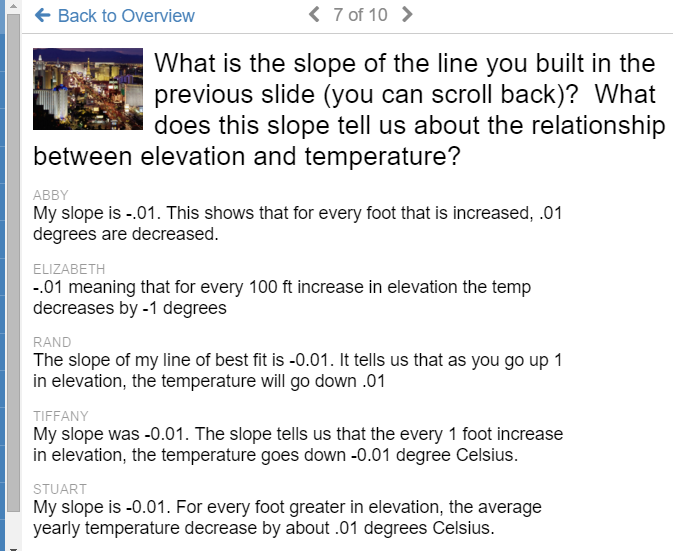
Finally, question slides were perfect for allowing students to communicate their ideas, and focus on vocabulary. In our class debrief, we discussed the meaning of slope in a best-fit line, and its role in making predictions about the overall pattern.

 question roll

But all has not been totally sunny with Activity Builder.  In my Algebra 1 class, I built an Activity to use as a station during class.  Splitting the class in half, one group worked with me on problems, while the rest worked through the activity, then flipping roles halfway through class.  You can try this activity at student.desmos.com, code 3FGM.

Storm clouds approached early, when a student complained that they didn’t know what to do – even though the first slide offered instructions to “Drag the points…”.  Quickly my “I’m an awesome teacher who uses stations” fuzziness turned into saltiness as students clearly were not following the activity faithfully.  Here’s what I learned:

Leading class through an activity beforehand would have been helpful. In the future, I’m going to make a vanilla lesson which walks students through simple tasks – dragging points, answering questions, entering equations, adjusting sliders – and let them see how I can view and use their responses.  Just setting a class into the wild, especially a class which often struggles with instructions, didn’t work so hot.


Last Saturday, I led a group of about 20 teachers in an Activity Builder workshp at the ATMOPAV Fall Conference at Ursinus. I had 3 goals for the assembled teachers for the hour:

  • Experience activities through a student perspective.
  • Experience the teacher dashboard.
  • Start building their own activities.

Some have asked for my materials, and I can’t say I have too much to share.  Check out my Slides and feel free to contact me with questions about the hour. Some highlights of the group discussions:

  • When is the best time in a unit to use an Activity?  So far, I have used it as an intro to a unit, and also as a summary of a unit.  The difference is in the approach to task.  An intro activity should invite students to explore and play, and think about generalizations – include lots of “what do you think?” opportunities.  In my summary activity, I asked specific questions to see if students could communicate ideas based on what we had learned.
  • Think about how you will leverage to teacher dashboard to collect and view ideas.  How does the overlay feature let all students contribute and build class generalizations in a new way?  How will you highlight individual student responses to generate class conversation?
  • Ask efficient questions.  There’s really not a lot of room in the text for long-ish tasks.  Keep things short, sweet, and focused.
  • Many teachers wanted to know more about building draggable points.  The way I do this is to create a table, enter some points, and use the Edit feature to make the points draggable.  Your best bet may be to take an already existing activity and pore through its engine, which reminds me….

Desmos is now assembling an searchable archive of vetted activities.  Go to teacher.desmos.com, and use the search bar at the top-left.  I highly recommend any creations by Jon Orr, Michael Fenton and Christopher Danielson.

copyAnd finally, an exciting new feature to Activity Builder just appeared today – you can now copy slides within an Activity.  Click the 3 dots to duplicate a slide and use it again, or edit a graph to use later.

Categories
Uncategorized

Residuals from the Past Month

It’s been a busy month of October. I don’t have a new lesson or resource to share this time – instead, here are some things which have been rattling around my brain.

Last night at the weekly Global Math Department online meet, NCTM President-Elect Matt Larson shared new and “in the works” resources for members, and a revised vision for PD in the coming years.  In the past few months, I have been fortunate to speak personally with both Matt and current President Diane Briars, and I am happy to hear that NCTM not only values the work of the Math-Twitter-Blog O-Sphere, but are now beginning to take lessons from the successes of ourline community and bring it to the national organization.

With regional conferences starting this week, I am most excited to see a new website NCTM has established to encourage ongoing dialogue: http://regionals.nctm.org/.  I won’t be able to make any of the regionals, but will be checking in from afar on this new site. I’m already enjoying the sharing from presenters, and the sense of ongoing discussion.

I re-arranged my bedroom furniture this summer, and I’m not sure I like it better.

This afternoon, I took one of my daily walks through the neighborhood, with the Bill Simmons podcast as my companion. His guest was Judd Apatow, and the conversation turned towards the negative aspects of celebrity.  Judd mentioned Eddie Murphy who started as observational comic, then became hugely famous, as someone whose work was altered by the seclusion of celebrity status. No longer able to make the every-day connection to his audience, the observational aspect of Eddie’s career withered away, and was replaced by other things.  Judd Apatow, sensing a need to re-visit his comedic roots for inspiration, dusted himself off to do stand-up and has caught his comedic second wind.

Is there a lesson here for teachers who leave the classroom to become administrators? How long does it take for separation from the classroom to take root – and can (and should) it be re-visited now and again?

Sometimes I wonder why nobody has been arrested yet for assaulting one of the Impractical Jokers

I have 3 quite different preps this semester, and I am professionally miserable because of it.  With block scheduling here, teachers have 3 courses each semester.  Now and then, 3 preps is not a big deal.  But I teach each course with someone different (or a different group) from the department, and I rarely share prep with any of them.  I’m also the only member of my department to have 3 preps, and this is the second semester in a row this has happened.  OK…I’m getting real close to my whining quota here, but I don’t think I am doing a good job right now.  Instead of having laser-focus on my courses, I find myself all over the place.  This is not helping my students and I am worried.

Some of my AP students report that they will go trick-or-treating next week.  For me, high school age is when you are out of the candy loop.  Am I right?

My Math Club kids are the most enthusiastic bunch I have “coached” in recent memory.  And the weekly Math Madness contests have been great for getting kids to talk about problem solving approaches.  I don’t usually enjoy doing math for competition’s sake, but we have been holding weekly de-briefs after each contest and the conversations have been informal, spirited and genuine.  I’m lucky to work with such a great group of kids!

Today is “Back to the Future” day – October 21, 2015.  The day Marty McFly visited the future on the big screen.  And I passed a DeLorean on the way home from work (no lie, this really happened!)

My new local hero is a colleague of mine at my school who teachers Anatomy and Physiology, Chris Baker.  In addition to being an awesome role model for kids, and someone passionate about his craft, he has jumped deeper into the Twitter pool and has embraced 20% time as part of his classroom culture.  Consider giving him a follow – he’s a good egg!