Categories
Uncategorized

Making It Stick…With Beanbags

The book Making It Stick – the Science of Succesful Learning has caused me to consider how I approach practice and assessment in my math classroom. The section “Mix Up Your Practice”, in particular, provides ideas for considering why spaced practice, rather than massed practice, should be considered in all courses.

But it was an anecdote which began the chapter on spaced practice which led to an interesting experiment for stats class.  The author presents a scenario where eight-year-olds practiced tossing bean bags at a bucket.  One group practiced by tossing from 3 feet away; in the other group, tosses were made at two buckets located two feet and four feet away.  Later, all students were tested on their ability to toss at a three-foot bucket.  Surprisingly, “the kids who did best by far were those who’d practiced on two and four-foot buckets, but never on three foot buckets.”

Wow!

Let’s do it.

My colleague and I teach the same course, but on different floors of the building during different periods. Each class was given bean bags to toss, but with different practice targets to attempt to reach.

  • In my class, lines were taped on the floor 10 and 20 feet from the toss line.
  • For Mr. Kurek’s class, one target was placed 15 feet from the toss line.

Photo Oct 05, 9 33 54 AMAfter every student had a chance to practice (and some juggling of beanbags was demonstrated by the goofy….), I picked up my tape lines, and placed a new, single line 15 feet from the toss line.  Each student then took two tosses at the target, and distances were recorded (in cms).

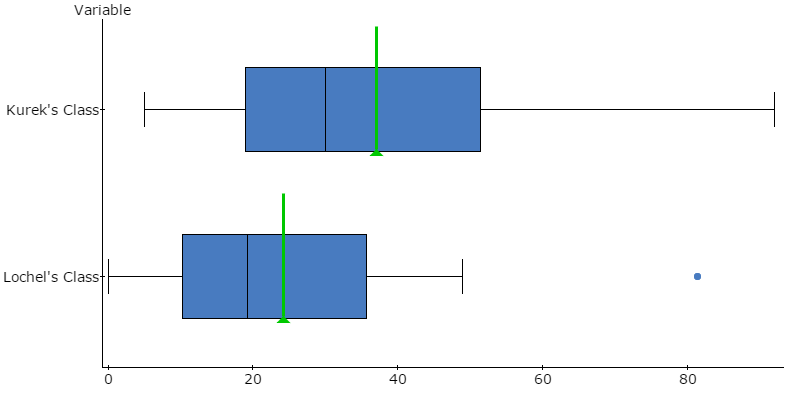
We then analyzed the data, and compared the two groups (the green lines are the means):
bean bags

I love when a plan comes together!  The students, who did not know they were part of a secret experiment, were surprised by the results – and this led to a fun class discussion of mixed practice.  Here, the mixed practice group was associated with better performance on the tossing task. Totally a “wow” moment for the class, and a teachable moment on experimental design.
Categories
Statistics

An Egg-Cellent Simulation

The scenario I used for a fun lesson with my 9th graders this week comes from a talk by James Bush from Waynesburg College, which I attended at the US Conference on Teaching Statistics in May.  James is a master of finding clips from TV and movies to use in his class to encourage discussion, and this clip from the Jimmy Fallon Late Show features a game called “Egg Russian Roulette”. I have embedded a clip here, but you can search for many times Jimmy played this game on his show.

For James’ college statistics courses, this clip is a helpful opener to the hypergeometric distribution, where we are interested in multiple successes from draws done without replacement.  While this setting could eventually be presented to my AP Stats students, it lives a bit outside of the scope of what we do at the college level. But there are some strong entry points for discussion with my 9th graders, including probability trees, conditional probability, and simulation.

PLAYING THE GAME IN CLASS

Before showing the video, two volunteers were called to participate in a mystery game.  The two student volunteers became a bit nervous over their decision when a carton of eggs was produced, eventually shown to be filled with plastic eggs (awesome idea by James!). My first chance to try this with volunteers on my own was at Twitter Math Camp in June, and lots of fun tweets followed.

Thanks to Richard Villanueva, who recorded many of the My Favorites from Twitter Math Camp, we have coverage of the ganeplay.  Check out all of the videos of My Favorites from TMC15 on his YouTube Channel.

Next, I asked the class to think of questions they have about the game they saw, or in general about Egg Roulette.  A good starting list developed:

  • How likely is it that Tom Cruise would lose that quickly?
  • Once Tom picks a raw egg, how likely is it that Jimmy is safe on his draw?
  • Is it better to go first or second?

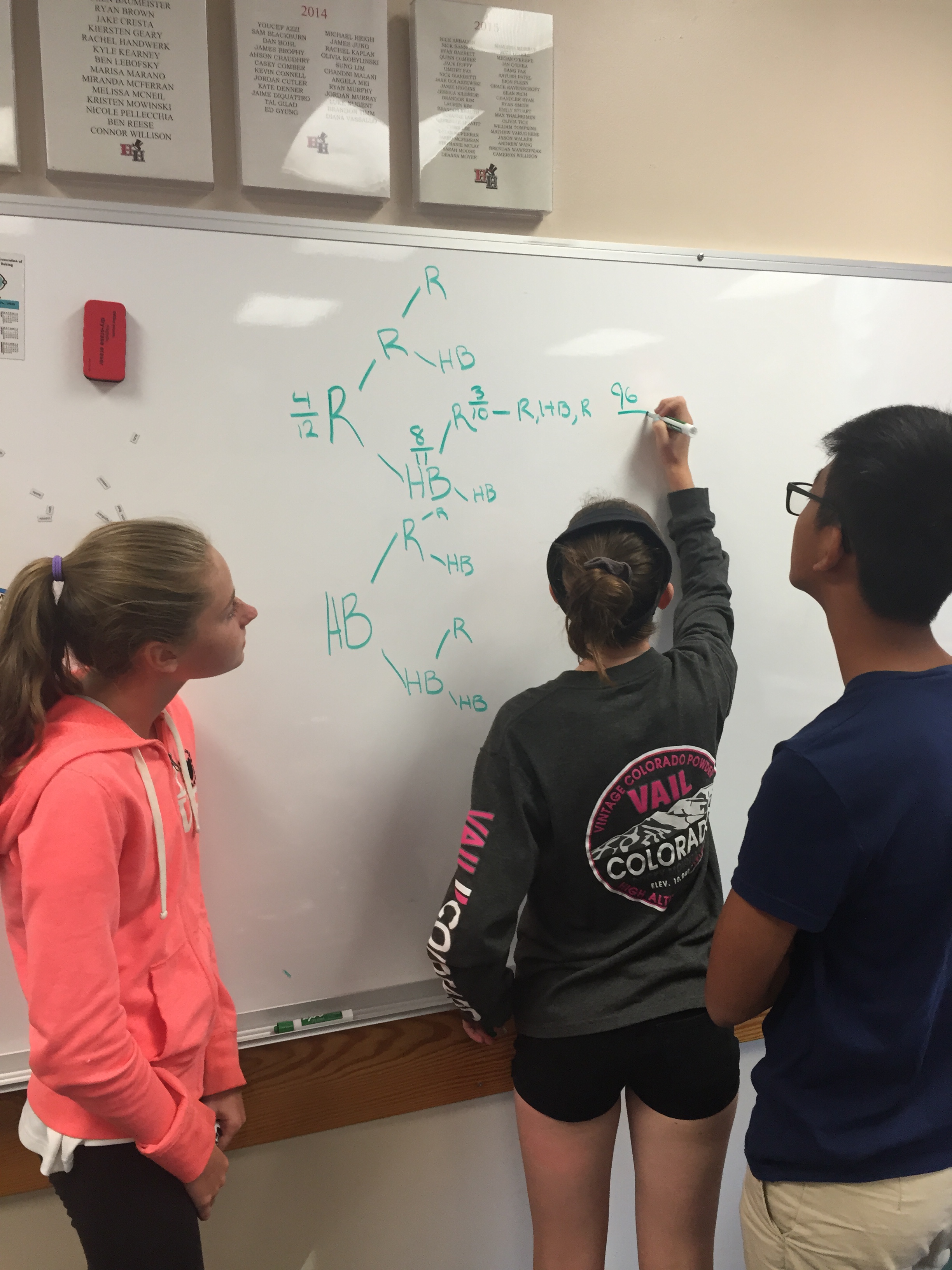
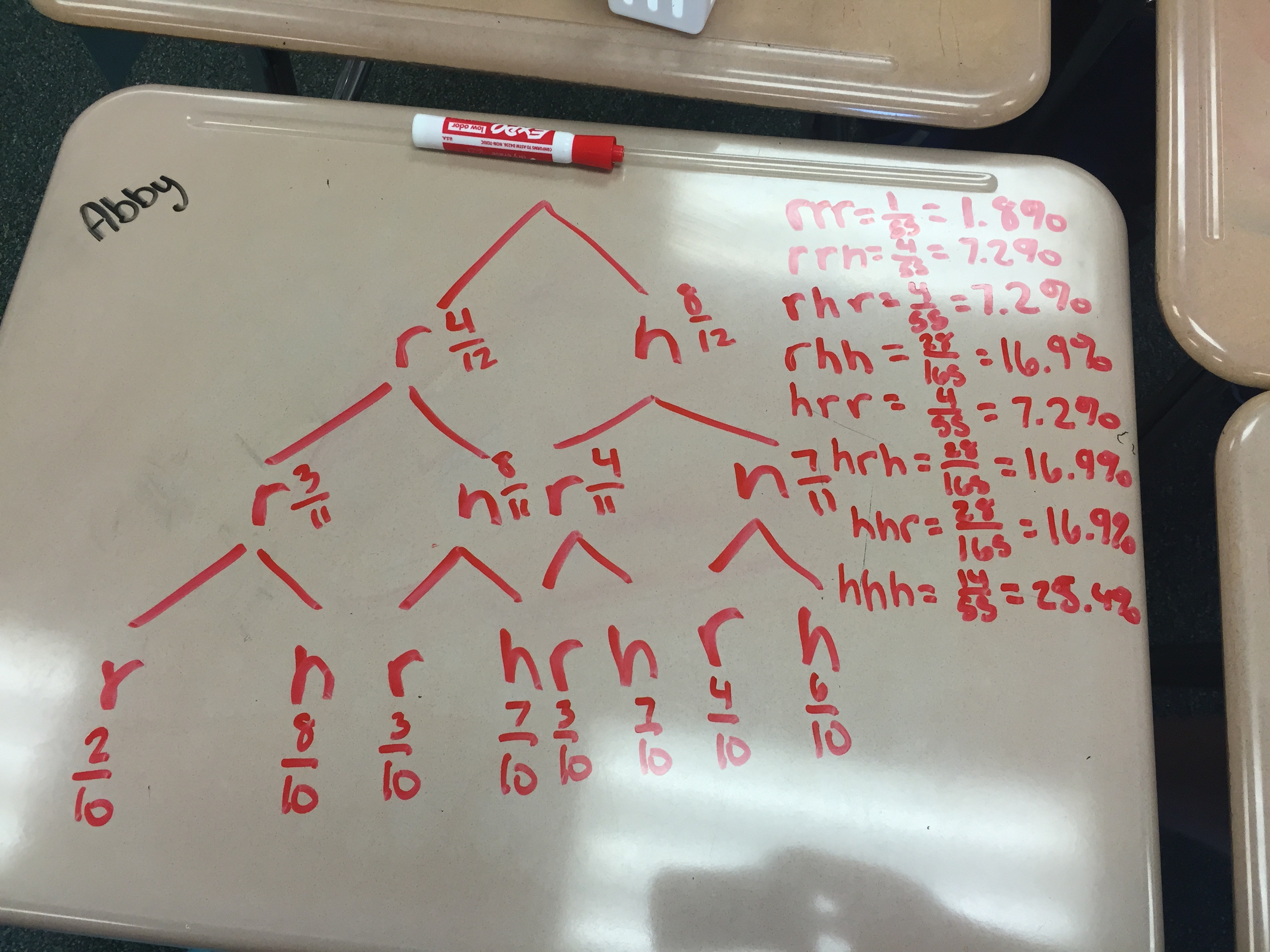
Photo Sep 18, 8 06 14 AM I then challenged my student groups to sketch out the first three rounds of egg roulette, and find the probability of Tom losing in 3 rounds. We had worked on trees the day before, and this game presented a good chance to apply what we had discussed earlier.

Photo Sep 18, 8 13 52 AM

SIMULATION

After our analysis of the first three rounds, the conversation then moved to strategy: is it better to go first or second, or does it not matter?  Our “gut reaction” poll revealed that “it doesn’t matter” was the most common response, with “go first” was in second place.  The thought behind going first is that you could easily draw a hard-boiled egg, and thus put pressure on the other player.

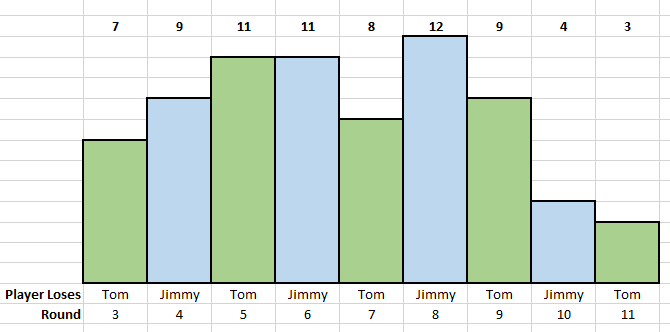
To simulate the game, pairs of students were given one suit from a deck of cards.  The ace was moved aside, leaving 12 cards (representing the 12 eggs).  The 10, jack, queen and king then  represent raw eggs.  After shuffling the cards, students dealt cards into two piles, Tim and Jimmy. When a player was dealt two raw eggs, the game ends and the result recorded.  We were quickly able simulate over 50 plays of Egg Roulette, and the class results were recorded.

Egg Simulation

One student quickly identified, and then defended, that the game can NEVER go the full 12 rounds.  Also, some students noted that the second player (here, Tom) has one extra opportunity to lose the game.  A second straw poll revealed that student perceptions on the game had shifted – few thought it was a 50/50 game, and many saw that the first player held a disadvantage.

FOLLOW-UP

In teams, students are now challenged to explore a similar (yet shorter) Egg Roulette game, compute theoretical probabilities, conduct a simulation, and analyze the results.  I’m looking forward to some interesting-looking trees.  The document here shows guidelines for this activity, some assignment ideas, and a full tree for the first 3 rounds of Egg Roulette.

Download the document

View this document on Scribd
Categories
Uncategorized

A Sneak Preview of My 2015-2016 Classroom

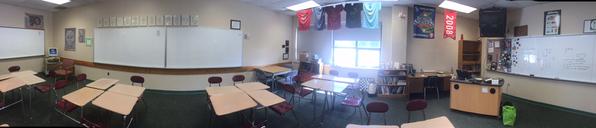
Today is the last day of summer vacation. In the past week, boxes have been unpacked, t-shirts and class decorations have been hung, and my awesome school custodians have provided me with even more whiteboard space – all the better for getting students up and moving

classroom

But beyond the physical layout for this year, here are some ideas I’ll focus on this coming year, many provided by my friends in the Math-Twitter-Blog-O-Sphere, the #mtbos for short.

GREETING STUDENTS WITH HIGH FIVES – Intertwined with all of the mathy goodness of Twitter Math Camp this past July was a simple and powerful device for student engagement from my friend Glenn Waddell – the High Five.

Each day last year, Glenn met his students at the door to give them a high five – a simple, caring gesture to establish a positive tone for class.  I often meet students at the door before class or linger in the hallway for informal chat, but I love the tradition and rapport Glenn establishes here and hope to emulate it.

ESTABLISH SEMI-REGULAR RANDOM GROUPINGS – this gem comes from Alex Overwijk, who is the king of Vertical Non-Permanent Surfaces and Visible Random Groupings. This year, I plan to randomly change my seating chart once each week, or at the start of a new unit – whichever seems to make the most sense at the time.  Traditionally, I’ll assign groups on my own and change them once or twice in a semester.  With some classes, I’ll allow students to choose their own groups.  But I have found that these practices often foster group-think, where a group will together develop the same bad habits through their work together.  I want more interaction, more sharing of ideas, especially in cases where students otherwise would not have encountered each other. I’m planning to assign each student a playing card on the first day, and set the new groups by dealing cards on the desks on days when it’s time to change.  I also confess here that a static seating chart was a huge crutch for me, as I would print out student names for me to glance down at when I needed.  Which leads into another goal for the new year…

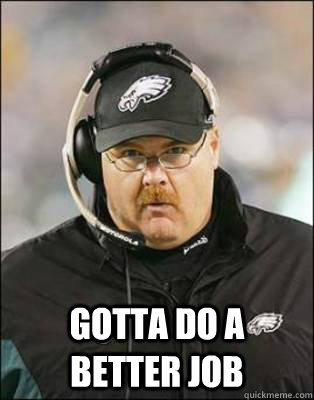
better jobI MUST LEARN NAMES DAMMIT! – I confess this could be one of my weakest areas as a teacher. I could make all kinds of excuses for it, but it comes down to this – I drop the ball when it comes to learning and recalling my students’ names. We start school next Tuesday with a 4-day school week, and my goal is to know all names as they walk in the door by the first Friday.  I have already gone through my class rosters (which conveniently provide photos). How awesome would it be to know student names before they even walk in the door?

And beyond my current students, I am brushing up on names from students I taught last year. I’ve missed out on these connections for too long, and it’s my fault – time to work harder at it.

IMPROVING MY HOMEWORK PRACTICES – I don’t grade homework anymore, and in many cases have changed the nature of assignments. I’ve settled into the philosophy that I would rather have students think about a handful of meaningful, discussable problems rather than complete a laundry list. This year, I am looking to include more articles and video clips for students to observe and discuss in lieu of traditional assignments.

To go over homework, I often employ random methods to share works on my document camera, with mixed success. I’m finding that since I don’t directly look at assignments anymore, the completion is spotty at all levels. I may need to go back to a few minutes of checking and informal greeting at the start of a period to improve assignment fidelity.

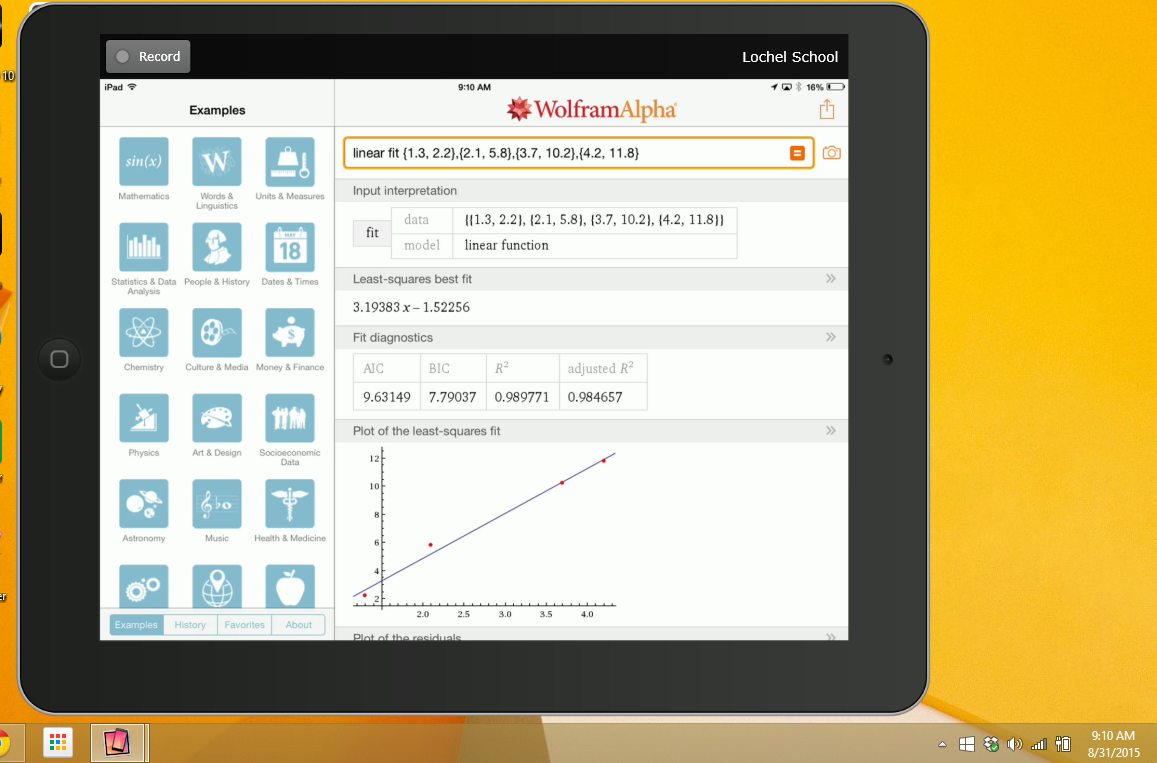
grabUSING REFLECTOR TO ENCOURAGE PARTICIPATION – It can’t be the new school year without a new tech tool to try out. This year, I am looking forward to using the Reflector 2 program from the folks at Squirrels. This inexpensive software, loaded onto my laptop, allows me to relfect the screen from my ipad or iphone onto the laptop. I’m hoping this will allow me to be more hands-free for presentations, and hand over the ipad to students to take control – using Desmos or Deoceri to create works and share in front of the class. Also, I’m wondering what a class would look like where students could reflect their own phones onto the screen and share works. Day 1 of class could feature a “load test” – what happens when many, many students all try to reflect their graphs at the same time?

Now, out to the craft store to buy some last-minute stuff!