Categories
High School

EdCamp and My Amazing Principals

alg-ad-snickers-betty-white-jpgThe first week of district PD – lots of meetings, scads of “sit and get” messages, and every administrator making sure their voice is heard.  I suspect what I am describing is not unique to my area. A great opportunity to energize is lost, and the “grind” begins. And I haven’t been too shy about expressing my displeasure through tweets when I am frustrated – I can be kind of a jerk (think of those Snickers ads…better?…better…).

This week my school admin team got it right. And I feel fortunate to work with them. 

For about a year, my school’s admin team had kicked around the concept of a school-wide EdCamp. To be honest, I never thought it would see the light of day…there are just too many other things loaded into the calendar.  So an invitation to work with a team of teachers to organize a high school-wide EdCamp was a true surprise…then the work began.

We planned 3 morning sessions, followed by lunch and prizes.  But beyond the structure of the day, we had a lot of talking-up to do.  Would our teachers, many of whom had never been to an EdCamp, understand the concept?  Would people propose sessions? Could we engage the curmudgeons in our teaching ranks? At our opening faculty meeting, we showed a brief video to help teachers understand the EdCamp concept, then talked it up over the next 2 days.

building

The morning of the conference many teachers suggested ideas, asked questions and thought about what they’s like to learn. In the end, we had a nice variety of topics and it felt like there was something for everyone!

grid

As I walked around during the sessions, I was thrilled to see rooms filled with discussions, and teachers from different departments with an opportunity to engage.  I know there is no possible way every to reach everyone, but I hope it was a day of professional learning for most.

https://twitter.com/bakerhhhs/status/903270130444009472

On my end, I offered a session “Activity Builder for the Non-Math Crowd” which seemed to be of use to those assembled. Then later, a session where we just did math – problems from Open Middle, Nrich, Visual Patterns and others let math teacher talk, learn, and think about engaging problems for their classrooms. You can download the problems I shared with this link.

Thanks to the fantastic people I work with for letting me be part of this: Baker, Dennis, Kristina and Melissa.

And a big thanks to the HH admin team: Dennis, Ralph, Tracey and JZ.  I appreciate the opportunity, and promise not to complain again….until the next time…..
 

Categories
Uncategorized

Baseball, Brain Cancer and Relative Risk

The 1993 Phillies were the most fun team I have ever followed.  I was nearing the end of my college years, and I vividly remember the insane night when me and 3 buddies celebrated a win at 4:30 in the morning, and the exact spot I was sitting when our hearts were broken with Joe Carter’s home run (I still look away when it comes up on highlight reels).

This week the catcher of that team, Darren Daulton, died after a battle with brain cancer.  Newspapers have shared memories of “Dutch” and among the articles is one which reminds us of the surprising number of former Phillies who have passed away due to brain cancer (Tug McGraw, John Vukovich, and Johnny Oates). A revised 2013 article from the Philadelphia Inquirer analyzes the the unusual number of Phillies who have developed brain cancer, and contains many appropriate entry points for Statistics courses.  Some highlights from the article:

  • A comparison of the observed effect to random chance – here a professor of epidemiology summarizes: “You can’t rule out the possibility that it’s random bad luck.”
  • A summary of plausible variables which could lead to elevated levels of exposure, such as artificial turf (which may have contained lead) or anabolic steroids.
  • An analysis of the increase rate of brain cancer among Phillies – here we are told that the Phillies’ rate is “about 3.1 times as high” as the national rate.  A confidence interval, along with an interpretation and associated cautions are also included.

Let’s explore that “3.1 times” statistic…time to break out the technology.


A few weeks back, I attended the BAPS (Beyond AP Statistics) workshop in Baltimore, as part of the Joint Statistics Meetings. Allan Rossman and Beth Chance shared ideas on using their applet collection to explore simulation (see my earlier post using the applets to Sample Stars) along with a “new” statistic we don’t often talk about in AP Stats – relative risk.

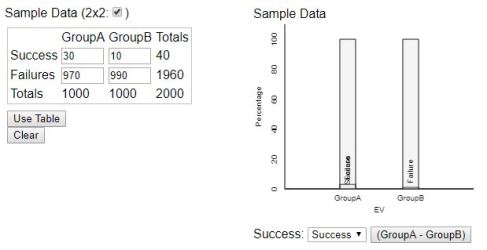
To start, I used the Analyzing 2-Way Tables applet and used the “sample data” feature.  Here I attempted to use the same numbers quoted in the article:

The national rate was 9.8 cases per 100,000 adult males per year, while the rate in the former Phillies was 30.1 cases per 100,000 – about 3.1 times as high.

There are two issues here: first, to perform a simulation we need counts, so numbers like 9.9 and 30.1 just don’t play nice.  I’ll use 10 and 30.  Also, I wasn’t surprised that this site was not real happy with my using a population of 100,000 for simulation.  Here, I am going with 1,000 for convenience and to make the computer processor gods happy – we can debate the appropriateness of this down the road.

table

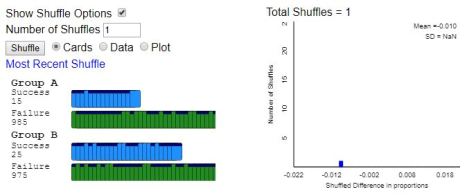
The applet will then simulate the random assignment of the 2,000 subjects here to the two treatment groups (group A: being a Phillie, group B: not being a Phillie). How likely is it that we will observe 30 or more “successes” (which here represent those who develop brain cancer) in one of the two groups?  In the applet, we can see how the “successes” have been randomly assigned from their original spots in the 2-way table to new groupings.

snip2

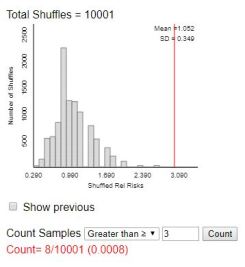
AT BAPS, Allan Rossman then explained how we can summarize these two groups using Relative Risk, which is listed under the “Statistic” menu on the applet. In general, relative risk is the proportion of success in one group divided by the proportion of success in a second group.  If we have proportions in two groups which are equal, then the relative risk would be 1.  We can then link to the newspaper article which claims a 3.1 “relative risk”, simulate many times with the applet (below we see the results of 10,001 simulations), and compare to the reported statistic.

risk.JPG

According to the simulation, we should only expect to see a relative risk of 3 or above about 0.08% of the time – clearly an “unusual” result.

But the article does not claim a significant difference, and cautioned against doing so as a number of assumptions were made which could alter conditions.  This would be an opportunity to discuss some of these design assumptions and how they could change the outcome.

Rest in Peace Dutch!


Categories
Uncategorized

Area Models and Completing the Square

I’m nearing the end of my time with my 9th graders, with this week dedicated to moving beyond factoring as the sole method for solving quadratic equations and towards more general methods like completing the square.

Late in May, David Wees shared materials which challenge students to investigate the relationships between “standard form” and “completing the square” form (aside – does anyone agree on proper terms for these?) using area models to build representations.  Given that I use area models often to introduce polynomial multiplication, I was eager to maintain consistency in the student understanding.

wees

But before we dove into David’s lesson, I wanted students to revisit their understanding of area models.  In this Desmos Activity Builder lesson I created, students shared their interpretations of area models and worked in pairs to investigate non-square models.  In one of the final screens, students argued for the “correct” interpretation of a model.

verify

Using the Desmos teacher dashboard, we could see clear visual arguments for both representations.  This was valuable as we ended the lesson for the day, and tucked that nugget away for Monday, when we would begin to formalize these equivalencies.

responses

After the weekend, students worked independently through David’s Completing the Square lesson. Not only did students quickly move through the area models and the dual representations, the debates between students to explain how to move from one representation to the other were loud and pervasive.  I’m also loving how many of my students have started to use color as an effective tool in our OneNote-taking (below).

student

At the end of the sheet, all students completed problems which translate standard form to vertex form with no support from me (“no fuss…no muss”).  It dawned on me that something amazing had happened….my students had figured out completing the square without my ever talking about completing the square.

Tomorrow we’ll tackle those pesky odd-number “b” terms, but my students own this already!