One of the joys of my job as a math coach is having conversations with colleagues about the hows and whys of math class. Often, the best conversations come from unplanned meetings, just chewing the fat about what is happening in classrooms. Earlier this month, I visited a second-year high school teacher with a quick question that turned into a deeper conversation after I noticed her posted objective: “factor polynomials where a > 1”. The objective was for our academic-level algebra class. I asked how things were going with the class, and the teacher expressed the usual frustration of teaching kids the process of factoring, which led to her asking what I would do differently…what did I have in my “bag of tricks” to teach factoring?
I had to think hard about my answer. Like most math teachers, I had taught Algebra I many times, and had gone through the process struggles students have with traditional factoring. I’ve never really subscribed to a “trick” for factoring: I have some colleagues who use a chart method, while others attempt grouping. But it occurred to me that the entire premise here was flawed…just how important is factoring to teach and learn? My second-year teacher friend thought for a minute, then gave the answer many teachers would give:
They’ll need factoring in Algebra II and other classes they take down the road.
Sigh…
Is that really the best answer we, as math teachers, can give for learning factoring? It’s just a cog in the polynomial machine: add – subtract – FOIL – factor – simplify rationals – graph. How exciting!
In a previous chat with a different teacher, I suggested that we upset the entire process. Why do we save fun, neat stuff like projectile motion for “later”? Dive right in, look at some non-linear graphs, and develop new ideas about quadratic functions, symmetry, intercepts, and vertices right away. If you have never been to the PhET (interactive science simulations from the University of Colorado), go there now. Check out the projectile motion applet:
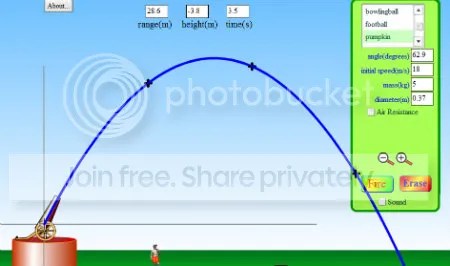
Have fun tossing Buicks across the sky.
Think about the number of kids who never get to experience these great math models, because we beat them with a stick with pages of FOIL and factoring worksheets, before they ever get to see a parabola.
So, what of factoring? Let’s say I wanted to re-write the following function in factored form:
=3x^{3}-13x+14 "f(x)=3x^{3}-13x+14")
Is it wrong to have students graph the function and look for intercepts?

If we have an intercept at x = 2, then we know that (x-2) must be a factor. From there, we can piece our way to the second factor of (3x-7). Is it “wrong” to teach students to look at polynomials this way? I suspect many would call it blasphemous, but somehow I know that my kids know more about the inter-connectedness of functions, intercepts, and polynomials than theirs.
I want my students to utilize and switch between multiple representations of all families of functions: equation, table, graph, context. Unfortunately, most textbook ensure that these topics will continue to be taught in a linear fashion.
Let’s take that old objective of “factor polynomials” and change it to “develop and understand quadratic models for natural phenomena”
And if the reason we teach anything in math is because “they’ll need it for their next class”, then we are doing math wrong.


 mathcoachblog