Categories
Algebra Technology

Channeling Creativity in Algebra 2

UPDATE – I recently posted more info about this project, with a rubric and more examples, at this post.

One of my favorite math projects takes place during our unit on conic sections in Algebra II.  In the project, students are challenged to manipulate equations of conics and graph them using software to make pictures.  I started with this project 12 years ago when a colleague, who has since retired, introduced me to his ideas.  Back then, we used a DOS program which could only graph in black, cyan and magenta.  We were happy if we saw a tree made from a hyperbola and a parabola leaf line.

The project grew new wings with a program called Math Toolkit, which allowed for finer graphing and the ability to save work.  Later, we started using Print Screen to grab the graphs and move them into MS Paint.  The projects grew more intricate, and many kids took off with their creativity.

This year, the Desmos online calculator brought the project to a new level.  Students this year could work on their equations at home, save work, and work with their teacher during time allotted in class.  Thanks to Kevin for working with his class to share their creations.

First up is Kristin.  Her project moves from Desmos to Paint.  Then un-needed pieces are removed, and the final product emerges.

Conic 1

Conic 2

Conic 3

Next up is Matt.  Here are his graphs after the axes and grid were removed….

Conic 4

Any ideas what the finished product will be?

Did you guess yet?

OK, so you just want to see it…ok….

Conic 5

What I love most about this project is when students discover how the conics behave, and experiment with them without fear.  In the next example, Connor wanted to tilt his ellipses and researched on his own how to make that work using trig functions (did I mention that these kids haven’t had trig yet?).

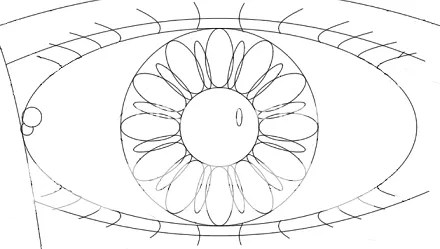
Connor1

Connor 2

Connor 3

In some years, I have had students peer-assess their work by creating an art gallery of their work.  Giving each student 5 star stickers, I had students select their favorites.  Contact me if you would like any of the instructions or rubrics I have used for this project in the past.  Thanks again to Kevin and his Algebra II class!

Categories
Algebra Middle School

Letting Go in Algebra Class

A problem from the May, 2012 issue of Mathematics Teacher by Jennifer Kaplan and Samuel Otten outlines a Max/Min problem from calculus which presents a scenario accessible to Algebra 1 and Pre-Algebra students.  In the problem, a dog chases a ball thrown from the beach into the ocean, as shown in the picture.

Beach problem

The challenge is to minimize the amount of time it will take the dog to travel from “me” to the “ball”, if he can run 4 meters per second on the beach, and travel 1 meter per second in the water.

In the past few months, I have been looking for interesting problems to try with different levels of classes, and have made observations about how students approach non-routine problems.  Today, I worked with an 8th grade Honors Algebra 1 class.  It was a nice day, so we gave kids the chance to move outside, work in groups, and take 40 minutes to work on their ideas.  While some groups preferred to work with pencil and paper, others took immediately to the chalk we provided to begin sketching their ideas.

Algebra Chalk

The teams have until next week to develop a solution to present to class.  Many groups after the allotted time seemed to have a process for working towards a solution.  But while I was happy with the persistence the class showed in working through the problem, only one group considered using a variable during their discussion, and that one group only considered x as a distance the dog needs to travel on the beach, and did not pursue it further.  The general procedure so far has been to collect data, make a table, or narrow down by guessing and checking.  So, here are my questions:

  • Should I worry that so few students can apply the algebra they have learned?
  • How can I coax groups to utilize some algebra, without being overly helpful?
  • Should math teachers always feel compelled to demonstrate the “right way”?  Is a non-algebraic solution less valid than an algebraic one?

The traditional math teacher in me can’t wait to jump in and walk students through “my” way to solve it.  But the facilitator in me was thrilled and impressed by the rich discussions taking place today.  It’s hard to let go of old ways of doing things.

Next week, students will produce 60-second videos where they will present their solutions.  Looking forward to the variety of arguments we will certainly see.  Also hoping to work on this problem with our non-honors and academic students.

Categories
Algebra Statistics

What’s the Probability That Quadratic Will Factor?

A comment from my post last week about the need for factoring led me to re-visit a question I have posed to classes before, but never allowed to move beyond the “gee, that’s interesting” stage.

Given a polynomial in standard form, with random non-zero* integer parameters a, b and c, what is the probability that the polynomial will factor?

I’ve pursued this question with classes before by writing a polynomial on the board, with blanks or boxes in the a-b-c positions.  Sometimes, I would take “random” shout-outs from the class to fill in the boxes.  With another class, the randint function on a TI calculator was used to generate our abc’s.  The point was to demonstrate that a large majority of quadratics are not factorable, and that despite the nice, rigged, problems we encounter in textbooks, we should spend far more time considering what to do with the messy ones.  But I’d never put pencil to paper and thought about the theoretical probability.

After my post on factoring last week, Jim Doherty mentioned a speaker he had encountered find an experimental probability that a quadratic would factor, and cited 7%.  That number seemed reasonable to me, but perhaps a bit on the high side.  I set up an Excel document to generate three non-zero integers (more on this later), and rigged a system to check for perfect-square discriminants.  I recorded experimental results, in groups of 1000 trials, and kept a running total.

Excel document

Quadratic Graph

After 25,000 trials, I found that 7.26% of the quadratics would factor.

*While this endeavor started off innocently and quickly enough, I had to start over after I realized my Excel document allowed for zeroes.  It took a little logical Excel rigging to exclude them.

So, there must be a theoretical probability out there someplace?  Anyone know how to do it?