In most Algebra 1 courses, the topic of Absolute Value inequalities comes at the end of a longer unit on inequalities. We shade our number lines, attend to our open or closed circles, and start to hit the wall a bit with the routine. So, as we begin to think about introducing absolute values, let’s get our students up and moving. Here’s how:
THE HUMAN NUMBER LINE
Print out or scribble out cards with the integers -12 to +12, or use my handy integer card set. This will give 25 cards, and you can adjust the cards based on the size of your class. Give each student, except 1, an integer card. The student who does not get a card will act as the observer during the activity, and will verify the class’ actions.
In a hallway, or outside on a nice day, have students sit in order from lowest to highest. The students are making a human number line. It is important that their card be clearly visible at all times. The class observer should verify that all students are seated in order, with somewhat equal space between them.
THE ACTIVITY
With students seated, the teacher holds up an inequality. Any student holding an integer which is a solution to the inequality will stand, thus making a human solution set. The job of the observer is to verify the correctness of his class-mates solution. My inequality cards file starts with two warm-up problems, to make sure the instructions are understood, before we start to head into the absolute value inequalities.

One of my colleagues used this activity with his class recently, having students step forward if they were a solution. He also added a twist I hadn’t thought of: having students hold their hands over their head to make an “open circle”, if they were a boundary number.

As the class builds the solution sets for the absolute value inequalities, have the observer describe the graph. What do greater-than problems “look” like? How about less-than problems? What sorts of problems tend to veer off (to infinity) in both directions? What sorts of problems are bounded? Here are some other teaching tips and ideas for this activity:
- Have students trade cards, or totally re-mix after 2 problems. If you don’t, the students with “end” cards can simply follow the crowd.
- This is a great time to find a class leader to be observer, or uncover a hidden talent of a shy student. Keep those cards visible. Give them the responsibility to keep things orderly.
- If you have room, take pictures of the human number lines, and use them later as a review, or to keep around the class to build the team spirit.
- Using this activity a lot, or with many classes? I always thought it would be neat to have integer shirts for this, and to use through the year.

BACK TO CLASS
After we have developed some ideas about absolute value inequalities and their solution sets, it’s time to start formalizing our thoughts. If you need more hands-on practice, click on the graph link below to try a Desmos demonstration with sliders.
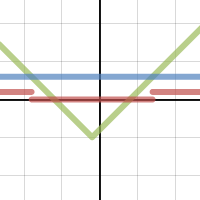
Compare the absolute value function (in blue), to the constant function (in green). The comparison (in red) allows us to look at make greater/less-comparisons.
Let me hear about your Human Number Line experiences!
 mathcoachblog