Categories
Algebra Geometry Middle School Technology

Doing the Translation Dance

Last month, I wrote about my talk on Encouraging Perseverance in Math Class, given at the Fall, 2012 ATMOPAV conference.  But earlier that same day, I had the opportunity to hear Scott Steketee‘s thoughts on functions: “Function Dances: Using Transformations to Make Variables Vary and Functions Behave”.
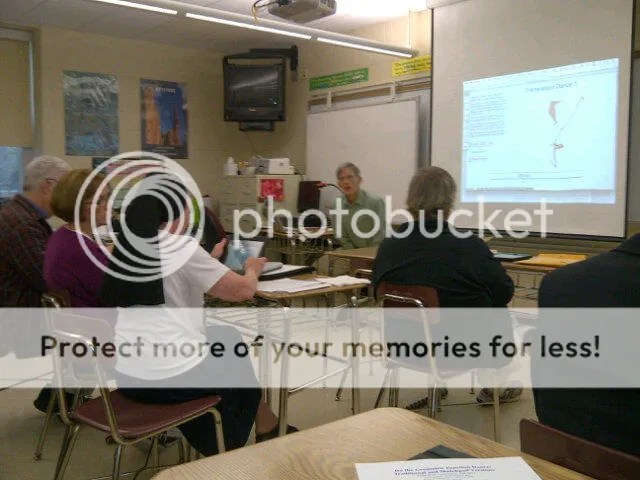
Steketee

I have found that the approach many teachers take to functions is one of notation only.  That by simply introducing the f(x) and g(x) symbols, and “covering” domain and range, algebraic functions will be understood.  Scott’s presentation provided ideas for introducing the concept of  function, without all of the scary symbols, through dynamic Sketchpad files.  The group worked through a number of progressively intricate functional relationships on iPads.  In this first example, students can grab points and look for relationships.  Some points will not move when dragged, as they are “dependent” upon other points’ movements.    Also, the dependencies vary, from simple linear relationships, to a few which require dilations or reflections.

iPad1

Later, we were introduced to the Sketchpad “Translations Dances”.  As one point (below, the point on the green outline) travels about its “domain”, we are challenged to trace the “range” of the translated point p.  These start off innocently enough, but become more diabolical as the translations begin to include reflections and rotations.

iPad2

These were addictive and appropriate uses for the iPad, and I was able to easily load the files into iPad’s Sketch Explorer through my DropBox account.

The second half of Scott’s talk was more kinesthetic, social, and potentially embarrassing, as the group split into partnerships to choreograph dances based on transformations.  My partner acted as the independent variable, and I (the dependent variable) followed her actions, using lines in the floor to act as  axis of reflection.  This would be a fun way to expose kids to functional ideas, but I made sure that no photographic evidence of my dancing ability exists!

What I appreciated most about Scott’s sketches and dances is that they allow teachers to develop functional ideas without having to wade through all of the complex language.  Through play and exploration, students can summarize their observations, and begin to characterize the relationships.  As students begin to understand the relationships between variables, we then can discuss the need to have special notation to express them.  Finally, dilations and reflections, which are often over-looked in our curriculum, become the stars of the show through fun (and addicting) Sketchpad games.  My screen grabs here certainly don’t do Scott’s files justice, so download them, play around, and enjoy the dances!

Categories
Algebra

Look Through the Eyes of Your Students

Here in Pennsylvania, many high schools are gearing up for the upcoming Keystone Exam in Algebra 1.  In this first year of Keystones, the Algebra 1 exam is being given not only to students as they complete Algebra 1, but also to 10th and 11th graders who have passed the course in the past.  The state has provided a number of sample items, which we have been using in math classes to help our students prepare.

A discussion of one of these released items not only revealed a common algebra misconception, but also generated thoughts of how teachers may see problems differently that their students.  Here is the question:

Problem

So, how could teachers and students view this problem differently?

HOW I SEE THIS PROBLEM:

Teacher Problem

My teacher eyes tell me immediately that this is a factoring problem.  I’m not sure how it is going to factor yet, but I am pretty confident that the answer will be C or D.  Choices A and B are not really even up for debate here.

My radar perked up when a colleague shared that a handful of students in one of her classes chose B.  B???  How the heck did they get B????

HOW SOME STUDENTS SEE THIS PROBLEM

Problem Student

My old nemesis….cancelling across addition and subtraction signs, how nice to see you again!

So, while I immediately see the problem as two expressions which will separately require factoring, I need to remember that students don’t always view problems the same way.  Being able to identify, discuss, and personalize these common errors are all part of the wonderful art of teaching.

And while illegal cancelling will be a struggle for students long after I retire, I often use the exercise below to generate discussion.

HOW TO TURN $100 INTO $199 (LEGALLY?)

Cancelling

So, either I have made a math error here, or I have a great method for generating some side income here (and why am I sharing it with you, anyway???).

Categories
Algebra

How to “Break” Your Graphing Calculator

A conversation with a colleague on function operations reminded me of one of my favorite “Oh Wow!” moments from math class.

You’ll need a TI-83 or 84.  This is a case where the Nspires are too nice for our use.

Enter functions as shown below.  We are interested in the rational function which comes from dividing the two previous functions:

Screen1

Since the denominator is a factor of the numerator, we can simplify the expression, resulting in a linear function when we graph.  But what about x=-3?  What happens there?  Let’s explore a bit:

Screen 2

Zoom in even more….doesn’t seem all that interesting…..

Screen4

Pretty boring.  But tell your students to keep zooming.  And then….

….wait for it……

…whoa!!!!!!….

Screen 5

Zoom in even more….

Screen 6

This is a nice reminder that, while we may simplify a function, we are still looking at a quotient and need to consider the parent functions used in the division.  And the “noise” we get here is a result of the algorithms TI calculators utilize to plot the points.  Actually, if somebody has a better explanation for the noise, I’d love to hear it.  Some “new” calculators will now show the hole in this function, like my new man-crush, the Desmos calculator:

Hole

But the noise is more fun.