Categories
Algebra Class Openers

Class Opener – Day 67 – Verifying Inverse Functions

We’re finishing up our unit on function operations.  Yesterday we developed the definition of inverse functions (using only linear functions) and graphed to demonstrate the symmetry. Time to see what we have learned:

functions

Many students’ instincts let them down on the first pair, believing them to be inverses. But after my prodding that they somehow verify the inverse relationship, we soon verified that f(g(x)) did not produce the result we desired.   The second example was then complete easily.

But what about that third problem?  They sure seem like inverses.  One student offered his proof for the pair:

They are inverses just because I know.

Sometimes ideas in math are just that obvious, and maybe we don’t need to prove them specifically.

On the board, we “proved” that both f(g(x)) and g(f(x)) both seem to simplify as x.  And a few numerical examples help show this:

  • f(g(5)) = 5
  • g(f(10)) = 10
  • g(f( -6 )) = 6……. ruh roh……

Students in my class have not been exposed to a formal definition of the square root function, and this led to a nice discussion of absolute value, and the need to restrict the domain in order to consider inverses. Planting seeds for algebra 2, which many of my students will take next semester, is always a bonus.
Categories
Algebra Class Openers

Class Opener – Day 65 – Kohl’s Coupons

After a weekend away from composite functions, today’s opener was designed to bring functions back into discussion, disguised as an innocent-looking shopping problem:

It’s the day of the big department store sale, and you have two coupons you have clipped from the newspaper.  One coupon takes $10 off the price of any item, while the other takes 30% off the price.  In what order should these discounts be taken for you to realize the maximum savings?

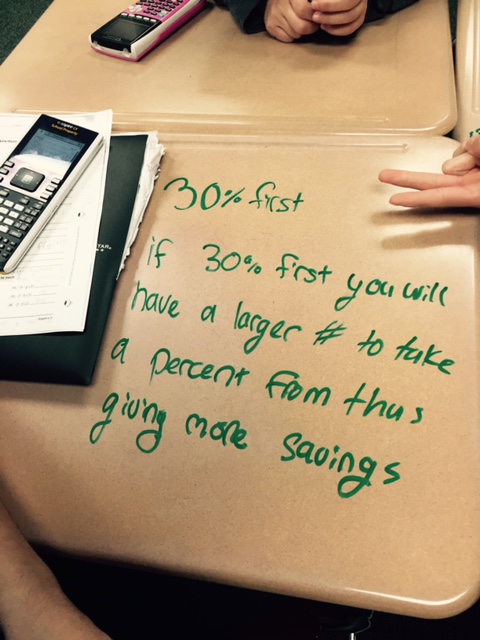
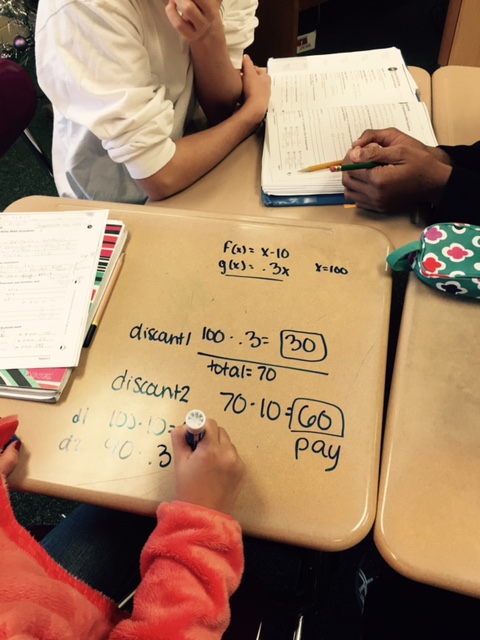
After a few minutes of table talk, just about all groups agreed that taking the 30% off first would seem an optimal strategy.  But when asked to provide justification, groups took much different paths.

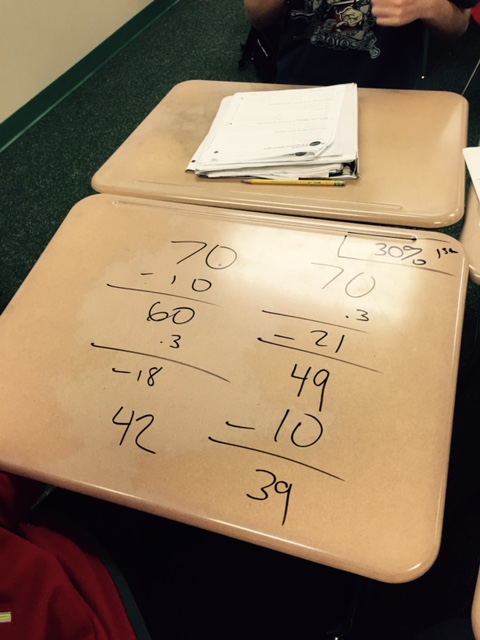
Some felt choosing a dollar value would provide adequete justification:

trial trial2

How many values are needed to convince ourselves that this strategy is optimal? Is it possible that one strategy is best for some prices, while the other is best for others?

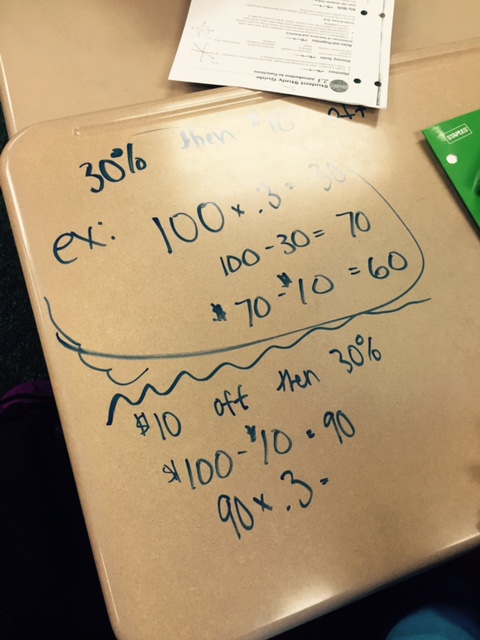
Another group shared the “I know I am right…just because” method

explain

Not very elegant…nor very convincing. But a ray of sunshine appears from the other side of the room, as a group considers defining functions to represent the discounts….but stops just short of pursuing them as a proof.

functions

The eventual “proof” done via composite functions shows that not only is one method superior – it will always be superior by 3 dollars. Add in a domain restriction that our starting value must be at least 10 dollars, and we have successfully reviewed all of our scary function vocabulary.

Categories
Algebra Class Openers

Class Opener – Day 63 – Function Addition

Not all of the class openers go off as intended.  I suppose if they did, and I had a magic formula for engagement, then I’d be living on a dessert island by now with the money I’d made off bottling the secret.

After a short quiz today, a lecture/exploration on operations on functions would begin. It’s not the most exciting lesson of the year, but there are some “ooh” and “aah” moments as students experience new functions.  Domain and range also frame the discussion – and we finally move beyond “all real numbers”.

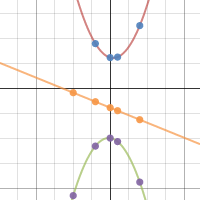
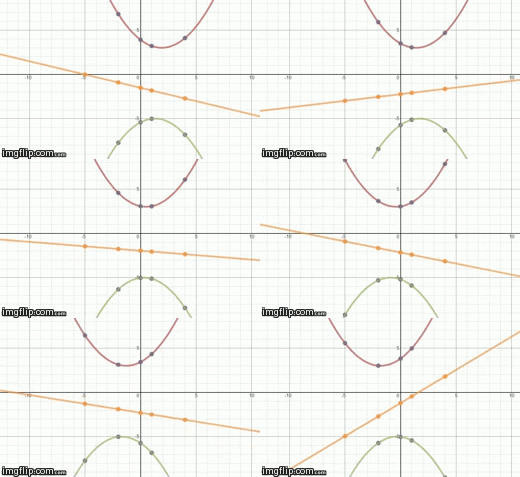
Even though we were starting with a quiz, I wanted a visual to get students thinking about function behavior, and start to make some conjectures about addition and subtraction of functions. The Desmos graph here was animated and rolling as students entered.

Click the graph to play on your own, and the animated gif below gives you a flavor the the motion.

evxel

After the quiz, I hoped to generate discussion regarding the graph.  What did the students notice? Any interesting patterns?  How are the graphs related? Can we gain some insight by looking at a table of values?

functions

I was hoping students would eventually notice that the ornage function was the sum of the green and red, or at least note the “betweenness” of it all. But with the rush to get notes and discussion started, this opener ended up on the back burner.  They’re not all winners….. All is not lost, though, as I’ll come back to this one tomorrow to build some connections between our notes and the homework.