Categories
Class Openers

Class Opener – Day 13 – Serenity Now!

Is Mr. Lochel asleep?

Today is the first major test for my freshman classes, and for all of them it is their first big test as high schoolers. And after a Back-to-School Night the evening before where I discussed some study strategies for the 9th graders, it’s a pretty stressful day for the young ones.

As students entered I heard the usual cacophony of frenzied papers being shuffled and concept cramming. It’s just too much noise and too much distraction before a test. Time to change the culture some with a video:

5 minutes of restful waves and ocean breezes to clear the mind. But it took a few minutes to take hold. At the start, as I sat in the front, eyes closed, silently contemplating the day, most students continued their frenzied studying. But eventually a few joined in, resting their heads, shushing each other, and taking advantage of a few moments away from math.

I’m hoping that today’s test will mark improvement for a number of my struggling students. I find that students coming from middle school often suffer from a similar mindset when it comes to taking math assessments: every problem must be done rigidly, teachers grade with an eye for missign nuance (arrows at the ends of lines, that sort of thing), papers are returned and go into a folder, and we move on.

This cycle isn’t good enough if we want students to reflect on their progress and grow.  The usual test study formula, where students shuffle through notes and seek more practice problems, isn’t sufficient. And while it is difficult to cause students to completely change study habits, I provided some tips for students as they progressed through the unit:

  • Every time you encounter a sticky classroom or homework problem, place a star next to it. In the days leading up to a test, redo these problems. Have the concepts had time to marinate? Are you now able to complete these problems with less difficulty?
  • Reflecting upon past classroom quizzes is essential. This year, my students are required to re-do all missed quiz items (excluding minor errors) as homework and attach them to their original quiz. I’m happy that a handful of students visited to discuss their corrections, while many more re-visited their previous math sins.
  • Deep breaths and long pauses matter. Undo obsession over that one test question, the one you have been working on for 20 minutes, is probably not healthy. Think about the warm ocean breezes, move on to items you CAN do well, and remain upbeat.
Categories
Class Openers

Class Opener – Day 12 – How Big is Big?

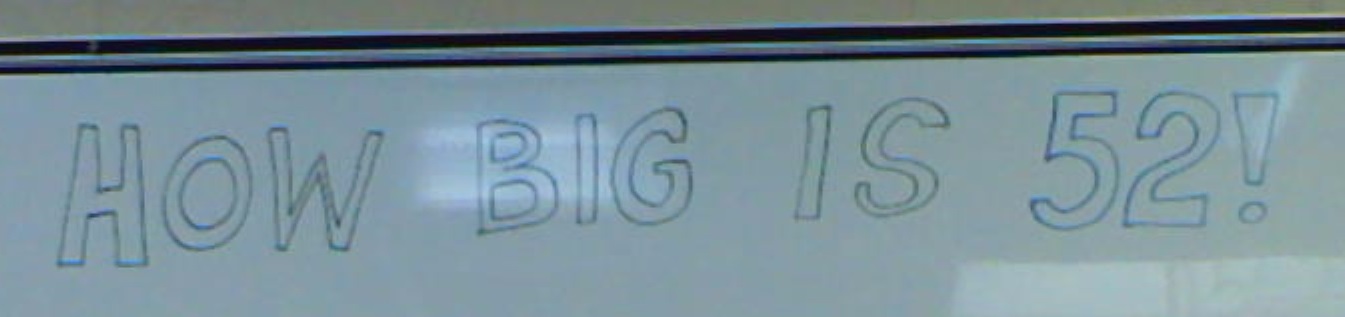
We’re coming to the end of our first unit of the year on basic probability, and headed towards the fun world of counting principles, including permutations, combinations and the binomial theorem.  To review ideas regaring factorial and size, students were faced with the following question on the board:

2014-09-17_0005

Many students ignored the exclamation point right off the bat, giving replies like “it’s a little bigger than 51”, or “pretty big”, until a student realized that I clearly meant factorial here.  This genrated classroom discussion about what factorial meant, and some side discussion about how big a number this could be, including some calculator experimentation. We’re off to a good start!

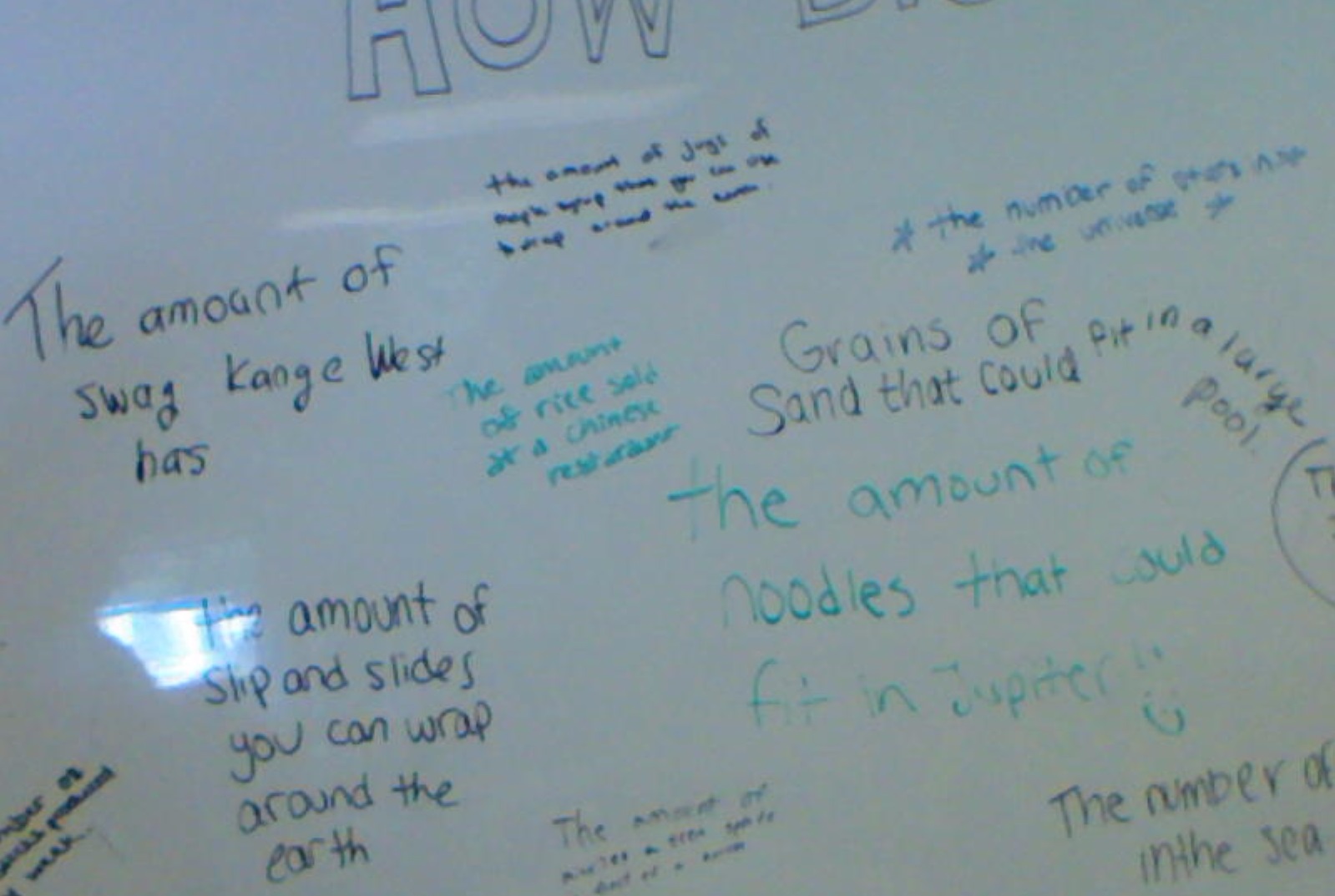
But just HOW big is this number?  To get students thinking, I asked them to consider what a quantity that big could represent, being as creative (within reason) as they like. Some of the responses were awesome fun.  Did you know Kanye had THAT much swag?

2014-09-17_0011 2014-09-17_0010

To finish this opener, I played one of my favorite clips: from the British panel show QI, Steven Fry uses a simple deck of cards to do something never before done by man! I’ve dicsussed this clip on the blog in the past, so visit there for more info regarding this card shuffling experiment.  Enjoy.

Categories
Class Openers

Class Opener – Day 11 – the Sequence that Pays!

Here’s the picture which greeted students as they enetered today:

Mersenne

Those are all odd numbers.

Why are they purple?

What’s with the dollar signs?

They are prime numbers.

Are they all prime? How can we tell? Many students remembered the “trick” for determining if a number is a multiple of 3, but how do we check 8191?  Maybe 13 or 17 goes into it, or some other funky prime.

But once we establish they are prime, what’s special about THESE primes. I let this sequence marinate for a bit as I continued instruction, and eventually offered a hint.

Add 1 to each number in the sequence.

This led to a clear observation in one class, and one I didn’t expect in another:

They are powers of 2

They are numbers from the 2048 game

So true! But what is special about these powers of 2, and why did I exclude others?


MersenneThe big reveal here is that the numbers shown at the start are Mersenne Primes: primes of the form shown on the right, where P is also prime.  And the Great Internet Mersenne Prime Search provides an opportunity for the amateur mathematician to participate in a quest to find bigger and bigger Mersenne Primes, and perhaps score a cash prize for your effort! Visit the GIMPS site for more information about the search, and the current status of the project, where the largest prime found boast over 17 million digits. While many in the class wondered why anyone would care about such primes (we will discuss codebreaking later our course when dealing with Matrices), others seemed intrigued by the pattern. And as we begin to discuss counting priniciples and large numbers tomorrow, this was a neat way to foreshadow.  Finally, I want to live someplace which values math so much that they put math on their postage, that would be cool….

Postage 1

Postage 2