The unit on experimental design is one of my favorites in the AP Stats year, but the structure of a matched pairs experiment – where every subject participates in both treatments – often confuses students. For the past few years, I have been introducing students to matched pairs design through a sport which is sweeping America…
HALLWAY BOCCE!
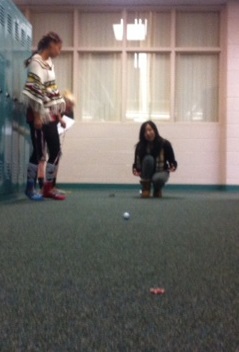 In hallway bocce, students place two poker chips 5 meters apart in the hallway. Then, standing behind one of the chips, they roll a golf ball towards the opposite chip, trying to get as close as possible. With our carpeted hallways, the golf balls really take off, so some practice is needed to get the right touch. During this practice session, the students don’t know where this is all heading in terms of experimental design.
Next, the students are given a direction sheet for recording results. Each “stat-lete” is asked to play bocce 4 times, twice with their right hand, twice with their left, alternating hands. A coin is used to determine which hand to start with. Partners then measure their attempts and record results. Note that today was “fashion disaster” day as part of our school’s spirit week.

Back in class, we then think about what could be conjectured before this experiment. Sure, we could compare the attempts by right hands and by left hands, but what does this tell us? We then settled on looking at players’ dominant versus their non-dominant hands, and made a dotplot of the results (note – my pre-made scale really was not sufficient here…those golf balls really fly!)

But this only allows us to compare hands in general. What we’d like to be able to do is determine if players are better with their dominant, rather than their non-dominant, hands. Subtracting these results, since all players participated in both treatments, allows for this comparison.
 In the end, those reasults seem quite inconclusive, but that’s okay! Not all experiments prove conjectures, and we learn about the process.



 mathcoachblog