My school isn’t 1-1 with technology yet, though there are rumblings we will get there next year….or the year after….or 2031…anyway, it’s time to get techy! My new classroom features 4 computer stations in the back – nice to have, but not super-helpful with classes of about 24 each. Station-model classroom structure has been super-helpful in my pre-calculus class in the first month. Besides the chance for all students to participate in rich technology-based activities, I’ve had the opportunity to carve out valuable small-group time with students. Here’s an example:
In our first pre-calc unit, we review functions and their shirts, folding in new ideas like the step function, piecewise and even/odd functions. My objective for the class was for students to consider functions in varied forms. As students entered class, playing cards were drawn to establish their groupings, so there were 3 groups of 7 or 8. With 15 minutes on the classroom clock, students started on their first station:
- Group 1 gathered in a small group with me in a circle of desks, where we worked through proving functions even or odd, and sketching their graphs.
 Group 2 worked at the computer stations on a Desmos Marbleslides featuring quadratic functions, with many students pairing up to work together. If you have never tried a Marbleslides, run and play now – we’ll wait for you to come back…
- Group 3 worked out in the courtyard (hey, my new classroom leads outside – which is nice) on a group task involving a piecewise function.
After groups had rotated through all 3 activities, we had time to recap / share and assess our learning over the hour. Here’s why I need to do this more:
- The small group station let me touch base with every student, assess strengths, find out what we need to work on, and provide feedback to everyone.
- Marbleslides is sneaky awesome! When students begin to obsess over function shifts and how to restrict domains and don’t want to peel away from their computer, you know something is going right.
- Class went fast! It felt like the mixed practice from Let It Stick was now becoming part of my classroom culture.
- My pre-calc is mostly 11th and 12th graders, who have had a pretty traditional classroom experience in their math lives. I can sense they appreciate that something difference is happening.
- All students are responsible for their learning. Even the least-active task, the piecewise function, was used the next class for sharing out and a jumping-off point.
 In the activity, students first consider seats in a theater, which leads to a review of linear function ideas. Vocabulary for arithmetic sequences is introduced, followed by a formal function for finding terms in a sequence. It’s this last piece, moving to a general rule, which worried me the most. Was this too fast? Was I beating kids over the head with a formula they weren’t ready for? Would the notation scare them off?
 The path – having students move from a context, to prediction, to generalization, to application – was navigated cleanly by most of my students. The important role of the common difference in building equations was evident in the conversations, and many were able to complete my final application challenge. The next day, students were able to quickly generate functions which represent arithmetic sequences, and with less notational confusion than the past. It certainly wasn’t all a smooth ride, but the improvement, and lack of tooth-pulling, made this a vast improvement over my previous delivery.
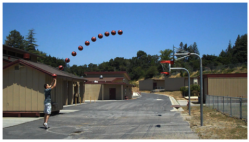 Dan Meyer’s “Did It Hit the Hoop” 3-act Activity probably sits on the Mount Rushmore of math goodness, and Dan’s recent share of an Activity Builder makes it all the more easy to engage your classes with this premise. In class, we are working through polynomial operations, with factoring looming large on the horizon. My 9th graders have little experience with anything non-linear, so this seemed a perfect time to toss them into the deep end of the pool. The students worked in partnerships, and kept track of their shot predictions with dry-erase markers on their desks. Conversations regarding parabola behavior were abundant, and I kept mental notes to work their ideas into our formal conversations the next day. What I appreciate most about this activity is that students explore quadratic functions, but don’t need to know a lick about them to have fun with it – nor do we scare them off by demanding high-level language or intimidating equations right away.


 mathcoachblog