Categories
Algebra

It Took Me 2 Years to Get This Approach to Imaginary Numbers

This past week the NCTM annual conference was held in Boston, and what an enriching epxerience! What made it so special this time around was meeting and hearing from my PLC of Twitter friends, many of whom I had admired from afar for some time. I’ll discuss the power of the MTBoS (Math-Twitter-Blog O’Spehere) in a later post.  Today I want to focus on a powerful session I attended in Boston, and how a new persepective developed – even after a 2 year delay.

The story starts 2 years ago at Twitter Math Camp in Philadelphia.  At that conference, I participated in an Algebra 2 small group, facilitated by the super-creative Max Ray, from the Math Forum. Splitting into smaller groups, I worked with a team to think about rational expressions – a unit which is often dry as sand in Alg 2 courses, and where I thought we could make some head-way. While we worked on our slightly-less dry, yet safe lessons, Max and a small group were discussing complex numbers on the board. There were mysterious circles, transformations, and discussions I didn’t understand.  I suppose I was taught about complex numbers the “traditional” way – we need them to solve certain quadratics and memrize some wierd rules about their behavior. We perform strange operations on them, and we definitely don’t ask why. I suppose I could have simply wandered over to the group and found out more, but the mathematical intimidation factor was high – I’m sometimes too proud to admit what I don’t know.

Fast forward 2 years, and I see Max is presenting a session with Michael Pershan. This is a must-attend. Two engaging speakers whom I appreciate for their ability to use students’ natural curiosity to facilitate math conversations.

Here’s the set-up: Michael finds a handful of volunteers to stand at the front of the room, standing on a hypothetical number line (Max stands at zero). The participants are then asked to consider the following transformations to their value, and move accordingly, returning after each move to their original position.

  • Add 2 to your value – participants all move to the right 2 spaces.
  • Multiply your value by 3 – participants all move to the left or right accordingly, depending on whether their original value is positive or negative.
  • Multiply your value by -1. OK, now the plot thickens.  While we can find our new position, Michael does a materful job in having participatins reflect upon the transformation. The first two moves required left and right shifts; here we need to consider a rotation about the origin. This rotation provides a rule for multiplication by a negative.

Photo Apr 16, 12 36 08 PM

The table has been set, the silverware polished. and now we need some new volunteers. We have a new number line, and some new transformations to think about.  BUT this time around we want to complete our movement by using the same transformation twice.  Let’s roll!

  • First, add 4 by using the same transformation twice.  This is a nice appetizer – let’s move 2, then 2 more.
  • Next, multiply by 9. This is a little trickier, as some folks almost crashed into the next presentation room. But two multiply by 3 moves do the job.
  • Now, multiply by 5. Oooh….we have an entry point into radicals. Some quick discussion, and we two moves – multiplying by a little mroe than 2 each time.
  • Finally, multiply by -1…in two moves…..

WAIT!  This is the stuff Max was talking about 2 years ago that I didn’t get.  The bulbs have gone off.  I GET this now!  We do a 180 degree rotation do perform a multiplication by -1, so now we need two 90 degree rotations.  And now we have an entry point into imaginary numbers, without the scary-sounding term.

What I appreciate most here is that we don’t need to wait until deep into algebra 2 to think about the imaginary unit.  These concepts are accessible to younger students, and we have a responsibility to achieve some conceptual buy-in before just thrusting abstract ideas in front of our students. You can find Michael and Max’s shared files here on their Teaching Complex Numbers page.

I get it now…I think….and I’m not ashamed to say it took me 2 years.

UPDATE: You need to immediately run to check out the fun summary Ashli has provided of this session. Her notebook sketches are unreal (in the non-numbr sense)!

Categories
Statistics

Statistics Arts and Crafts

The Chi-Squared chapter in AP Statistics provides a welcome diversion from the means and proportions tests which dominate hypothesis test conversations. After a few tweets last week about a clay die activity I use, there were many requests for this post – and I don’t like to disappoint my stats friends! I first heard of this activity from Beth Benzing, who is part of our local PASTA (Philly Area Stats Teachers) group, and who shares her many professional development sessions on her school website. I’ve added a few wrinkles, but the concept is all Beth’s.

ACTIVITY SUMMARY: students make their own clay dice, then roll their dice to assess the “fairness” of the die. The chi-squared statistic is introduced and used to assess fairness.

clayYou’ll need to go out to your local arts and crafts store and buy a tub of air-dry clay. The day before this activity, my students took their two-sample hypothesis tests.  As they completed the test, I gave each a hunk of clay and instructions to make a die – reminding them that opposite sides of a die sum to 7. Completed dice are placed on index cards with the students names and left to dry. Overnight is sufficient drying time for nice, solid dice, and the die farm was shared in a tweet, which led to some stats jealousy:

The next day, students were handed this Clay Dice worksheet to record data in our die rolling experiment.

In part 1, students rolled their die 60 times (ideal for computing expected counts), recorded their rolls and computed the chi-squared statistic by hand / formula. This was our first experience with this new statistic, and it was easy to see how larger deviations from the expected cause this statistic to grow, and also the property that chi-squared must always be postivie (or, in rare instances, zero).

Students then contributed their chi-squared statistic to a class graph. I keep bingo daubers around my classroom to make these quick graphs. After all students shared their point, I asked students to think about how much evidence would cause one to think a die was NOT fair – just how big does that chi-squared number need to be? I was thrilled that students volunteered numbers like 11,12,13….they have generated a “feel” for significance. With 5 degrees of freedom, the critical value is 11.07, which I did not share on the graph here until afterwards.

FullSizeRender

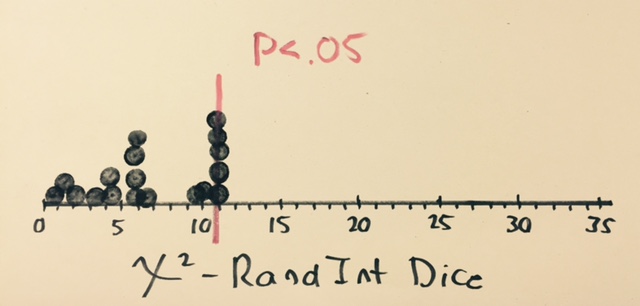
In part 2, I wanted students to experience the same statistic through a truly “random” die. Using the RandInt feature on our calculators, students generated 60 random rolls, computed the chi-squared statistic, and shared their findings on a new dotplot.  The results were striking:

FullSizeRender - 3

In stats, variability is everywhere, and activities don’t often provide the results we hope will occur. This is one of those rare occasions where things fell nicely into place. None of the RandInt dice exceeded the critical value, and we had a number of clay dice which clearly need to go back to the die factory.

Categories
Uncategorized

Introducing Discovery Hour with Codebreaking

Our school has been on a semester block schedule for over 20 years, with some tweaks made to accomodate building size, AP courses and electives. But this year brought a major schedule change, and an opportunity to think about how we use time to engage students. After periods 1 and 2 (each 75 minutes), all students move into something called HATS period. The acronym stands for Hatters Achieving Targeted Success, and during the period students have a lunch period, along with assigned time with teachers. It’s a great mid-day block for students to touch base with activities and clubs, seek help, make up work, and our RTII team has utilized the time to meet formally with students and facilitate individual help sessions.

I saw an opportunity to engage students in meaningful activities during this time, and have started Hatters Discovery Hour – modeled after the Genius Hour concept many elementary and middle schools offer. My thought is that so many of our teachers have awesome ideas to share which don’t quite fit class time. Also, it’s an opportunity for students to experience teachers they may not cross paths with during their high school career. Let’s build more connections!

The past 2 months have seen some fascinating offerings.  Our No Place for Hate Team has used Discovery Hour to facilitate open discussions on race relations.  Meanwhile, a science teacher shared his experiences working as an EMT in a medical diagnosis session. Juggling was the fun focus of one session, and Discovery Hours on memory systems, photography and meditation are in the works.

THE REAL IMITATION GAME – CRYPTOGRAPHY

For my Discovery Hour session, I shared many of my collected activities on codebreaking. With Oscar season just passed and some simmering interest in the Imitation Game, it was a perfect time to talk about the role of codebreaking through history. Even better, my principal and district curriculum director (and my former boss) were on hand to join in the fun:

I was ambitious, trying to fit 4 codebreaking challenges into the hour. In the end, we had just enough time to keep things moving and hold some fun discussions in these 4 areas. Scroll below to download the handouts.

CRYPTOGRAMS – We started with a basic letter-to-letter cipher. I used a long quote from Bill Gates, which almost turned out to be too long – as I felt a time crunch hitting early. But longer quotes allow more entry points, and I couldn’t pull my principla away from the challenge!

CAESAR SHIFTS – Here we used an online applet to explore shifts, and this provided an entry point for modular arithmetic, which few of the students had encountered before.

HILL CIPHER – By now we had established that the first two coding procedures did not seem too secure. I have shared Hill Cipher with students in my classes before during matrix units, and again a cryptography website was helpful in providing some easy codebreaking trials. When I have done these in class, I often develop problems which get around the modular arithmetic issue (it takes longer to discuss than I often have time for) but we were able to squeeze in a 5-minute mod primer.  See below for other Hill Cipher problems I have used.

THE ENIGMA – The cherry on the sundae, and where many students were stunned by the complexity. This online Enigma simulator is one of my favorites – I love the visual of the wiring. So many good questions concerning inverses, how codebooks were traded and how the British broke the code. I left enough time to show Numberphile’s Enigma video, which capped off the hour nicely.

Looking forward to sharing more of what I know in later Discovery Hour sessions, and thrilled so many of my colleagues are buying into the idea.

View this document on Scribd