Categories
Class Openers Statistics

Class Opener – Day 54 – Matched-Pairs in AP Stats

The unit on experimental design is one of my favorites in the AP Stats year, but the structure of a matched pairs experiment – where every subject participates in both treatments – often confuses students. For the past few years, I have been introducing students to matched pairs design through a sport which is sweeping America…

HALLWAY BOCCE!
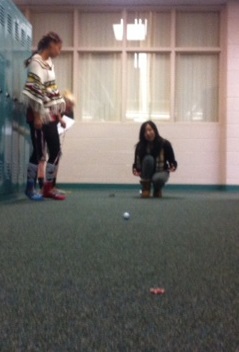
bocce2In hallway bocce, students place two poker chips 5 meters apart in the hallway. Then, standing behind one of the chips, they roll a golf ball towards the opposite chip, trying to get as close as possible. With our carpeted hallways, the golf balls really take off, so some practice is needed to get the right touch. During this practice session, the students don’t know where this is all heading in terms of experimental design.

Next, the students are given a direction sheet for recording results. Each “stat-lete” is asked to play bocce 4 times, twice with their right hand, twice with their left, alternating hands. A coin is used to determine which hand to start with. Partners then measure their attempts and record results.  Note that today was “fashion disaster” day as part of our school’s spirit week.

bocce1


Back in class, we then think about what could be conjectured before this experiment.  Sure, we could compare the attempts by right hands and by left hands, but what does this tell us?  We then settled on looking at players’ dominant versus their non-dominant hands, and made a dotplot of the results (note – my pre-made scale really was not sufficient here…those golf balls really fly!)

bocce4

But this only allows us to compare hands in general. What we’d like to be able to do is determine if players are better with their dominant, rather than their non-dominant, hands. Subtracting these results, since all players participated in both treatments, allows for this comparison.

bocce3In the end, those reasults seem quite inconclusive, but that’s okay! Not all experiments prove conjectures, and we learn about the process.

Categories
Technology

Class Opener – Day 53 – Don’t Take My Twitter Away!

Yesterday was an exciting day in the school-tech world, as a group of educators met at the White House and discuss education policy relating to technology – specifically the access and cost of broadband for students. A special daytime version of #edtechchat was held, and I had the opportunity to give my 2 cents on the opportunities technology allows for differentiation:

Thanks to Tom Murray and the #edtechchat crew for their sharing out from this exciting day.

But today brought my twitter enthusiasm to a screeching halt….overnight our tech department applied a new filter to the district network. Students and staff are now under the same network filet umbrella. The net result here is that TWITTER IS BLOCKED! {insert dramatic twist music}

Part of my morning then became e-mail back and forth between our tech folks and administrators, expressing my disappointment.  For now, I can access twitter through a “15 minute window”, which clearly is a non-solution. Through these “conversations”, the filtering of twitter for students has risen as an issue, so I have a few questions for my blog friends:

  1. Do students in your district have access to twitter during the school day?
  2. Have you experienced any discipline issues related to twitter?
  3. Why should students have twitter “unblocked”? Give me your best argument.

OK, so today was more of a rant…rather than an opener… Sometimes unpredictable episodes occur.

Categories
Class Openers

Class Opener – Day 52 – “Impossible” Codebreaking

It’s day 3 of codebreaking openers, and time to up the ante! After offering Jolly Ranchers (who should provide me stock, with all the great pub I give them in my classroom) and candy bars for codebreaking challenges, we’re ready for the big time….

message

And BOOM goes the dynamite!

“That’s a filthy lie!”

Wait…do my students not trust me? Well, I suppose my students have good reason to NOT trust me, as it’s not everyday practice to hand out gift cards for solving problems.  But the cell phones came out, typing in the phrase with faint hopes of Googling an answer.  Many students had questions about yesterday’s code – a Hill cipher – wanting to know how letters become numbers, and great questions about the role of inverses. And while I gave very few clues about today’s challenge, I assured them that it was NOT done with a Hill cipher – something much more complex is going on.

rotors

I was feeling a little generous (just a little), and left a small clue on a side board for them to consider. But just how helpful is it?  What are rotors? And what’s with the Roman numerals?  Just a small clue that today’s challenge was coded using an Engima machine – or at least an online applet simulation of one. This is a challenge I have done before, and for the last 12 years, and have yet to give out a gift card.  This is the first year I have given out at least a little information – rotor positions – and I am still supremely confident that my message will not be broken.

I’m giving away some of the explanation, but I am not worried – unless my students are REALLY persistent. While classwork was done today, many students had great questions about the problem, finding ideas on their phones (which I endorse!).  And I admit I started to get a little nervous when I saw a photo of an Enigma machine on one phone.  Am I tempting fate?  We’ll find out by tomorrow.