Categories
Technology

How are We Connected? Meaningful Adjacencies.

It’s Siemens STEM Academy Week at Discovery HQ in Silver Spring, MD, and I am enthused, excited, engaged, tired, and looking forward to more.  This is my third year participating in this program, and the experiences just get better and better.  Fifty educators from around the country are here to experience sessions related to STEM education, and make new connections.  Check out #stemin13 on Twitter to follow the action through Friday, and look back on previous sessions.  Also, experience last year’s STEM Academy through my blog posts from last year:

Digital Storytelling with Hall Davidson

Let’s Play Plinko, my STEM 2012 Presentation

Flipping the Classroom with Lodge McCammon


imageThis year, the Fellows heard from Discovery Channel personality Danny Forster, host of “Build it Bigger”, who shared his experiences traveling the world examining interesting engineering and architetural feats, and the thrilling (and sometimes gasp-inducing) views of those experiences.

Part of Danny’s talk focused on the 9/11 Memorial in New York City; in particular, the fascinating method the memorial designers chose for arranging the names of those memorialized around the base.

What methods could designers have used to arrange the names?  An alphabetic approach seems reasonable, accessible, and un-complicated.  But how does this method honor friendships?  Co-workers?  Fiancees?

The designers decided on an approach which has since been named “meaningful adjacencies”.  Victims’ families were contacted and asked to name up to 5 victims with whom their loved one shared a relationship.  This data was then used to create connections, with the goal that names listed on the memorial base would be connected to – adjaent to – as many meaningful relationships as possible.  With almost 3,000 names to consider, this became a large optimization problem, and a fascinating one to discuss with your classes.

Memorial

Here are some reading and resources to get you started:

Jer Thorp explains his methodology for creating the algorithm used to analyze the relationship data.  Great visuals for networking and a video example of the algorith in action.

PBS interview with Jer Thorp and Jake Barton

Scientific American summary of the Meaningful Adjacency method

9/11 Memorial Names Guide

“Rise of Freedom Flashback” – 9 minute video from foxnews.com

“Names Come to Life” from The Rising by Discovery Channel


How can you introduce this complex problem to your classes?  Have students think about different ways we could arrange the class.  Certainly, an alphabetical method is reasonable, but how else could we arrange students?  By height?  By desire to sit in certain seats?  Are there students who we would want, or need, to arrange near each other?  Are there others we should keep separated?

Try this with your class:

Have each students write their name on an index card.  Then, under their name, have each student list their 5 favorite movies (or TV shows, or books…whatever).  Collect the cards, and spread them across a floor, or using magnets, to a magnetic board.  How can we arrange students to ensure that student with similar interests appear close to each other.  Consider this hypothetical class example, where favorite movies of students are considered.

STEP 1 – We found a number of students who liked the Smurfs, and others liked Monsters University.  They have been placed near each other:

Example1

STEP 2 – Digging deeper, we found that some of the Monsters U lovers also liked the Smurfs, and vice-versa.  These students have been placed strategically to ensure connections.

Example2

STEP 3 – Some students also enjoy Despicable Me, and are placed next to each other.

Example3

STEP 4 – One of these students also enjoys Monsters University, so connections are made.

Example4

STEP 5 – But a problem arises when we look at Donna, who seems distant from Bob, Aiden and Joe.

Example5

Here’s where would we revise our model, and experiment with new ideas.  Can we ever have a model which has perfect adjacencies?  How can we maximize these adjacencies.  Have teams of students consider, develop, and defend their models and vote on the best.  Extend this into an introduction to network models and matrix representations, or just use it as a class-building activity on your first day.

Categories
Algebra Middle School Statistics Technology

4 Engaging Ideas From Twitter Math Camp

This past week, over 100 math teachers descended upon the Drexel University campus for Twitter Math Camp 2013.  It was a fantastic opportunity to meet people I had communicated with via Twitter for some time, make new friends, and share math ideas.  It’s a real rush to hang out with colleagues who share similar ideals on math instruction, and a commitment to improve our practices.  Check out the hashtag #tmc13 on Twitter to look back on some of the action and reactions, and find new math folks to follow.

While there’s so much to share from TMC13, I know there are many math friends who couldn’t attend who are looking forward to hearing about the goings-on, so in this post I share 4 ideas from this year’s Twitter Math Camp I am eager to try in my classroom right away.

EliELI’S BALLOONS – Followers of the blog know that I am a big fan of the Desmos online graphing calculator.  The highlight of the week for me, and I suspect for many, was having Desmos founder Eli Luberoff model a lesson using his creation.  Eli’s enthusiasm for sharing Desmos, and his sincere desire to work with teachers to improve the interface, are infectuous.  There were many “oooh” and “aah” moments from the assembled group, and a loud cheer for the “nthroot” command…yes, it’s a pretty geeky group!  (thanks to @jreulbach for tweeeting out the great picture of Eli showing off Desmos’ position when you Google “graphing calculator”)

Eli’s lesson idea has a simple and engaging premise:

  • Hand out balloons
  • Blow up the balloon.  For each breath, have a partner record the girth of the balloon
  • Consider the data set

Balloons

That’s it.  No worksheet.  No convoluted instructions.  Eli walked us through an exploration of the data set using Desmos, using the table to record the data, and considered various function models: is a square root model?  Is it logarithmic?  The group eventually settled upon a cube root as the proper model – and how often in class do we encounter data best modeled by a cube root?!  Since the explanatory (air entering the balloon) is volume, and the response variable (girth) is linear, the cubic model makes perfect sense. Fun stuff.  But wait…there’s more!  Eli then analyzed the fit of curve by looking at the squares of the residuals.  Click the graph below to check out my best-shot recreation of Eli’s presentation, and play around with the fit of the curve by toying with the “a” slider.

More great new additions to Desmos are coming.  Thanks to Eli for letting us preview some of them!  Was a pleasure meeting you and hearing about your fascinating story.

GLENN’S PROBLEM POSING – Glenn Waddell is a colleague I feel I have a lot in common with, in that we have both experienced the frustrations of trying to “spread the word” to colleagues of the great new ideas, and strong need, for inquiry-based mathematics.  In this session, Glenn presented a framework for problem posing in mathemtics which can be employed equally-well with real-life problems (see the “meatball” example in Glenn’s Powerpoint, which was adapted from a Dan Meyer “math makeover” problem) or with a garden-variety drill problem.

The framework asks that teachers lead students in a discussion that goes beyond just the problem in front of us.  Think about the many attributes of a problem, list them, consider changes to them and their consequences, and generalize results.  Glenn suggests the book “The Art of Problem Posing” by Brown and Walter as a resource for getting started, which employs the problem posing framework.

Framework

Glenn led the group through an exploration of a quadratic equation, where we started by listing its many attributes.

Glenn Problem

Now we consider changes to attributes:

  • What would happen if there were a “less than” sign, rather than equals?
  • What would happen if the last sign were minus?
  • What is it were an x-cubed, rather than x-squared?

There’s no limit to the depth or number of adaptations, and that’s why I like this method of problem posing for all levels of courses.

Download Glen’s presentation on the TMC wiki, and explore the wiki to get the flavor of many of the sessions.

A PAIR OF LESSONS FROM MATHALICIOUS

Logo

If you have never visited Mathalicious, go now….take a look at some of the free preview lessons, and you will become lost in the great ideas for hours.  THEN, make sure you sign up and get access to all of the engaging lessons.  Here is a company that is doing it right: lessons come with a video or visual hook, data which naturally lead to a discussion of tghe underlying mathematics, and just the right amount of structure to encourage students to contribute their thoughts and ideas.  At TMC, Mathalicious founder Karim Kai Ani led the group through two lessons.  A brief summary is given here, but I encourage you to check out the site and subscribe….you’ll be glad you did.

The “Romance Cone” – What is the appropriate age difference between two romantic partners?  Is there a general rule?  A fun lesson, “Datelines” on Mathalicious, where students explore a function and its inverse, without using those scary-looking terms.  I have been looking for an opening activity for our Algebra 2 course, which brings back ideas of function, inverses and relationships, and looking forward to trying this as a my first-day hook.  Also a great activity for Algebra 1.

PRISM = PRISN? – I have led my probability students through an exploration of false positives in medical testing for many years, and I like how this activity puts a new twist, and some great new conceptual ideas, on the theme.  “Ripped from the headlines”, this lesson challenges students to consider government snooping, and the flagging of perhaps innocent citizens.  If a citizen is flagged, what is the probability they are dangerous?  How often are we missing potentially dangerous folks in our snooping?  What I really liked here was the inclusion of Venn Diagrams, with sets representing “Flagged” and “Dangerous” people, where the group was asked to describe and compare the diagrams.  Fascinating discussions, and a good segue into Type I and Type II error for AP Stats if you want to take it that far.

This lesson does not appear to be available on the Mathalicious site yet, (update from Mathalicious – will be released in the Fall) but will be using it when it is completed!  Later that day, the TMC teachers broke into smaller groups to gain behind-the-scenes access to the Mathalicious writing formula.  Thanks to Kate and Chris for sharing, listening, and giving us all the opportunity to contribute ideas.

Categories
Algebra

Completing the Literal Square

An interesting post comparing polynomial division methods on the More Than a Geek blog reminded me of my own experience teaching completing the sqaure.  There were times in my career where I absolutely dreaded teaching this method, and tried my best to dance around it.  Now, my attitudes have changed, as mastering this method and looking at it in different ways provides so many interesting avenues for analyzing a quadratic function.

The post asks if the “box” method for teaching muliplication of binomials could be extended to completing the square, and I am happy to report that it can!  In fact, using binomial boxes may reach more visual learners and let them complete a square in a more literal sense.

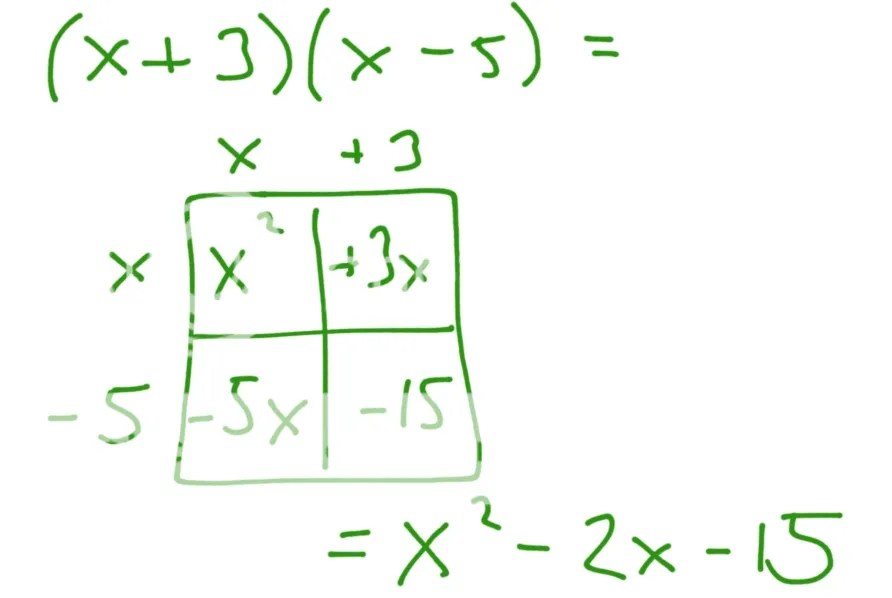
First, some reminder of the “box” method for multiplying binomials (Note, don’t EVER call it FOIL!!!).  This method allows a more visual approach of the double-distributive property, and a visual organizer for students who require this level of structure:

Mult Binomials

USING THE BOX METHOD FOR COMPLETING THE SQUARE

We start with a quadratic, which we are interested in converting to vertex form:

STEP 1: shove that -9 out of the way, and set up a binomal multiplication box:

Step 1

STEP 2:  Fill in the x-squared box, and put half of the b term in each of the x-term boxes:

Step 2

STEP 3:  Now, quite literally, we need to complete the square by filling in the last box.  Also, since we add 25 to right side, we must also subtract 25 from the same side.

Step 3

STEP 4: A little housecleaning, and we have our quadratic in vertex form.

Step 4


My ideas for this are hardly unique. Check out these great blogs for more completing the square action:

Finally, enjoy a quick video where I walk through the box method, with a few stickier examples.