Categories
Technology

Screencasting Follow-Up

About a month ago, I posted on screencasting tips and basics, using resources from an after-school PD session I facilitated for teachers in my district.  The fantastic TV crew in the district filmed my presentation, and edited it down to a nice summary of the session.  Click the link below to get to our district’s video PD page, and look for the “creating your own classroom screencast” video.

HHTV Professional Development videos

Also, feel free to enjoy a video from back in December on Writing Strategies for Math Class, and other topics from my district colleagues.

I usually hate watching myself in these videos, but appreciate the fine work of Andrew Morse, Bob Anderson, and the HHTV crew!


Categories
Technology

Teachers Sharing Desmos Ideas

This coming Tuesday, April 9, the fantastic online graphing calculator Desmos will be featured in a webinar held through the Global Math Department.  This is part of a weekly math conference series hosted by bigmarker.com.  Some weeks, there is a set theme, while other weeks teachers present their favorite lesson.  It’s exciting to hear some of the math teachers I have come to respect and admire through twitter and blogs share their favorite lessons, and you will always find something worth adapting for your classroom.  You can check out an archive of past webinars on the conference section of the Global Math Department on bigmarker.com.  I am looking forward to sharing my conic section lesson this week, and the agenda is packed with great ideas for Desmos, including:

  • @samjshah – Using sliders in polar equations to study conic sections
  • @Mr_Stadel – an exploration of gemetric shapes
  • @MrOrr_geek – Creating pictures using function transformations

Pop in and say hello, or come back later and enjoy the webinar archive.

DESMOS MAKES TABLES NOW!

Earlier this year, Desmos unleashed its table feature, and it is a seamless addition to an already simple tool.  You have choices for how to implement a table in a Desmos document.  Start a new table, and enter a rule in the “y” position.  Or take an existing function, and “edit” it to become a table.  Or, name your function as f(x) and Desmos will recognize it in a new table.  Here, a quadratic function was converted to a table, and a new column added to compute values of the derivative.

Desmos Capture

Think about the conversations you can with your class about this.  How do the values of the rule “2x+4” relate to the graph of the quadraic function?  When does 2x+4 take on positive / negative value?  When is it zero?

Play with the Desmos graph by clicking on the link, and enjoy the table feature.

DAILY DESMOS

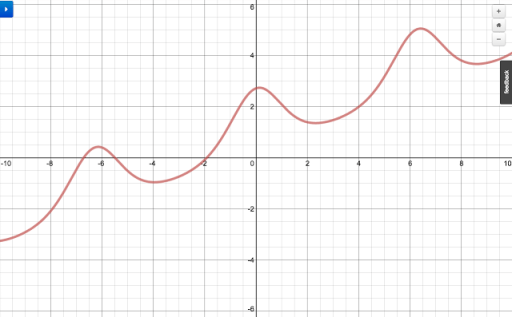
Sometimes it’s the simplest idea that produces the biggest wow moments, and the Daily Desmos site earns my kudos for not only its simple, powerful concept, but also its potential for differentiation.  Each day, 2 new graphs generated on Desmos are given.  It is up to you, or your students to determine how the graph was made.  How was this graph made? Daily Desmos

Many of us teach high schoolers how to graph trig functions, and our students certainly know linear functions.  So, how to combine them?

The site also challenges users to contribute their own graphs and provides guidelines for basic and advanced graphs.  What a fantastic tool for differentiation:  allow you quick finishers to pursue a Desmos graph, and show off their ideas to the world.  Print out the graphs, post them around your room, and let math go beyond the mundane and routine.  When you have your first conversation about polar coordinates and functions with your class, when you weren;t planning to have it, you’ll know you are doing something right for your kids!  Thanks to Michael Fenton for starting the Daily Desmos.  Keep up the great work!

Categories
Uncategorized

Redos and Retakes – #sbgchat on twitter

These days, all of the “cool kids” in twitter chats are checking in at 9PM on Wednesday evenings, where #sbgchat (standards-based grading chat) is growing quite an audience.  After just a few weeks, I am hooked into the discussions, and look forward to more challenging discussion from hosts Tom Murray and Darin Jolly.  This past week, the hot topic was redos and retakes.  Before the chat, I enjoyed videos by Rick Wormeli, whose ideas pumped me up to learn more, not unlike a football coach motivating his athletes.

Rick Wormeli on “Redos, Retakes and Do Overs”:  part 1 and part 2

This week’s chat featured some fantastic discussion about redo’s and retakes, with the following questions:

  1. Should students be given the opportunity to redo formative assignments, why or why not?  How about summative assignments?
  2. How should a redo or retake be altered from the first opportunity?
  3. What steps should occur prior to the retake of an assessment for the student and the teacher?
  4. How should the number of redos factor into a student’s grade?

If you have never participated in a Twitter chat, be prepared for information overload.  But the wonderful thing is that you will always find someone to share your ideas with, and you can always go back to the archives to pick up on pieces you missed.  You can check out the chat archive and review the ideas, and perhaps make some new Twitter contacts.

THINK ABOUT YOUR OWN EXPERIENCES

My advice to anyone considering redos in their classroom is to do some reading, think about your goals, and discuss your ideas with colleagues.  Perhaps you will find teachers in your own building who already have begun a system for retakes, which you could attach yourself to.  Or create a PLC in your building to think about how a system of redos or retakes would work.

One of the best resources for gettting started is the November, 2011 issue of Educational Leadership, which focused on effective grading practices.  You will need to be an ASCD member to access the article.  If you aren’t, contact your administrator and hopefully they can help you with access.  Rick Wormeli’s article on “Redos and Retakes Done Right” contain many of the same ideas seen in the videos, and a great starting point for thinking about your own classroom philosophies.

HOW TO DO IT: here are resources on retakes and redos from teachers who have implemented them in your classrooms.  Hope you find something you can use!

A Principal’s Reflections – blog by Eric Sheninger, with a how-to guide from one of his building’s math teachers.  Includes a contract for retakes, and a classroom policy to share with parents.

Dan Meyer’s thoughts on assessment – personalizing assessment and keeping track of skill progress in math class.  What I really enjoy about Dan’s thoughts here is the amount of responsibility students begin to accept for their own progress, and in making good choices.

Cybraryman’s List – a comprehensive list of grading practices.  From articles providing rationales for differing grading procedures, to classroom look-in, there is something for you to think about here.

The Solon District in Iowa has a implementation guide for Stanards-Based Grading.  Check out the sections on student re-takes, and how students initiate them.

Dan Longhurst – On his blog, Dan shares his experiences with Standards-Based grading and his classroom experiences with embedding redos into assessment on newer material.  Dan is a physics teacher, and his ideas are easily transferrable to math classrooms.