Categories
Technology

Teachers Sharing Desmos Ideas

This coming Tuesday, April 9, the fantastic online graphing calculator Desmos will be featured in a webinar held through the Global Math Department.  This is part of a weekly math conference series hosted by bigmarker.com.  Some weeks, there is a set theme, while other weeks teachers present their favorite lesson.  It’s exciting to hear some of the math teachers I have come to respect and admire through twitter and blogs share their favorite lessons, and you will always find something worth adapting for your classroom.  You can check out an archive of past webinars on the conference section of the Global Math Department on bigmarker.com.  I am looking forward to sharing my conic section lesson this week, and the agenda is packed with great ideas for Desmos, including:

  • @samjshah – Using sliders in polar equations to study conic sections
  • @Mr_Stadel – an exploration of gemetric shapes
  • @MrOrr_geek – Creating pictures using function transformations

Pop in and say hello, or come back later and enjoy the webinar archive.

DESMOS MAKES TABLES NOW!

Earlier this year, Desmos unleashed its table feature, and it is a seamless addition to an already simple tool.  You have choices for how to implement a table in a Desmos document.  Start a new table, and enter a rule in the “y” position.  Or take an existing function, and “edit” it to become a table.  Or, name your function as f(x) and Desmos will recognize it in a new table.  Here, a quadratic function was converted to a table, and a new column added to compute values of the derivative.

Desmos Capture

Think about the conversations you can with your class about this.  How do the values of the rule “2x+4” relate to the graph of the quadraic function?  When does 2x+4 take on positive / negative value?  When is it zero?

Play with the Desmos graph by clicking on the link, and enjoy the table feature.

DAILY DESMOS

Sometimes it’s the simplest idea that produces the biggest wow moments, and the Daily Desmos site earns my kudos for not only its simple, powerful concept, but also its potential for differentiation.  Each day, 2 new graphs generated on Desmos are given.  It is up to you, or your students to determine how the graph was made.  How was this graph made? Daily Desmos
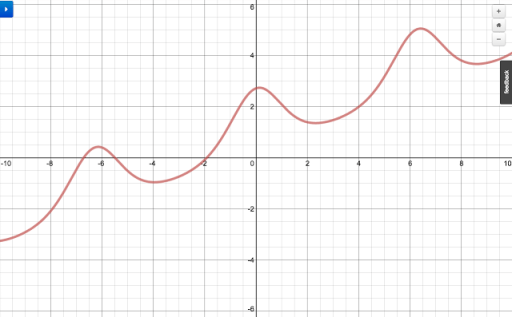
Many of us teach high schoolers how to graph trig functions, and our students certainly know linear functions.  So, how to combine them?

The site also challenges users to contribute their own graphs and provides guidelines for basic and advanced graphs.  What a fantastic tool for differentiation:  allow you quick finishers to pursue a Desmos graph, and show off their ideas to the world.  Print out the graphs, post them around your room, and let math go beyond the mundane and routine.  When you have your first conversation about polar coordinates and functions with your class, when you weren;t planning to have it, you’ll know you are doing something right for your kids!  Thanks to Michael Fenton for starting the Daily Desmos.  Keep up the great work!

Categories
Technology

“Wow” Moments with Wolfram|Alpha

The Siemens STEM Academy offers great resources for teachers, from lesson plans, to blog posts from teachers, to fantastic free webinars.  Full disclosure: I have written for the STEM Academy blog, and been a part of the Academy summer program…but I am but a small fish in a cool ocean of resources!

This week, the Academy hosted a free webinar featuring a demonstration of the dynamic knowledge provided by Wolfram|Alpha.  Having used Wolfram Demonstrations before in my classroom, I was looking forward to learning more about this search tool.  Crystal Fantry provided an hour-long overview of this exciting resource, and ideas for classroom uses.  It’s amazing how many “wow” moments I have these days with the new tech tools our students can have in their hands, but this one goes beyond that.  Knowing that students have access to resources like this should cause us all to think about our roles as math teachers / facilitators….this is a game-changer!

So, just what is Wolfram|Alpha?  The site is simple, just enter what you want to search for, and off you go…but this tool is so much more than that.  The “about” from their website provides some insight:

Wolfram|Alpha introduces a fundamentally new way to get knowledge and answers—not by searching the web, but by doing dynamic computations based on a vast collection of built-in data, algorithms, and methods.

So, what the heck does that mean exactly?  Let’s learn by diving in.  And while you can use Wolfram|Alpha for far more than math, this is a math blog so let’s focus in on some math….

Try this: “y=2x +3”.  Let’s start with something simple…what does Wolfram|Alpha give us?

WA1

Fun stuff.  A nice graph, the domain, and alternate form.

How about this: “3x+5=2x-9”

Also nice, a plot of the the functions.  And the equations’s solution..but what’s this…a “step-by-step solution”?  If you are logged in (free accounts) you can step through the solution:

WA2

So, what happens now when you give that worksheet of equations to solve for homework?

There are a lot of other neat computations to explore, try some of these as starters:

  • “y=(x+2)(x-3)”
  • “inverse y=x^2+3x+1”
  • “sin(x)+cos(x)=1”
  • “Integrate x^2 dx from 0 to 5”

WA3But Wolfram|Alpha goes beyond quick lists and computation.  How about “Pascal’s Triangle mod 5”. Or “triangle sides 3, 6, 8”, or try the elusive 17-gon, and see the many facts to check out.

A TOOL FOR RESEARCH AND GENERALIZATION

I have only scratached the surface of the many features, and there are also lots of nooks, crannies and links for you to explore.  I’m eager to use this tool with students as a means to research new ideas, and make some sense of their characteristics.  For example, let’s think about domain and range, as I ranted about in a previous post.  I like that Wolfram|Alpha expresses domains using set notation, and this is a great opportunity to have students research new functions.  Most of what we do in Algebra 1 deals with linear functions, so we get a lot of “all real numbers” domains.  Expose your students to non-linear functions, once they know how to make their x,y tables.  Try these:

  • y = 5 / x
  • y = rt (x-2)
  • y = 1 / (x^2 – 9 )
  • y = 2^x
  • y = x^2 – 4

And what to do with these new functions?  Let’s place them into categories, share our findings, and communicate our ideas.  Give each group 2 or 3 new functions to look at and share their findings on www.padlet.com.  This site, formerly called WallWisher, allows everyone to contribute their ideasd and move them around the canvas.  Here’s a sample of my function domain wall, click the link to contribute your own, play around the wall, and double-click in any empty space on the canvas to contribute.  Or sign up for a free account and create your own wall.

Padlet

Thanks to Kyle Schutt (@ktschutt) and the gang at Discovery Education for providing these great webinars.  Be sure to check out the Siemen’s STEM Academy blog for more great resources, blog posts, and archived webinars.

Categories
Middle School Technology

Probability Openers – Separating the Possible from the Plausible

A recent problem I reviewed from the Mathematics Assessment Project (MAP) caused me to refelct upon the coverage of probability in our classrooms.  The website provides sample tasks and assessment tools for schools and districts as they adjust curriculums to match the Common Core.  In the standards, probability begins to take center stage in grade 7:

Investigate chance processes and develop, use, and evaluate probability models.

Probability is treated like the ugly step-sister in many math courses: ignored, shoved to the side.  Look at standardized testing results, including AP Statistics, and you will find that probability standards often produce weak results.  The isolated fashion with which we treat probability is certainly not helping.  Let’s develop strategies to not only re-think probability, but to encourage communication of ideas and develop understanding.

I have taught probability at many levels: as an 8th grade teacher, as an AP Statistics teacher (and reader) and as the author of a Prob/Stat course delivered to 9th grade students.  This year, I taught my first college course in Statistics, where the problems with probability persist.  The picture below is from my college Stat 1 class, which you can also see on the great site Math Mistakes, by Mike Pershan.  Visit and provide your input:

Conditional

Here are two activities I hope you can use in your classrooms to help fight the probability battle.

“WHICH IS MORE LIKELY” OPENER:

The Core Standards provide a framework for our students base knowledge of probability:

Understand that the probability of a chance event is a number between 0 and 1 that expresses the likelihood of the event occurring. Larger numbers indicate greater likelihood. A probability near 0 indicates an unlikely event, a probability around 1/2 indicates an event that is neither unlikely nor likely, and a probability near 1 indicates a likely event.

Before we can start diving into formulas and fractions with probability, we need students to understand, and be able to express, whether an event is likely or not likely.  For simple events, like flipping a coin or drawing a card, this can be an easy discussion, but what happens when we start talking about complex events, like flipping multiple coins, tossing 2 dice, or choosing a random car from a parking lot?  Download my Probability Opener, which asks students to assess events and compare their probabilities.  Answers are provided.  The events start off innocently enough, but soon meander into more complex tasks, where students are asked to identify the more likely outcome:

You roll the dice and move your piece in the game of Monopoly…

A:  You end up on Boardwalk

B:  You end up in Jail

This is also a great activity if you have a classroom clicker system, or for Poll Everywhere if cell phones are allowed.

SPINNER BINGO

This activity is an adaptation of a Spinner Bingo problem from the Mathematics Assessment Project site I mentioned at the top of the post.  Visit the MAP site for not only the task, but a rubric and samples of student work.

The problem presents a scenario where students are asked to assess a spinner game, and bingo cards created for the game.  Read the files given on your own, but here is a quick summary:

  • 3×3 bingo cards are filled out, using non-repeating numbers from 1-16.
  • Two spinners with 8 equal spaces numbered 1-8, are spun, and the sum computed.
  • Players mark off their bingo cards if the sum appears on their card.

This is a nice scenario, so let’s adapt it and use it as our unit opener.  Having students play a game, and develop and justify a strategy, is a great way to get started.  Here is a lesson guide I have written to help you get started.  Also, the site Unpractical Math provides a virtual spinner applet you can use.  It’s often easier to just dive in and play, so here is a brief video demo of the game and how you can play it in your classroom:

Please let me know if you use either of these activities, and would appreciate your feedback. Thanks.