Categories
High School Statistics

Compute Expected Value, Pass GO, Collect $200

Photo Oct 11, 7 08 49 AM.jpgExpected Value – such a great time to talk about games, probability, and decision making!  Today’s lesson started with a Monopoly board in the center of the room. I had populated the “high end” and brown properties with houses and hotels.  Here’s the challenge:

When I play Monopoly, my strategy is often to buy and build on the cheaper properties.  This leaves me somewhat scared when I head towards the “high rent” area if my opponents built there.  It is now my turn to roll the dice.  Taking a look at the board, and assuming that my opponents own all of the houses and hotels you see, what would be the WORST square for me to be on right now?  What would be the BEST square?

For this question, we assumed that my current location is between the B&O and the Short Line Railroads.  The conversation quickly went into overdrive – students debating their ideas, talking about strategy, and also helping explain the scenario to students not as familiar with the game (thankfully, it seems our tech-savvy kids still play Monopoly!).  Many students noted not only the awfulness of landing on Park Place or Boardwalk, but also how some common sums with two dice would make landing on undesirable squares more likely.

ANALYZING THE GAME

After our initial debates, I led students through an analysis, which eventually led to the introduction of Expected Value as a useful statistic to summarize the game.  Students could start on any square they wanted, and I challenged groups to each select a different square to analyze.  Here are the steps we followed.

photo-oct-11-8-14-56-am

First, we listed all the possible sums with 2 dice, from 2 to 12.

Next, we listed the Monopoly Board space each die roll would causes us to land on (abbreviated to make it easier).

Next, we looked at the dollar “value” of each space.  For example, landing on Boardwalk with a hotel has a value of -$2,000.  For convenience, we made squares like Chance worth $0.  Luxury Tax is worth -$100.  We agreed to make Railroads worth -$100 as an average.  Landing on Go was our only profitable outcome, worth +$200. Finally, “Go to Jail” was deemed worth $0, mostly out of convenience.

Finally, we listed the probability of each roll from 2 to 12.

Now for the tricky computations.  I moved away from Monopoly for a moment to introduce a basic example to support the computation of expected value.

I roll a die – if it comes out “6” you get 10 Jolly Ranchers, otherwise, you get 1.  What’s the average number of candies I give out each roll?

This was sufficient to develop need for multiplying in our Monopoly table – multiply each value by its probability, find the sum of these and we’ll have something called Expected Value.  For each initial square, students verified their solutions and we shared them on a class Monopoly board.
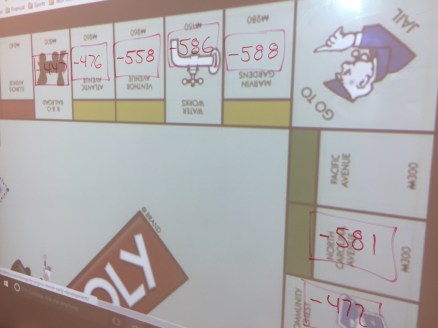
photo-oct-11-8-21-37-am

The meaning of these numbers then held importance in the context of the problem – “I may land on Park Place, I may roll and hit nothing, but on average I will lose $588 from this position”.

HOMEWORK CHALLENGE: since this went so well as a lesson today, I held to the theme in providing an additional assignment:

Imagine my opponent starts on Free Parking.  I own all 3 yellow properties, but can only afford to purchase 8 houses total.  How should I arrange the houses in order to inflict the highest potential damage to my opponent?

monopoly-back-row

I’m looking forward to interesting work when we get back to school!

Note: I discussed my ideas about this topic in a previous post.  Enjoy!

Categories
High School Technology

Pulling In To the Station

My school isn’t 1-1 with technology yet, though there are rumblings we will get there next year….or the year after….or 2031…anyway, it’s time to get techy!  My new classroom features 4 computer stations in the back – nice to have, but not super-helpful with classes of about 24 each. Station-model classroom structure has been super-helpful in my pre-calculus class in the first month. Besides the chance for all students to participate in rich technology-based activities, I’ve had the opportunity to carve out valuable small-group time with students.  Here’s an example:

In our first pre-calc unit, we review functions and their shirts, folding in new ideas like the step function, piecewise and even/odd functions.  My objective for the class was for students to consider functions in varied forms.  As students entered class, playing cards were drawn to establish their groupings, so there were 3 groups of 7 or 8.  With 15 minutes on the classroom clock, students started on their first station:

  1. Group 1 gathered in a small group with me in a circle of desks, where we worked through proving functions even or odd, and sketching their graphs.
  2. marbleslideGroup 2 worked at the computer stations on a Desmos Marbleslides featuring quadratic functions, with many students pairing up to work together. If you have never tried a Marbleslides, run and play now – we’ll wait for you to come back…
  3. Group 3 worked out in the courtyard (hey, my new classroom leads outside – which is nice) on a group task involving a piecewise function.

After groups had rotated through all 3 activities, we had time to recap / share and assess our learning over the hour.  Here’s why I need to do this more:

  • The small group station let me touch base with every student, assess strengths, find out what we need to work on, and provide feedback to everyone.
  • Marbleslides is sneaky awesome! When students begin to obsess over function shifts and how to restrict domains and don’t want to peel away from their computer, you know something is going right.
  • Class went fast! It felt like the mixed practice from Let It Stick was now becoming part of my classroom culture.
  • My pre-calc is mostly 11th and 12th graders, who have had a pretty traditional classroom experience in their math lives.  I can sense they appreciate that something difference is happening.
  • All students are responsible for their learning.  Even the least-active task, the piecewise function, was used the next class for sharing out and a jumping-off point.


Categories
Uncategorized

A Bulleted Assemblage of Items for the New School Year (but not a list)

The “list” article is a popular device, and one which often draws the eyeballs. Lists are also, often, a cop-out – a way to express many ideas without having to dig too deeply.  I hate lists….

As I start my new school year tomorrow, I give you this bulleted assemblage of items which are on my mind as I look forward to our first day.

  • Fawn Nguyen’s 7 Deadly Sins of Teaching Math is required reading for all professionals. In particular, I strive to pay more attention to my (teacher talking / student talking ) ratio.  I like to think I am strong in this area, but I need to do better. Before the end of the last school year, our district screened the movie “Most Likely to Succeed” to all professional staff.  In an opening scene, the teacher provides first-day freshmen with an opening day task – and then leaves the room.  The students struggle, the teacher eventually intervenes, but a powerful classroom culture is established.  I want to provide more tasks to my students where I’m simply not needed.
  • I have used a number of opening-day activities for AP Statistics over 14 years. Distracted Driving and the Henrico hiring case are two I used most often. But I think Doug Tyson’s Smelling Parkinson’s activity could be my new favorite. It’s a powerful premise which gets kids talking about the possible vs the plausible on day 1, with a hint of simulation thrown in for good measure. I show the video below to the class and right away the statistical importance of what we do for the entire school year is established.
  • Desmos Activity Builder will take on a much bigger role in my classroom.  I’ve created activities for both my Pre-Calculus and my freshman Prob/Stat class to review their understanding, and also to serve as my “getting to know you” opportunity.  Look forward to sharing out how it goes.
  • Shoes.  I hate new shoes. They’re tight and often rip apart the back of my ankle until I break them in.  If we can have pre-washed jeans, then we can have pre-worn shoes.  We need our best people on this.
  • Who knew a cute Pythagorean triple generator could be of interest to so many. After I posted about an interesting share from Ken Sullins at the PCTM summer conference, so many folks chimed in with their ideas.  Thanks especially to Joel Bezaire who shared additional ideas from Twitter Math Camp.  I’m using this in my pre-calc class on day 1.

  • I’ve given the same probability problem to my freshmen for the last few years. I love everything about this problem on day 1: it gets kids talking, it gets kids struggling, and it tells me much about their problem solving background.


OK, maybe this was a list after all.  I need to do some last-minute ironing.