Categories
Uncategorized

A New Really, Really Big Prime Was Found! Woo Hoo!

On January 25, the largest prime to be discovered to date was “found”.  I use the word found in quotes, because the special number found was determined as part of the Great Internet Mersenne Prime Search (GIMPS).  Mersenne primes are prime numbers of the form:

where P is itself a prime number.  The  numbers 3, 7 and 31 are Mersenne Primes, corresponding to P’s of 2, 3 and 5.  In the GIMPS program, anyone with a computer can help search for new Mersenne primes by installing a program on their computer, which runs quietly in the background.  The recently found prime is the 48th Mersenne Prime to be found, and has over 17 million digits.  It’s not often that math is news, so this is a great opportunity to use something “ripped from the headlines”.

This is big, exciting news in the math community!  And the finding was heralded by an article on foxnews.com, which included the following passage:

Prime numbers, which are divisible only by themselves and one, have little mathematical importance. Yet the oddities have long fascinated amateur and professional mathematicians.

First, thanks to Fox News for pouring cold water on this big discovery.  Prime numbers are hardly oddities, and play a big role in much of the math we all do.  And, prime numbers, while often taught as a trivial notion, play a vital role in our national, world, and personal security.  In fact, the whole idea of RSA cryptography, that which keeps our data secure in thsi data-driven world, relies on prime numbers.  A quick search turned up some useful site which explain the role of the prime number.  Enjoy them, share the news with your students, and celebrate the discovery!

Prime Numbers and Cryptography – Clay Math Institute

RSA explained using paper and pencil

RSA numbers – from Wolfram Mathworld

RSA cryptosystem – prime glossary

Categories
Algebra

Absolute Value Inequalities and the Human Number Line

In most Algebra 1 courses, the topic of Absolute Value inequalities comes at the end of a longer unit on inequalities.  We shade our number lines, attend to our open or closed circles, and start to hit the wall a bit with the routine.  So, as we begin to think about introducing absolute values, let’s get our students up and moving.  Here’s how:

THE HUMAN NUMBER LINEIntegers

Print out or scribble out cards with the integers -12 to +12, or use my handy integer card set.  This will give 25 cards, and you can adjust the cards based on the size of your class.  Give each student, except 1, an integer card.  The student who does not get a card will act as the observer during the activity, and will verify the class’ actions.

In a hallway, or outside on a nice day, have students sit in order from lowest to highest.  The students are making a human number line.  It is important that their card be clearly visible at all times.   The class observer should verify that all students are seated in order, with somewhat equal space between them.

THE ACTIVITY

With students seated, the teacher holds up an inequality.  Any student holding an integer which is a solution to the inequality will stand, thus making a human solution set.  The job of the observer is to verify the correctness of his class-mates solution.  My inequality cards file starts with two warm-up problems, to make sure the instructions are understood, before we start to head into the absolute value inequalities.

Inequalities

One of my colleagues used this activity with his class recently, having students step forward if they were a solution.  He also added a twist I hadn’t thought of: having students hold their hands over their head to make an “open circle”, if they were a boundary number.

class

As the class builds the solution sets for the absolute value inequalities, have the observer describe the graph.  What do greater-than problems “look” like?  How about less-than problems?  What sorts of problems tend to veer off (to infinity) in both directions?  What sorts of problems are bounded?  Here are some other teaching tips and ideas for this activity:

  • Have students trade cards, or totally re-mix after 2 problems.  If you don’t, the students with “end” cards can simply follow the crowd.
  • This is a great time to find a class leader to be observer, or uncover a hidden talent of a shy student.  Keep those cards visible.  Give them the responsibility to keep things orderly.
  • If you have room, take pictures of the human number lines, and use them later as a review, or to keep around the class to build the team spirit.
  • Using this activity a lot, or with many classes?  I always thought it would be neat to have integer shirts for this, and to use through the year.

Shirt

BACK TO CLASS

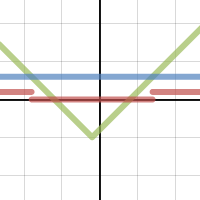
After we have developed some ideas about absolute value inequalities and their solution sets, it’s time to start formalizing our thoughts.  If you need more hands-on practice, click on the graph link below to try a Desmos demonstration with sliders.

Compare the absolute value function (in blue), to the constant function (in green).  The comparison (in red) allows us to look at make greater/less-comparisons.

Let me hear about your Human Number Line experiences!

Categories
Technology

It’s the End of Math as We Know It! (and I Feel Fine)

I’m a relatively new iPad user…just scratching the surface of the neat stuff out there, sometimes thinking how cool it would be to be back in the classroom with these tools, sometimes doing the slow burn when I see great tools go un-used. Every now and then I run into an app which has me running to my colleagues like a giddy schoolboy…such as today when a friend tweeted about the MyScript Calculator.

There’s really not much to this app:  you write a math calculation on the screen, and the app recognizes your handwriting, and performs the calculation.  It doesn’t solve equations, it doesn’t factor…it just calculates.   Check out my hairy knuckles as I take it for a test-drive.  Also, note that I understand that there are a number of goofy ways to record an iPad screen…I’m a newbie….baby steps….

It works for iPhone as well.  Take this app around your school, show it off to teachers, and enjoy the reactions and conversations.  Is this the end of the world?  Will we have a generation of kids who can’t make change for a 5?  Hey, it’s just a calculator…a pretty cool one.

So, how do we adapt math instruction in a world where computations are at our fingertips?  Ask better questions!