Categories
High School Middle School

Your Official Guide to Math Classroom Decorations

null_zps9fabad2bThe most recent challenge by the MTBOS (Math-Twitter-Blog-oSphere) is to share what’s on your classroom walls.  (Follow the action on twitter, #MTBoS30)

This post will go beyond my own classroom, and take you on a tour of many classrooms of my colleagues.  Here I present to you the Official Guide to Math Classroom Decoration.

To rank these items, I will be using the “Justin Scale”, an internationally-accepted scale of math beauty.  It is based on the works of Justin Aion, who is an expert on classroom decoration.  Seriously, you should be following Justin’s Blog for his daily classroom obsessions.

Here’s how the “Justin Scale” works

  • 1 Justin = an insult to scotch tape
  • 2 Justins = better than having a blank wall; marginally stimulating mathematically
  • 3 Justins = setting the tone for an engaging math experience
  • 4 Justins = cool beans!

You can see it’s pretty scientific.  Now, on to the decor!


PROCEDURE POSTERS

null_zpsc7a23222In the history of math posters, has any student ever looked at one of these and thought “hey, so THAT’S how you add fractions”…seriously?  Sure, these posters are well-intentioned, but they are boring as heck and suck any imagination out of math class.  Also, I have to cover them up anytime the SAT comes around.

VERDICT:

15justins_zps3a62194a


MATH T-SHIRTS

null_zpsaa5c3df8

I like to have items around my room which tell a story. Maybe they are stories of past students or experiences; other times they remind me of math nuggets I pull out once a semester. These shirts are from a number of Muhlenberg College Math Contests from the past few years, each with a neat math concept from the year of the contest.  On the left, the 28th year celebrated 28, a perfect number. 27 is a cubic formula, and the 31st features the Towers of Hanoi.   Full disclosure, I designed the 16th shirt as an undergrad.

VERDICT:

3justins_zps3ec74981.JPG


TI CALCULATOR POSTER

null_zpsbff2ac29Go to any math conference and you’ll find gaggles of math teachers walking around the vendor area with swag bags, free stuff the many companies have for you. TI posters are one of the most popular items, and you’ll find many math classrooms sporting these artifacts of math boredom.  “It was free, therefore I must place it on my wall”

These posters fill lots of space and give your room the right dose of geekiness.  And a reminder of the vast machine TI is.  Have any english teachers ever placed a large photo of a typewriter on their wall?  Nope.

VERDICT:

1justin_zps94600af5 (1)


INFOGRAPHICS

null_zps451468c7

A338E759-516A-4B97-8AAE-EB7C225B9AB1_zpsxravcheaSo many cool infographics to choose from, so little toner. Love posting these guys all over my room; love it even more when I find kids checking them out just before the bell.  But they are a pain to print, and they age badly.


VERDICT:

25justins_zps7e14c577


ASSORTED MATH HUMOR / INSPIRATIONAL POSTERS

null_zps8b6526d1

Usually purchased by rookie teachers, you will find these posters at your local teacher supply store.  Hunting season for these posters is short, running from early August to mid-September, so get yours while they last.  “Is that a cat hanging from a tree”….why yes, yes it is….

VERDICT:

1justin_zps94600af5 (1).JPG


PICTURES OF INTERESTING THINGSnull_zpsb74b0de6

You don’t need to try hard to find neat stuff for your classroom.  A colleague of mine, who often teaches geometry, has pictures of neat things above his board.  Here’s your challenge: find your favorite items from 101qs.com, print them, and post them all over the place. The conversations start themselves.

VERDICT:

3justins_zps3ec74981


 STUFF KIDS MADE AND DID

null_zpsaf8330f6

Anytime you can post, share and provide inspiration through student work, it’s bonus time.  Here, I share pictures from many past years of our AP Statistics Fair.  These often lead to stories of projects past, and where many of these students are now in their colleges and careers.  As we get later in the year, student work will take over many of the empty spaces on the walls. Also, I have a John McClane action figure on this board….and you can’t blaspeheme Nakatomi Plaza….never forget!

VERDICT:

4justins_zpsf824160c.JPG


Categories
High School Statistics

Chi-Squared Tests: Rock, Paper, Scissors.

At the beginning of the school year, I shared a post about a fun Rock, Paper, Scissors applet on the New York Times website.  Back then, my class used the applet to collect data for 2-way tables, and considered appropriate methods for displaying the data set.

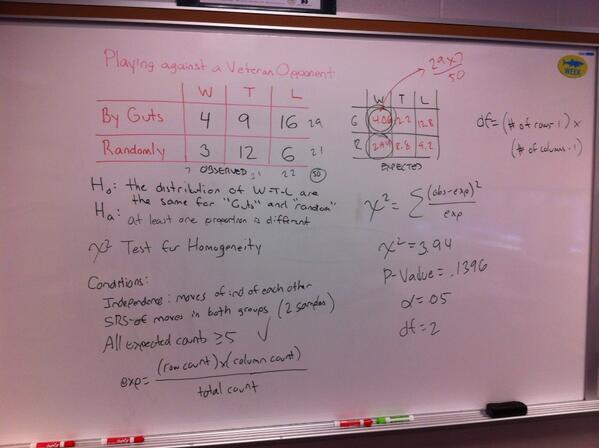
Fast-forward 6 months: my AP Statistics class is knee-deep into hypothesis testing, and we’re now up to Chi-Squared tests.  These are some of my favorite tests, as the data is often richer than what we find in tests for means or proportions.  Here’s how we used the Rock-Paper-Scissors applet to produce data:

  • Teams played the game in veteran mode.
  • In round 1, teams were given 3 minutes to play the game normally, which I’ve labeled the “guts” method.
  • In round 2, teams were given 3 minutes to play the game randomly, using “randint” on their calculator to generate a digit from 1 to 3, which corresponds to a move.

We then considered an appropriate test for assessing the data.  This comes on the heels of Chi-Squared Goodness of Fit tests.  But here we have two samples, and we want to determine if the proportions are similar in both samples: this was our first test for homogeneity, and it was easy to move through the mechanics of the test.

Board

Doug Page also shared a worksheet he has developed for using the Rock, Paper, Scissors applet.  I do not have contact info for Doug, but I hope he provides some details on his success in the comments.

This activity will now become a yearly staple in my AP Stats arsenal!  Enjoy.

Categories
High School Middle School

Some of My Students Failed Today! Woo Hoo!

A new semester has just begin here at my high school, and one of my classes is a co-taught course we call Prob/Stat.  The Prob/Stat course is one we offer to our 9th graders, as a follow up for Algebra 1.  It includes concepts in probability and statistics, along with algebraic concepts like systems, polynomial operations, and matrices.  The students in this academic class will take the Pennsylvania Keystone Exam in May, a graduation requirement, so this course is quite important for them.

My math department colleague and I, along with both co-teachers, agreed that we did not want this to “feel” like math courses they had taken up until now.  We wanted our students to become more reflective in their approach, think about their strengths and weaknesses, and devlelop their own learning paths.  We have embraced Standards-Based Grading and a policy of re-dos and retakes to help meet our ideals for this course.

On the first day of the class, I wanted to set the tone that communication and discussion would be valued in my classroom.  I asked the students to arrange their desks in a circle, which brought many questioning looks and rolling eyes.  But once we established our circle (actually, it was more like an oblong), I passed around small slips to paper to every student.  I asked the group to list any factors which had caused them to not perform well in their past math classes.  Many students were willing to share their stories: “I don’t do homework”, “Teacher X didn’t like me.”, “I don’t like to ask for help.”…the list was rich.  Placing a trash can in the center of the floor, I instructed students to ball up their slips of paper, and toss them into the bucket…they are in the past! Chum BucketI stole this idea from my time at the Siemens STEM Academy, where we started the week by catapulting our educations hold-backs into the chum bucket (it was Shark Week at Discovery Ed).  You can read more about the chum bucket activity on the Siemens STEM Institute blog.

Next, I asked the students to write something they could do, moving forward, to improve their math outlook.  What an awesome conversation!  One student shared her fear of reading problems in math, but a desire to work through it and seek help.  Many students confessed their need to complete assignments.  Others communciated the need to start self-advocating, asking more questions.

DIVING INTO STANDARDS-BASED GRADING

For many students in my class, this is their first experience with Standards-Based Grading.  Before the course began, I took all course concepts and arranged them into 4 anchors, mimicking the anchor language of the PA Keystone Algebra 1 content.  Each anchor contains 5-7 standards, written as “I can” statements.  The document also contains room for multiple attempts on the same standard.  As students complete notes or assignments, I instruct them to write the standard we are working on clearly at the top of the page.

View this document on Scribd

In this course, we start off with the probability sections, so we actually led off with 4.5 “I can find the probability of a simple event”.  Probability is a topic which haunts students of all ages, sizes, and ability levels.  And while many students did just fine on their first quiz, a number of students struggled.  Under normal circumstances, this would cause deep sighs from me, and steamrolling on. But, to be honest: I HAVE NEVER FELT MORE ENERGIZED ABOUT STUDENTS STRUGGLING IN MY CLASS!

All students in the class have their own binder, which houses the Standards Tracker, and all assessments. During the next few class meetings, my co-teacher and I will develop groups for small group instruction to discuss mis-conceptions, and work towards the re-do on their 4.5 quiz.  At the same time, we have moved forward into 4.6, multi-stage events.  We are striving to set-aside time each Friday to be reflection and redo time, in order to establish regularity with these new grading concepts.  I find myself looking forward to students dicussing their needs, and working with them to do better next time.  It’s early in the semester, but already things feel different.

Check out some of my earlier blog posts on Redos, Retakes, and Standards-Based Grading:

Rick Wormeli – Redos and Retakes

Standards-Based Grading, twitter chat recap

Quality Assignments, #sbgchat